
Digital mediation and technologies in forced displacement
Rohingya Refugees in Bangladesh
by Rohan Pai, Amrita Nanda, Sakhi Shah, and Kavya Narayanan
At a Glance
The forced displacement of the Rohingya from Myanmar to refugee camps in Bangladesh has placed the community within a state–humanitarian paradigm where digital technologies serve as key channels of aid but instruments of control. Our analysis reveals Rohingya refugees—stateless and reliant on temporary protection—encounter biometric IDs, registration platforms, and aid systems that promise support but often simultaneously deepen surveillance and data extraction. This case study examines how digital infrastructures shape their vulnerabilities, raising urgent questions about privacy, agency, and the governance of crisis technologies
Lay of the Land

A global humanitarian crisis
UNHCR estimates 117.3 million people were forcibly displaced worldwide by the end of 2023 (up from roughly 50 million a decade earlier), with nearly 9 in 10 now living in low- and middle-income countries.
Forcibly displaced communities typically carry a background of generational trauma and communal persecution. What ensues after such displacement is a loss of identity—as the vulnerable and unprotected self is now ushered into a “spectacle of numbers”, and cognised by state actors, multilaterals and humanitarian service providers as a crisis demanding control and management.
Global trends highlight a growing predicament that requires immediate attention from states and policymakers. As of mid-2023, major displacement crises include 6.49 million Syrians (mainly in Lebanon, Jordan, Iraq, Egypt, Turkey), 6.1 million Afghans (primarily in Pakistan and Iran), 1 million Rohingya from Myanmar (in Bangladesh), roughly 12 million from African conflicts (Sudan, South Sudan, DRC, Somalia, CAR, Eritrea), 7.7 million Venezuelans (since 2014), 1.7 million Palestinians displaced by Israel's war on Gaza, and 3.7 million internally displaced and 6.3 million abroad from Russia's war on Ukraine.
The state-multilateral-humanitarian paradigm
During conflict and emergencies, the state-multilateral-humanitarian paradigm has proven to be a crucial quasi-entity for forcibly displaced persons by extending essential service provision and temporary legal status to navigate a newer socio-economic setting through identification systems.
However, this has proven to be a double-edged sword enabling webs of fluctuating population control and surveillance and failing to allow for self-determination of the affected population. The demolition of the legitimate self therefore leads to the demolition of legitimised protection, often pushing forcibly displaced people into the realm of statelessness.
Mandates and obligations guiding multilateral and state action during crises
The 1951 Refugee Convention and its 1967 Protocol serve as cornerstone international treaties guiding UN and state action by defining refugees, establishing fundamental principles like non-refoulement (prohibiting return to countries where they face serious threats), and setting out refugee rights including access to courts, education, and employment.
UNHCR's mandate: Lead and coordinate international action to protect refugees, provide emergency assistance, ensure state compliance with international obligations, and resolve refugee problems worldwide. It also developed the Global Compact on Refugees (2018, following the 2016 New York Declaration) to enhance international cooperation and equitable liability in refugee protection.
Global Refugee Forum 2023: Emphasized need for localized/grassroots organizations including local NGOs, academics with lived experience, Red Cross/Red Crescent Societies, and frontline cities/municipalities
UNHCR Digital Transformation Strategy 2022-2026: Establishes best practices for digital technologies in refugee management, prioritizing digital inclusion, protection, ethics, and human rights in the digital world.
Humanitarian action is primarily guided by the Humanitarian Charter (drafted 1997), which along with Core Beliefs (right to dignity and life, disaster resolution), Protection Principles, and the Core Humanitarian Standard (CHS) for accountability, forms the Sphere Handbook that serves as the sector-wide reference emphasizing affected populations' rights and humanitarian actors' obligations to meet their needs.
Humanitarian actions that prioritizes logistics and supply chain management
The humanitarian sector operates as a business prioritizing logistics and supply chain management due to heavy donor dependency and funding cycles favoring efficiency over effectiveness in meeting affected populations' needs. The Grand Bargain (2016), an agreement between aid organizations and donors to improve humanitarian aid effectiveness through increased funding, promotes innovation and technology deployment to enhance coordination and accountability, but contradicts the CHS within a political economy that incentivizes hoarding beneficiary data for more funding. This reveals tensions between state, multilateral, and humanitarian incentives that lead to contradictory policymaking and on-ground actions.
The Rohingya—the world’s largest humanitarian crisis
The Rohingya population, a vulnerable group that has faced persecution over decades, presents a compelling case study for examining the role of technology in forced displacement. As a predominantly Muslim ethnic minority in Myanmar, the Rohingya have faced systemic persecution and discrimination for decades from oppressive state regimes. The most recent wave of mass violence in 2017 led to an exodus of roughly 700,000 people, forcing nearly 1 million Rohingya to now reside in refugee camps in neighbouring Bangladesh.
Statelessness of the Rohingya and the diaspora
The Rohingya are now rendered stateless, dispersed across Cox's Bazar refugee camps in Bangladesh, Malaysia, Indonesia, and approximately 600,000 remaining in Rakhine State, while the 2021 military coup has intensified civil conflict with the military weaponizing identification systems, checkpoints, and surveillance against political opposition and minority communities, restricting movement and preventing them from reclaiming land and property rights.
Critically vulnerable within a state-humanitarian paradigm
The forced displacement of the Rohingya Muslim community from their homes in Rakhine State, Myanmar to refugee camps in Cox's Bazar, Bangladesh has situated them within a state-humanitarian paradigm, that has exposed them to surveillance, data maximalism, and negligible agency to negotiate with digital technologies deployed to manage the crisis.
As a community that is rendered stateless due to ethnic persecution from an oppressive, majoritarian regime in their origin state, and a host country that is currently offering them temporary residential status strictly on the basis of humanitarian grounds, Rohingya refugees remain extremely vulnerable to policy shifts from external forces such as state and multilateral actors.
Tracing the crisis
The beginnings of state-backed oppression: Since Myanmar's 1948 independence, successive governments have challenged Rohingya historical claims to Rakhine State (where they comprised nearly one-third of the population), with initial citizenship recognition shifting to state-backed oppression after 1962 military rule established extreme nationalism that deemed Rohingya illegal Bangladeshi immigrants and implemented policies protecting the Buddhist Bamar majority while restricting minority rights, legitimizing discrimination and violence.
First instance of forced migration: In 1978, Burma's Operation Naga Min (Dragon King) to register citizens and identify "foreigners" led to confiscation of Rohingyas' national ID cards, destruction of their homes and property throughout Rakhine State, and soldier assaults that forced approximately 200,000 Rohingya to flee to Cox's Bazar, Bangladesh, marking the first major cross-border forced migration of the community.
Continued state-backed persecution: Myanmar's persecution continued with a 1982 citizenship law denying Rohingya recognition as one of the country's 135 official ethnic groups, followed by Operation Pyi Thaya (Clean and Beautiful Nation) in 1991 responding to democratic reform demands, during which soldiers executed, raped, and assaulted Rohingya, forcing approximately 250,000 to flee to Kutupalong and Nayapara refugee camps in Cox's Bazar; however, Bangladesh stopped officially recognizing new arrivals as refugees after 1992, leading many Rohingya to create makeshift camps around existing ones.
State identification systems, authority and control/Diminution of Rohingya identity through state institutions
The Burmese state's treatment of Rohingya Muslims since independence demonstrates how state machinery creates dichotomies between groups with differing identities, with identification systems serving as instruments of authority and control to suppress minority ethnic groups' rights to social integration into mainstream Burmese society.
From 1984 onwards, Myanmar systematically delegitimized Rohingya through identity documentation, labeling them as "Islam" to strip ethnic identity (1984), denying Citizenship Scrutiny Cards (1989), issuing temporary "White Cards" without citizenship proof while registering them as "Bengali" to suggest immigrant status (1995), forcing "Bengali" identification in the 2014 census after Buddhist nationalist pressure, and revoking "White Cards" and voting rights in 2015 to replace them with National Verification Cards (NVC) labeling them as foreigners without citizenship.
Identification systems first separated minority Rohingya from the Burmese community, then allowed the state to dehumanize them by erasing their ethnic identity through "Islam" labels and later "Bengali" categorization to portray them as illegitimate immigrants with no rightful claim to land and legal protections. State apparatus is thus manipulated to gradually erase a group's identity and their right to protection as members of their sovereign state.
Origins of a genocide
These instances trace the origins of a genocide enabled through state apparatus and identification systems, where oppressive public institutions exacerbated social inequalities by forcing Rohingya to negotiate with discriminatory systems that denied legal provisions and citizenship rights, consistently challenging their association with the state and using state power to 'other' them from Burmese society.
The arms of the state extending into the digital realm
Growing prevalence of digital technology within
state infrastructure: The growing prevalence of digital technologies in Myanmar's state infrastructure threatens increased state control that could further enable discriminatory practices against unprotected displaced communities like the Rohingya attempting repatriation, with the military testing biometrics on displaced people, the stateless, and opposition members (despite some evading surveillance due to infrastructure inefficiencies), highlighting how digital tools could magnify state power and minority disenfranchisement.
From paper-based to digital identification: In the past, paper-based identification systems allowed the state to weaponize state architecture to disenfranchise the Rohingya population. Identity and documentation allowed the establishment of a social contract, enabling effective participation within social and economic spheres of the nation-state. In Myanmar, state identification exercises and law enforcement (with the new military rule in 1962) together diminished the rights of the Rohingya community. On the other hand, within camps in Bangladesh, the UNHCR identification and verification processes now provide roughly 1 million Rohingya refugees with digitally mediated, centralised access to essentials such as food, shelter, education, health and child protection services in the largest refugee camp in the world.
The Rohingya crisis now reflects the growing influence of digitalization, with the community dependent on digital identities offered by state actors and multilateral agencies like UNHCR, necessitating investigation into how the shift from paper-based to digital identification systems enacted by multiple stakeholders affects them. Given that identity and data have historically been instruments of power, surveillance, and oppression by the Burmese state, there is urgent need to assess whether these oppressive dynamics are being replicated in the digital realm as newer technological infrastructures are built upon digital identity as their foundational building block.
Through a Community Lens
Crisis/Exodus (2017) - Violent displacement from Myanmar
Arrival/Registration - Emergency response and initial aid
Camp Life/Management - Long-term protracted displacement
Phase 1 is dominated by violence: Facebook and other social media is weaponized, networks are shut down, making communication a matter of deep risk and difficulty
Phase 2 shows emergency humanitarian response and involves immediate aid, registration and introduction to the camps and orientation to service provision through the introduction of the Smart Card
Phase 3 shows total institutional control within a network of 117 organizations, fragmented systems, and suppression of community mobilization
The journey map illustrates the Rohingya refugee experience as a trajectory from violent displacement to protracted humanitarian containment.
It highlights how digital systems shift from weaponized state apparatus to dominant multilateral control.
The map is divided into three main stages: Crisis/Exodus, Arrival/Registration, and Camp Life/Management.
Crisis/Exodus
State-Backed Violence and Identity Erasure:
Military crackdown in August 2017 preceded by systematic identity erasure
In 2015, Myanmar government revoked "White Cards" that had provided limited rights, stripping Rohingya of voting rights
Nearly 700,000 Rohingya forced to flee, with at least 6,700 killed during military operations
UNHCR described it as "a textbook example of ethnic cleansing"
Digital Weaponization:
Facebook played central role in inciting violence
November 26, 2016: State media published content describing Rohingya as "extremists, terrorists, ultra-opportunists and aggressive criminals" and "human fleas" who are "loathed for their stench and for sucking our blood"
After August 25, 2017: State Counsellor's official Facebook page regularly posted graphic photographs using slur "Bengali" to portray Rohingya as migrants from Bangladesh
Meta's failure to moderate hateful content and use of algorithms flagged since 2012 for promoting extremism facilitated this campaign
Connectivity as Control:
Myanmar government intentionally slowed down the network during exodus
Military personnel and Buddhist individuals demanded "money, phones, and other valuable items" from fleeing individuals at river crossing
Yet phones remained critical for survival: "Everyone with a phone in my village was in a social media group to share information about the difficulties faced, to ensure safety and security on our journey"
Used WhatsApp, WeChat, and IMO to communicate routes and dangers, though with limited internet data and no SIM balance
A risky and violent journey:
Physical crossing involved traversing barbed-wire fences under gunfire,hiding in prawn ponds to avoid military, waiting days for boats
"Many who arrived in Bangladesh after escaping the crackdown in Myanmar had gunshot wounds. They had to immediately receive treatment after crossing the border"
Arrival/Registration
This stage reveals the consequences of the documentation gap created at entry. Migrants encounter India's Digital Public Infrastructure (DPI), designed primarily for Indian citizens, creating multiple friction points.
Government Response:
Bangladesh PM announced Bangladesh had "the ability to feed 160 million people" and "enough food security to feed the 700,000 refugees"
Despite not being signatory to 1951 Refugee Convention, government provided shelter and humanitarian support.
Humanitarian Mobilization:
UNHCR airlifted over 1,500 metric tons of emergency aid (blankets, plastic sheets, tents, jerry cans)
Assisted in developing new refugee sites by funding infrastructure: roads, latrines, wells
Médecins Sans Frontières (MSF) and other health services provided emergency medical care
Registration and Introduction to Camps:
October 2017: RRRC launched family counting exercise with UNHCR support
Over 100 staff deployed to collect information and issue cards with unique identifier numbers to identify vulnerabilities and provide baseline data for site planning
"Volunteers visited door-to-door and asked us to go to the registration centre for the family card"
Smart Card Introduction:
November 2018: UNHCR and Bangladesh government began issuing "Smart Cards" to refugees above age 12; Replaced two existing cards
UNHCR stated cards intended to "provide a secure identity documentation for refugees" and "establish a more efficient system for refugees to access services and assistance"
Rohingya expressed fears: "Since UNHCR possesses all our information, there's concern they might use it during repatriation. They could potentially present our information internationally as evidence"
Camp Life/Management
Multi-Stakeholder Ecosystem:
117 partners: 10 UN agencies and 107 international and national NGOs
Coordinated through Government of Bangladesh's RRRC
Strategic Executive Group (SEG): UNHCR, IOM, and UN Resident Coordinator provide overall guidance
Digital Infrastructure:
UNHCR's PRIMES system (using proGres v4): central identity database
WFP's Building Blocks: blockchain technology for food distribution
WHO's DHIS2: manages health data across providers
Emergency Telecommunications Sector (ETS): established by WFP and 29 partners, provides digital connectivity for humanitarian organizations
ETS remained operational even during government-ordered internet shutdowns that suspended 3G/4G services for refugees
Increasing Dependence:
Smart Card became mandatory for accessing all services
"The purpose of issuing the family card and smart card was to give us access to humanitarian services. We were also told that we can't access any services if we didn't have the cards"
The "identity paradox": Smart Card provides camp access but explicitly codes refugees as "Forcibly Displaced Myanmar Nationals" (FDMN)
This denies their refugee status and Rohingya ethnic identity
State Control:
Bangladesh government exercises control through Camp-in-Charge (CiC)
CiC appoints Majhis (block leaders) to manage camp sections
Refugees cannot directly approach CiC: "We can't directly approach various stakeholders, including CiC. For instance, in the event that we encounter any sort of issue, we first approach the majhi to discuss it in more detail"
Community Suppression:
Attempts at self-organization violently suppressed
"A friend played a meaningful role in providing education at a Camp-3 school, but an NGO reported them to the Camp-in-Charge (CIC). This led to the school's demolition, and the teachers being subjected to violence from the police"
"Initially, people had shops in the camp, but the government demolished them all"
Along the Periphery
IOM's Determinants of Migrant Vulnerability frames vulnerability as the product of individual, household, community and structural factors rather than as a fixed trait of particular migrants.
This corridor produces a distinct pattern: under an open border and a treaty promising integration, vulnerability takes a unique form through a liminal presence.
Dual invisibility
Nepali migrants are neither foreigners nor citizens and remain itinerant, liminal, and largely missing from the developments that shape policy and resourcing in both countries.
Even while accounted for in identification efforts, for example through Aadhar, these unlock ancillary functions like a SIM card, a bank KYC and identity verification while the substantial entitlements it ostensibly carries including welfare schemes and healthcare subsidies stay out of reach. This invisibility extends both ways: Nepal, by withholding the labour permits that guard its Migrant Workers' Welfare Fund, excludes India-bound workers from the protections it extends to other migrants abroad.
Specific markers of vulnerability
Economic vulnerability also compounds low digital literacy, limited awareness and language barriers that in turn shape integration experiences. Young men for whom migration is a 'rite of passage' are funnelled disproportionately into informal, undocumented work.
Legal status
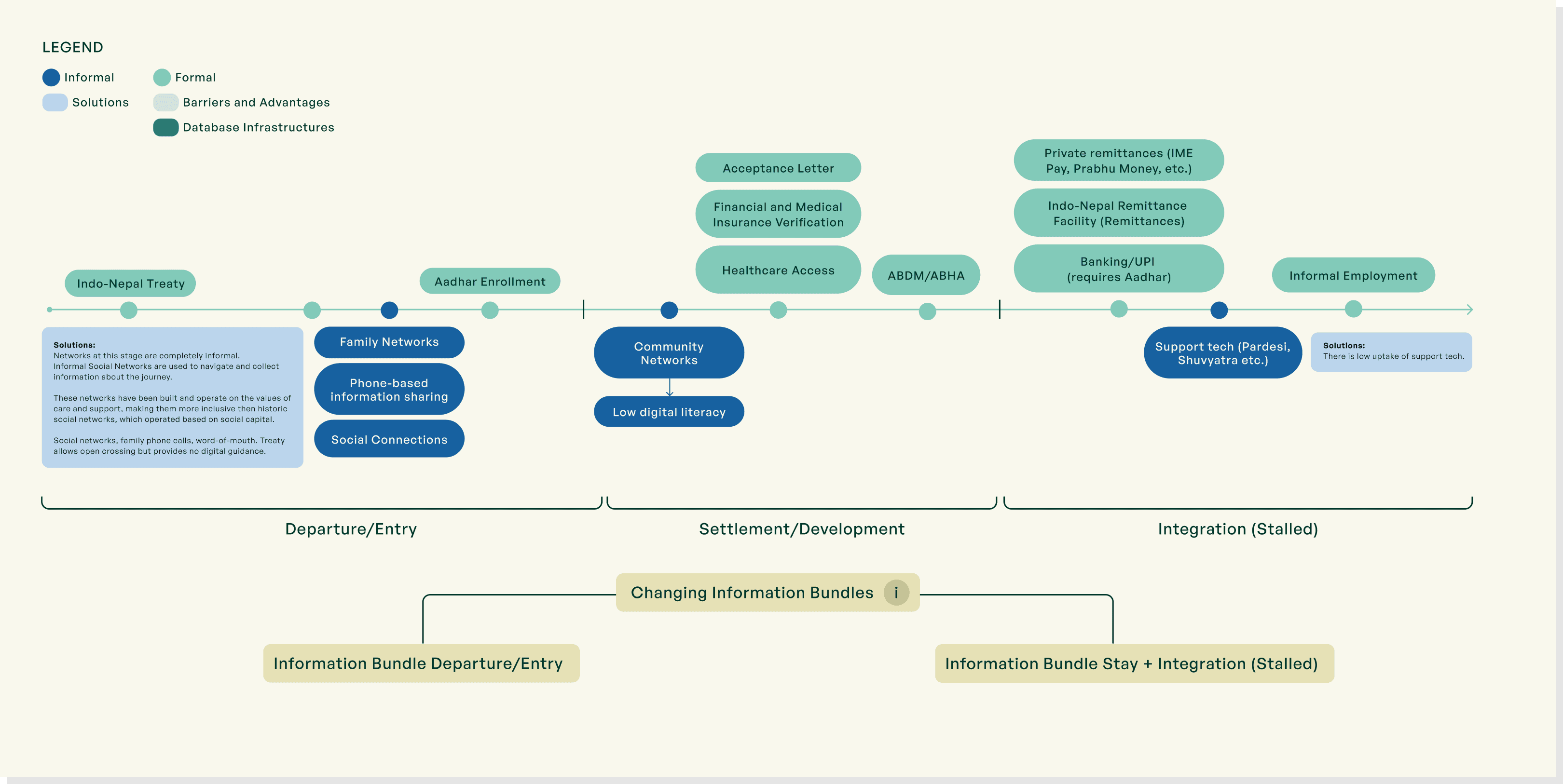
Article VII of the 1950 Indo-Nepal Treaty promises the nationals of each country reciprocal privileges in the other including the same rights of residence, property ownership, participation in trade and commerce, and movement. In practice, India's Ministry of External Affairs reads the provision narrowly, and its meaning is contested across both policy landscapes. Migrants are therefore neither foreigners, subject to a clear immigration regime, nor citizens entitled to welfare and occupy an itinerant, liminal position that produces accountability gaps rather than protections.
Economic status
Despite treaty rights to equal participation in trade and commerce, migrants are confined to the informal economy. Remittances are the lifeline of economic life. However, the regulated channel, the Indo-Nepal Remittance Facility, routes only through two public-sector banks and suffers from the lack of awareness. Additionally, UPI, the interface that locally transformed domestic transfers, stays closed to a largely unbanked population.
Unequal access to community resources
With no formal touchpoint at entry, migrants rely predominantly on family networks and word-of-mouth. Concerningly, purpose-built tools such as Shuvayatra and Pardesi see minimal uptake shaped by low digital literacy and a wariness of technology.
Discrimination experiences
At enrolment centres they are frequently mistaken for illegal immigrants and turned away. A High Court ruling denying them ration cards that is still pending before the Supreme Court bars them from subsidised healthcare under PMJAY. Fieldwork records migrants being asked to produce an Aadhaar card at hospitals where citizens face no such demand, and being denied care when they cannot. Legal entry, in this scenario, seems to secure neither recognition nor equal treatment.
For these migrants, the periphery is defined by the experience of suspension. They are datafied as residents but denied as rights-bearers. Even while enrolled, identified and remitting through regulated rails, they remain unable to convert this into welfare, healthcare or formal work.
Across Data and the Digital
This section
Explores the Rohingya community's interactions with digital infrastructure during their journey and within refugee camps where they currently reside
Highlights the complications that may arise for stateless, forcibly displaced populations when they interface with digital technologies deployed by state, humanitarian and multilateral actors
Uncovers the extent of digitally-mediated management of the Rohingya population
Examines five prominent digital systems in use within camps
Traces data flows between entities and highlights points where the refugee has limited means to negotiate their data rights
Tracks the role of digital technologies and stakeholders involved in technology deployment to examine whether the historical othering of the community is further perpetrated through current digital identification systems,
Delineates pathways for technological developments to be complemented by adequate safeguards to protect the community from further harms through digital instruments.
Limited visibility into make and build of digital systems
Digital infrastructure for crisis management, closely controlled by multilateral and humanitarian actors with limited transparency, adversely affects displaced people who must interact with these systems while receiving minimal information about how their data is used, shared, or stored, creating a gap between rights-preserving intentions and on-ground realities shaped by diverse stakeholder incentives in crisis response.
Understanding datafication and digital systems for displaced populations requires exploring how stateless and violently displaced persons globally depend on top-down digital systems to access welfare and rebuild social, legal, economic, and political identities, necessitating that digital systems be explicitly mindful, care-based, and oriented toward equity and self-determination.
A digital infrastructure primary designed
for logistics and population management
Through mixed-methods research, we discovered that digital infrastructure within refugee camps in Cox's Bazar is primarily designed for logistics and population management, often overlooking the specific needs of the refugee population. The multi-stakeholder environment of humanitarian service provision—comprising state actors, multilateral and international organisations, and non-governmental organisations—complicates the assessment of how effective digital technologies are in safeguarding the refugee population from further harm.
These stakeholders frequently operate under different mandates, objectives, or competing interests—which can lead to fragmented, and sometimes contradictory approaches to data governance and digital infrastructure implementation.
Digital technology in the camps: a coin with two sides/
The good and the bad of digital technology in the camps
In the camps, digital technology plays a crucial role in managing daily operations and providing services. Biometric registration run by the UNHCR in collaboration with the Bangladesh government, is used extensively to ensure accurate identification and streamlining of essential service provision such as healthcare, cash-assistance and education.
Unpacking Rohingya refugees' interactions with digital infrastructure is essential, as technologies deployed by states, multilaterals, and humanitarian stakeholders act as instruments of control that can either mitigate or exacerbate community vulnerabilities—demonstrating both potential for improved efficiency and accountability in aid delivery and significant challenges regarding data privacy, consent, and exclusion risks for those lacking digital access or literacy,
These considerations underscore the need for ethical consideration and robust guidelines governing technology deployment in refugee settings.
State of Play
Growing appetite for digital systems: Digital infrastructure deployed by government agencies, multilaterals, and NGOs providing humanitarian relief and development assistance to the Rohingya reflects the growing appetite for digital systems and data-driven decision-making in migration management.
The ecosystem: As of 29 February 2024, 976,507 Rohingya refugees—largely women and children— were residing in 33 camps in Ukhiya and Teknaf Upazilas of the Cox’s Bazar District, as well as on the island of Bhasan Char. 117 partners, including 10 UN agencies, 107 international and national NGOs are working closely with the Government of Bangladesh (GoB) to support close to 1 million Rohingya refugees and nearly half a million Bangladeshi host communities.
Digital identification, the bedrock of all service delivery
Digital identification forms the foundational building block for other digital service delivery systems, carrying the weight of social contracts with state actors and the legitimacy and dignity
of individual and collective existence. Due to mandates requiring first-mover response in conflicts and emergencies, digital identity has traditionally been controlled by state and multilateral actors, with the UN network, legacy humanitarian actors, and private sector technology developers acting as custodians who operationalize digital identity and activate digitally-mediated service provision at population scale during crisis management.
The UNHCR smart card—a central piece of critical digital infrastructure: For the Rohingya, the UNHCR Smart Card provides a means to navigate their current socioeconomic situation within refugee camps, forming the bedrock upon which critical digital infrastructure for service delivery has been designed. Other essential service provision is centred around this identity card, with multiple stakeholders such as the RRRC (Government of Bangladesh), WFP (food and cash voucher assistance), UNICEF (education and child protection), IOM (shelter and site management), WHO (healthcare) and BRAC among other organisations tapped into this network.
Overflow of data flows
Multiple actors have entered the digital lives of Rohingya refugees, as in many crisis situations. The following section analyzes five prominently used digital systems in Cox's Bazar refugee camps (non-exhaustive) to provide an overview of technological and data systems, stakeholder roles, and community impact. To analyze how systems can be designed to safeguard the Rohingya from further harm and compare current practices of technology deployment in forced displacement contexts globally, each system is examined by deploying actor, description, migrant interface, coverage/scale on-ground, data governance practices, and interlinkages with other systems to map data flows and usage outside Bangladesh camps.
Scale and Coverage
The systems demonstrate varying levels of penetration within the Rohingya refugee population. PRIMES shows the highest coverage, followed by WFP's SCOPE/Building Blocks. On the other hand, the DHIS2 faces adoption challenges with less than 50% of health facilities completing reports despite 77 health partners being involved.
They also have divergent approaches to scalability. PRIMES and DHIS2 demonstrate massive global reach (28.2 million people in PRIMES; 3.2 billion people in DHIS2-using countries). Building Blocks has successfully deployed in Jordan, Lebanon, and Ukraine with proven impact (preventing $35 million in duplication (unintended assistance overlap) in Ukraine alone). However, the CFP was developed specifically for Cox's Bazar and Bhasan Char, with limited replication elsewhere, highlighting the trade-offs between context-specific solutions and scalable infrastructure in humanitarian technology.
Interoperability
While these systems were designed to serve complementary functions, their integration remains limited and fragmented. PRIMES and SCOPE demonstrate the most significant linkage, formalized in December 2020 when SCOPECARDs were made 100% dependent on UNHCR data. However, DHIS2's connection to PRIMES remains unclear despite health facilities previously using Smart Cards for verification. The ETC and CFP operate largely in isolation with minimal documented integration with other systems, creating potential data silos.
Data Governance
All systems face varying degrees of scrutiny regarding data protection practices. PRIMES has encountered the most significant pushback, with refugees protesting unconsented data sharing with the Myanmar government for repatriation purposes, as documented by Radio Free Asia and Human Rights Watch in 2021. WFP's partnership with Palantir has raised transparency concerns despite assurances about anonymized data. In contrast, DHIS2 benefits from recognition as a Digital Public Good and WHO collaboration, while the CFP operates under the Accountability Manifesto framework. The ETC, concerningly, has limited publicly available information on data governance adherence.
Accessibility
The systems reveal a digital divide in how refugees interact with humanitarian services. PRIMES and SCOPE rely on physical cards requiring biometric verification: this means direct touchpoints but also potential exclusion risks. DHIS2's General Health Card is a step towards integrated health histories. Meanwhile, both ETC and CFP mitigate the digital access gap by explicitly relying on offline intermediaries (nearly 400 field staff for CFP and trained personnel for ETC CONNECT). However, mediation raises questions around refugee agency and direct access to services.
PRIMES
UNHCR
SCOPE and Building Blocks
World Food Programme
WHO DHIS2
World Health Organisation
Emergency Telecommunications Cluster
World Food Programme
Common Feedback Platform
DRC, IOM, UNHCR, with on-ground partners BRAC, Action Aid Bangladesh, Technical Assistance Inc (TAI), CARE
MIGRANT INTERFACE
Physical Smart Card connected to the PRIMES database.
SCOPECARD e-vouchers for fresh dairy, produce and meat; families registered by fingerprint; linked to PRIMES to avoid de-duplication.
General Health Card (August 2023) giving providers a patient’s full history in one place; previously the UNHCR Smart Card.
No direct digital interface initially; aid reached through offline intermediaries. ETC CONNECT app (2017) and CwC centres (2018); BRAC receives ~800 requests through it.
Nearly 400 trained field staff register complaints on the digital platform on behalf of refugees.
DESCRIPTION
Population Registration and Identity Management Ecosystem: one interoperable ecosystem for registration, identity and case management, holding biographic and biometric repositories.
Building Blocks delivers entitlements on blockchain in all but two camps; SCOPE manages beneficiaries in the other two — registration, deduplication, cash and in-kind transfer, delivery tracking.
Free, open-source platform for aggregate and individual health data; the world’s largest HMIS and the national tool in Bangladesh, with a DGHS "EDMN server" from 2017.
Global network providing shared communications in emergencies: security communications, voice and internet within 48 hours. Led by WFP with 29 partners.
Joint inter-agency consolidation of anonymized community feedback each month, built on Kobo forms and MS Access, feeding Accountability to Affected Populations.
SCALE
98%
possible Smart Card coverage. 1,006,574 refugees under the Joint Response Plan 2024; 984,591 on the Operational Data Portal.
909,000
refugees fed monthly across 33 camps; US$12 per family per month, redeemable at 21 outlets.
<50%
of health facilities complete reports into DHIS2. About 77 health partners as of April 2022.
102
sites connected; 790 workers from 21 organisations; plan for 15,000 users at up to 1,000 sites.
83,880
tickets across 34 sites in April 2024; 27,258 closed on the spot, 29,846 responses received.
USAGE IN OTHER REGIONS
28.2 million people registered in PRIMES by end 2023; 2.55 million newly registered across 138 countries. Sudan/Chad, Pakistan, Ethiopia.
Jordan (2017): ~10,000 Syrian refugees redeeming transfers by eye scan in Azraq. Lebanon: US$56m after the port explosion. Ukraine: US$337m to 3 million people.
80 low and middle-income countries, 100+ with NGO programmes; 3.2 billion people — 40% of the world — live in DHIS2 countries.
Palestine: activated 31 October 2023, 19 partners on the ICT helpdesk. Ukraine: activated 03 March 2022; 4,300 base stations destroyed or damaged.
Built specifically for Cox’s Bazar and Bhasan Char. IFRC has piloted other feedback mechanisms elsewhere.
DATA PRACTICES AND MANAGEMENT
Aligned with UNHCR’s data protection policy, but Radio Free Asia and Human Rights Watch reported unconsented sharing with the Myanmar government. UNHCR denied wrongdoing.
The Global Data Strategy 2024–2026 makes governance its third pillar. The 2019 Palantir agreement drew concern that transparency on collection and sharing remains limited.
A recognised Digital Public Good with published documentation guidelines on standards, interoperability and local participation.
Limited information on adherence to data governance policies or principles.
Overseen by IOM, UNHCR and DRC, with training and protection guidance aligned to the Accountability Manifesto and standards for sensitive feedback.
INTERLINKAGES WITH OTHER SYSTEMS
Identity management, case management, assistance in cash and in kind, and data management across the UNHCR operation.
SCOPECARDs are 100% based on UNHCR data; family changes go to UNHCR first, then WFP automatically issues a new card.
Government, UN and I/NGOs plug into the network, but linkages are closely controlled by WHO; the Health Card’s link to PRIMES is unclear.
Carries connectivity and online data management for humanitarian partners, with little transparency on what is shared between them.
Minimal information on use of the CFP database by other stakeholders or systems.
Opaque data sharing systems, the case of the DHIS2 and the ETS
Large-scale actors (WHO, UNHCR, IOM, BRAC, UNICEF) have installed digital systems with opaque data-sharing structures in Rohingya camps.
The District Health Information Software (DHIS2) is used for health data entry and management by multiple healthcare organizations, easing interactions between data sources and enhancing dataset interoperability. WHO, in partnership with Bangladesh Government and UNICEF, integrated the Early Warning, Alert and Response System (EWARS) with DHIS2 to enable Government health specialists to forecast disease outbreaks.
Despite systematic DHIS2 usage across the health sector, data usage and sharing agency remains with WHO and Government organizations managing these systems .This centralized control defeats the purpose of deploying interoperable systems like DHIS2, which proved invaluable for population-scale disease tracking.
On the other hand, Sri Lanka effectively stepped up disease tracking during COVID-19 by enabling health service providers nationwide to contribute and use aggregated DHIS2 datasets.
Similarly, the Emergency Telecommunications Sector (ETS), established by WFP and 29 partners, provides digital connectivity for humanitarian service providers as foundational infrastructure within camps. ETS network remained operational for humanitarian organizations during multiple Government of Bangladesh internet shutdowns in Cox's Bazar region.
However,ETS access is restricted to 29 partners within the WFP network. Moreover, ETC systems were developed in collaboration with Cisco and Ericsson; the growing private-multilateral nexus on data sharing and system 'testing' from these collaborations remains opaque.
Analysing the Impact of Digital Infrastructure in Rohingya Refugee Camps
Digital infrastructure in the camps has streamlined delivery of essential services (shelter, healthcare, sanitation, education, skills development, legal assistance, gender-based violence prevention), with humanitarian agencies asserting that:
refugee identification enables virtual contact for assistance and protection
individual registration data provides inputs for efficient service provision and
intentional design choices like WFP's decentralized blockchain networks increase accountability and reduce fraud risk.
On the flip side:
Limited/nonexistent internet access, low digital literacy, and socioeconomic, linguistic, and cultural barriers prevent equal access and benefits for forcibly displaced populations
How digital infrastructure is deployed and data is governed directly affects benefits, empowerment, potential harm, and vulnerability of migrant and refugee populations
Digital footprints collected through crisis management systems can enable surveillance and restrict refugee movement
Unclear and non-transparent data governance has wide-ranging implications for vulnerable populations like Rohingya refugees who remain at risk of targeting by their origin state
Organizations like the UNHCR are disincentivized from adhering to strict accountability measures due to the power they wield through essential service provision dependent on their infrastructural capacity.
The example of the UNHCR Smart Card
For instance, Smart Cards provide refugees with some agency by granting them the ability to transact with aid organisations such as the WFP (rations), BRAC (health services), UNICEF( child protection) and other relevant actors that operate on the ground.
However,
The Smart Card is dependent on the PRIMES system for service provision. Within a humanitarian network of 117 service providers, consisting of multilateral organisations, I/NGOs and other local actors, all their systems must be integrated to cater to identity verification facilitated through a single actor, i.e, the UNHCR in this case.
For example, UNHCR’s capacity to engage volunteers on-ground to conduct the registration exercise and maintain an active online database for 1 million+ refugees has made the smart card so prevalent within the camps that it has left local actors and NGOs with little to no choice in integrating with the UNHCR Smart Card for their own verification processes.
Further, the classification of Rohingya as Forcibly Displaced Myanmar Nationals (FDMN) under the Bangladeshi regime, and being denied citizenship in their home state, has restricted the purported benefits of the Smart Card to camp life, thereby further exacerbating the looming threat of Rohingya statelessness through such system design.
Lack of clarity around adequate safeguards
Questions around whether adequate safeguards protect refugee data collected through PRIMES from multiple integrated sources, especially given breach risks for targeted populations like the Rohingya.
Unclear whether newly integrated service providers adhere to data protection measures, as these cannot be scrutinized by UNHCR's technical team.
Refugees have minimal control over where their data is shared or what information becomes visible to current service providers.
Local providers (e.g., healthcare facilities) may link identification records to services accessed, creating additional data exposure risks.
Ecosystem Map

Regulators
Government departments and agencies with the legal power to regulate migration, displacement, issue documentation and enforce immigration laws.
Eg: Ministry of Disaster Management & Relief (MoDMR), Deputy Commissioners, Refugee Relief and Repatriation Commissioner (RRRC), Upazila Nirbahi Officers (UNOs),

Facilitators
Well funded, large scale organisations providing protective services, legal aid and humanitarian assistance through formal programs or channels.
Eg: National Task Force (NTF), Strategic Executive Group (SEG) Dhaka, WFP, FAO, UNHCR, UNICEF, UNFPA, IOM, WHO, Save the Children

Service Providers
Formal businesses or institutions providing commercial services to Rohingya refugees and communities, although it need not be exclusive to them, which requires data collection or identity verification.

Advocacy
Organisations primarily focus on providing legal aid, representation, rights and policy advocacy for Rohingya refugees.
Eg: International and national NGOs, Action Aid Bangladesh, CARE, Technical Assistance Inc. (TAI)
Community Actors
Community or bottom-up organisations which are created by Rohingya refugees as systems of care.
Eg: Rohingya Refugees Culture Centre, WhatsApp groups

Research Organisations
Organisations or institutes which conduct research about or with Rohingya refugees and communities, enabling further movement towards improved living conditions.
The following stakeholder map provides a deeper understanding of how the Rohingya Refugee Response is structured, with state-led actors and multilaterals actively involved in migration management within the Cox’s Bazar camps.
Ecosystem Map

The Rohingya response is led and coordinated by the Government of Bangladesh. For the humanitarian community, the Strategic Executive Group (SEG) provides overall guidance for the Rohingya refugee response and engages with the Government of Bangladesh at the national level and liaisons with the National Task Force (NTF) chaired by the Ministry of Foreign Affairs and relevant line Ministries. The NTF provides oversight and strategic guidance for the overall response. The UN Resident Coordinator, United National High Commissioner for Refugees (UNHCR) Representative and International Organization for Migration (IOM) Chief of Mission serve as the SEG co-chairs.
At the field level in Cox’s Bazar, the Senior Coordinator of the ISCG Secretariat ensures the overall coordination of the response, including liaison with the RRRC, District Deputy Commissioner and government authorities at the sub-district level. The ISCG Senior Coordinator chairs the Heads of Sub-Office Group, which brings together the heads of operational UN agencies and members of the international and Bangladeshi NGO community working on the response, as well as donor community representatives based in Cox’s Bazar. The Senior Coordinator also convenes the Sector Coordinators’ Group, to ensure inter-sector coordination in the response.
Imposition of digital infrastructure and top-down control over decision making
The Government of Bangladesh and the Strategic Executive Group (SEG) composed of UNHCR, IOM and the UN resident coordinator maintain control over decision-making regarding camp and refugee management.
Digital infrastructure is thus imposed on the Rohingya refugees, often without prior consultation with the community and other local stakeholders.
Due to hierarchies and power dynamics created by such top-down structures, refugees are subjected to excessive exposure to digital systems and data collection. This can be observed in decisions regarding the architecture of service provision within camps, and the varying digital interfaces refugees had to be equipped with to access essential services:
"I have been issued three cards: the first one is commonly known as the Gondha Card (Myanmar Nationals’ Registration Card), also called the MOHA Card, and the second is a Smart Card issued by UNHCR. As refugees, individuals like me receive these cards, including the MOHA Card and the Smart Card. Additionally, our family was given a Family Card and a SIM card. The MOHA Card is crucial for receiving significant packages and is essential for obtaining gas. The SIM card is necessary for receiving rations from WFP, gas, and other essential items. The Family Card is also required in conjunction with it."
Community involvement not prioritised when decisions are taken about the implementation of refugee-facing digital systems such as the Smart Card or SIM card.
Instances of ad-hoc decision-making have also impacted other aspects of camp life for refugees due to the government’s policy goals that may not necessarily align with the assimilation of refugees and host communities in the region.
Rohingya efforts to mobilise and interact with others in the community, and aspirations to restore a living that reflects their cultural identity have been consistently suppressed by government-led actions.
“A friend played a meaningful role in providing education at a Camp-3 school, but an NGO reported them to the Camp-in-Charge (CIC). This led to the school’s demolition, and the teachers being subjected to violence from the police.”
“Only 5% of the Rohingya population is employed, while the remainder relies on ration support due to unemployment. Initially, people had shops in the camp, but the government demolished them all.”
Imposition of digital infrastructure and top-down control over decision making
The Government of Bangladesh and the Strategic Executive Group (SEG) composed of UNHCR, IOM and the UN resident coordinator maintain control over decision-making regarding camp and refugee management.
Digital infrastructure is thus imposed on the Rohingya refugees, often without prior consultation with the community and other local stakeholders.
Due to hierarchies and power dynamics created by such top-down structures, refugees are subjected to excessive exposure to digital systems and data collection. This can be observed in decisions regarding the architecture of service provision within camps, and the varying digital interfaces refugees had to be equipped with to access essential services:
"I have been issued three cards: the first one is commonly known as the Gondha Card (Myanmar Nationals’ Registration Card), also called the MOHA Card, and the second is a Smart Card issued by UNHCR. As refugees, individuals like me receive these cards, including the MOHA Card and the Smart Card. Additionally, our family was given a Family Card and a SIM card. The MOHA Card is crucial for receiving significant packages and is essential for obtaining gas. The SIM card is necessary for receiving rations from WFP, gas, and other essential items. The Family Card is also required in conjunction with it."
Community involvement not prioritised when decisions are taken about the implementation of refugee-facing digital systems such as the Smart Card or SIM card.
Instances of ad-hoc decision-making have also impacted other aspects of camp life for refugees due to the government’s policy goals that may not necessarily align with the assimilation of refugees and host communities in the region.
Rohingya efforts to mobilise and interact with others in the community, and aspirations to restore a living that reflects their cultural identity have been consistently suppressed by government-led actions.
“A friend played a meaningful role in providing education at a Camp-3 school, but an NGO reported them to the Camp-in-Charge (CIC). This led to the school’s demolition, and the teachers being subjected to violence from the police.”
“Only 5% of the Rohingya population is employed, while the remainder relies on ration support due to unemployment. Initially, people had shops in the camp, but the government demolished them all.”
Refugees left out of the picture of everyday decision making
The Government of Bangladesh as primary stakeholder and the SEG setting camp regulations influence how personnel exercise control through commanding positions in day-to-day operations.
Management-oriented coordination consistently excludes refugee needs, creating bureaucratic hurdles that favor the state, humanitarian organizations, and NGOs over refugees.
In 2017 during the mass exodus, Bangladesh banned carriers from selling SIM cards to Rohingya refugees citing security concerns.
Al-Jazeera reported this communication gatekeeping prevented refugees from contacting families in other regions for remittances, causing further isolation.
In this way, consent is structurally impossible when refusal means no food, shelter, or protection and statelessness means no recourse if data is misused.
“We have a majhi in every block and a head majhi for 19 to 20 blocks in camps. We can't directly approach various stakeholders, including CiC. For instance, in the event that we encounter any sort of issue, we first approach the majhi to discuss it in more detail. After that, we may approach the volunteers of the CiC, who will listen to us, document our issue, and forward it to the CiC. Hence, we must travel with majhi or head majhi in order to share information directly with the CiC.”
Within this structure where Majhis have limited decision-making control and refugees face restricted communication, internet shutdowns deprive Rohingya refugees of basic human rights.
In this way, governance structures severely impact digital infrastructure implementation:
multiple ID cards offered then rescinded,
communications gatekept to state and humanitarian actors with minimal community consultation, and
lack of institutional structure for bottom-up feedback on services and grievances.
These bureaucratic practices compound refugee vulnerabilities, prioritizing logistical control over refugees' needs.
Within our Framework
The Migration Infrastructure Assessment (MIA) is a diagnostic tool that allows us to evaluate migratory corridors across the world by understanding how data and digital spaces account for the needs of people on the move. This tool situates five pillars across three stages, as laid down below. More information on the parameters and diagnosis structure of the MIA can be found here.
" height="16.504237999999997px" id="bAcwUBxmE" stroke-dasharray="" stroke-linecap="butt" stroke-linejoin="miter" stroke-miterlimit="10" stroke-width="0.7" stroke="rgb(23, 97, 160)" transform="translate(47.494 0.352)" width="19.656099999999995px"/><path d="M 48.858 73.653 C 75.841 73.653 97.716 57.165 97.716 36.826 C 97.716 16.488 75.841 0 48.858 0 C 21.874 0 0 16.488 0 36.826 C 0 57.165 21.874 73.653 48.858 73.653 Z" fill="rgb(254, 253, 244)" height="73.6525px" id="jDLC3p_u9" stroke-dasharray="" stroke-linecap="butt" stroke-linejoin="miter" stroke-miterlimit="10" stroke-width="0.7" stroke="rgb(23, 97, 160)" transform="translate(16.203 17.75)" width="97.7159px"/><path d="M 7.761 15.523 C 12.048 15.523 15.523 12.048 15.523 7.762 C 15.523 3.475 12.048 0 7.761 0 C 3.475 0 0 3.475 0 7.762 C 0 12.048 3.475 15.523 7.761 15.523 Z" fill="rgb(254, 253, 244)" height="15.523100000000003px" id="S8lqqhMFF" stroke-dasharray="" stroke-linecap="butt" stroke-linejoin="miter" stroke-miterlimit="10" stroke-width="0.7" stroke="rgb(23, 97, 160)" transform="translate(101.723 30.867)" width="15.522999999999996px"/><path d="M 0 14.553 C 0 6.514 8.959 0 20.012 0 C 31.065 0 40.024 6.514 40.024 14.553 Z" fill="rgb(254, 253, 244)" height="14.552900000000001px" id="dWst33jwF" stroke-dasharray="" stroke-linecap="butt" stroke-linejoin="miter" stroke-miterlimit="10" stroke-width="0.7" stroke="rgb(23, 97, 160)" transform="translate(89.473 48.605)" width="40.02430000000001px"/><path d="M 0 0 C 0 0 0.39 5.035 7.65 6.931" fill="transparent" height="6.931099999999997px" id="QIeOaVUgT" stroke-dasharray="" stroke-linecap="butt" stroke-linejoin="miter" stroke-miterlimit="10" stroke-width="0.7" stroke="rgb(23, 97, 160)" transform="translate(109.486 30.867)" width="7.6499999999999915px"/><path d="M 7.649 0 C 7.649 0 7.26 5.035 0 6.931" fill="transparent" height="6.931099999999997px" id="x2hwmD9iw" stroke-dasharray="" stroke-linecap="butt" stroke-linejoin="miter" stroke-miterlimit="10" stroke-width="0.7" stroke="rgb(23, 97, 160)" transform="translate(101.723 30.867)" width="7.649000000000001px"/><path d="M 12.275 0 C -2.297 0.074 0.156 27.27 0.156 27.27 L 24.353 27.27 C 24.353 27.27 25.49 -0.066 12.275 0 Z" fill="rgb(254, 253, 244)" height="27.26971824227173px" id="jJVbPKdjQ" stroke-dasharray="" stroke-linecap="butt" stroke-linejoin="miter" stroke-miterlimit="10" stroke-width="0.7" stroke="rgb(23, 97, 160)" transform="translate(8.086 42.391)" width="24.37739025406398px"/><path d="M 0 14.553 C 0 6.515 8.959 0 20.012 0 C 31.065 0 40.025 6.515 40.025 14.553 Z" fill="rgb(254, 253, 244)" height="14.552900000000001px" id="mVXsgi0Ka" stroke-dasharray="" stroke-linecap="butt" stroke-linejoin="miter" stroke-miterlimit="10" stroke-width="0.7" stroke="rgb(23, 97, 160)" transform="translate(0.35 62.02)" width="40.024591px"/><path d="M 14.695 0 C 15.559 1.272 15.896 2.582 15.896 4.232 C 15.896 8.619 12.338 12.18 7.948 12.18 C 3.557 12.18 0 8.622 0 4.232 C 0 2.782 0.389 1.422 1.066 0.252 L 14.794 0.055" fill="rgb(254, 253, 244)" height="12.179500000000004px" id="U1dSCGCiy" transform="translate(12.131 47.871)" width="15.895800000000001px"/><path d="M 14.695 0 C 15.559 1.272 15.896 2.582 15.896 4.232 C 15.896 8.619 12.338 12.18 7.948 12.18 C 3.557 12.18 0 8.622 0 4.232 C 0 2.782 0.389 1.422 1.066 0.252 L 14.794 0.055" fill="transparent" height="12.179500000000004px" id="qXsBuoc5q" stroke-dasharray="" stroke-linecap="butt" stroke-linejoin="miter" stroke-miterlimit="10" stroke-width="0.7" stroke="rgb(23, 97, 160)" transform="translate(12.131 47.871)" width="15.895800000000001px"/><path d="M 7.762 15.523 C 12.048 15.523 15.523 12.048 15.523 7.762 C 15.523 3.475 12.048 0 7.762 0 C 3.475 0 0 3.475 0 7.762 C 0 12.048 3.475 15.523 7.762 15.523 Z" fill="rgb(254, 253, 244)" height="15.52308px" id="S6e0VeYtz" stroke-dasharray="" stroke-linecap="butt" stroke-linejoin="miter" stroke-miterlimit="10" stroke-width="0.7" stroke="rgb(23, 97, 160)" transform="translate(49.531 4.137)" width="15.523200000000003px"/><path d="M 0 14.553 C 0 6.515 8.959 0 20.012 0 C 31.065 0 40.025 6.515 40.025 14.553 Z" fill="rgb(254, 253, 244)" height="14.552900000000001px" id="YCPyLrdGJ" stroke-dasharray="" stroke-linecap="butt" stroke-linejoin="miter" stroke-miterlimit="10" stroke-width="0.7" stroke="rgb(23, 97, 160)" transform="translate(37.279 21.875)" width="40.0246px"/><path d="M 7.731 15.463 C 12.001 15.463 15.463 12.001 15.463 7.731 C 15.463 3.462 12.001 0 7.731 0 C 3.462 0 0 3.462 0 7.731 C 0 12.001 3.462 15.463 7.731 15.463 Z" fill="rgb(254, 253, 244)" height="15.462800000000001px" id="oWDyZiqO1" stroke-dasharray="" stroke-linecap="butt" stroke-linejoin="miter" stroke-miterlimit="10" stroke-width="0.7" stroke="rgb(23, 97, 160)" transform="translate(67.51 63.18)" width="15.462800000000001px"/><path d="M 0.003 14.495 C 0.003 6.49 8.926 0 19.933 0 C 30.939 0 39.863 6.49 39.863 14.495 L 0 14.495 Z" fill="rgb(254, 253, 244)" height="14.4953px" id="Fv_WWWMWO" stroke-dasharray="" stroke-linecap="butt" stroke-linejoin="miter" stroke-miterlimit="10" stroke-width="0.7" stroke="rgb(23, 97, 160)" transform="translate(55.307 80.848)" width="39.862899999999996px"/><path d="M 0 0 L 0 14.602" fill="transparent" height="14.602199999999996px" id="JByZBiyhc" stroke-dasharray="" stroke-linecap="butt" stroke-linejoin="miter" stroke-miterlimit="10" stroke-width="0.7" stroke="rgb(23, 97, 160)" transform="translate(75.24 80.848)" width="1px"/><path d="M 1.113 2.226 C 1.727 2.226 2.226 1.727 2.226 1.113 C 2.226 0.498 1.727 0 1.113 0 C 0.498 0 0 0.498 0 1.113 C 0 1.727 0.498 2.226 1.113 2.226 Z" fill="rgb(254, 253, 244)" height="2.2256px" id="JIyVYe18K" stroke-dasharray="" stroke-linecap="butt" stroke-linejoin="miter" stroke-miterlimit="10" stroke-width="0.7" stroke="rgb(23, 97, 160)" transform="translate(71.115 84.313)" width="2.2256px"/><path d="M 1.113 2.226 C 1.727 2.226 2.226 1.727 2.226 1.113 C 2.226 0.498 1.727 0 1.113 0 C 0.498 0 0 0.498 0 1.113 C 0 1.727 0.498 2.226 1.113 2.226 Z" fill="rgb(254, 253, 244)" height="2.2256px" id="KPS4GxuJv" stroke-dasharray="" stroke-linecap="butt" stroke-linejoin="miter" stroke-miterlimit="10" stroke-width="0.7" stroke="rgb(23, 97, 160)" transform="translate(71.115 90.617)" width="2.2256px"/></svg>)
" transform="translate(32.342 2.461)" width="8.845399999999998px"/><path d="M 4.219 2.11 C 4.219 0.945 3.275 0 2.11 0 C 0.945 0 0 0.945 0 2.11 C 0 3.275 0.945 4.219 2.11 4.219 C 3.275 4.219 4.219 3.275 4.219 2.11 Z" fill="rgb(254, 253, 244)" height="4.219420000000001px" id="rvDT7p0As" stroke-dasharray="" stroke-linecap="butt" stroke-linejoin="miter" stroke-miterlimit="10" stroke-width="0.7" stroke="rgb(23, 97, 160)" transform="translate(39.079 0.352)" width="4.2194199999999995px"/><path d="M 0 54.882 L 0 17.902 L 30.809 0.052 C 31.001 -0.057 31.339 0.017 31.339 0.17 L 31.339 54.882 L 0.003 54.882 Z" fill="rgb(254, 253, 244)" height="54.8818667780653px" id="fKRNq6Xnn" stroke-dasharray="" stroke-linecap="butt" stroke-linejoin="miter" stroke-miterlimit="10" stroke-width="0.7" stroke="rgb(23, 97, 160)" transform="translate(9.457 20.375)" width="31.33937px"/><path d="M 0 0 L 0 13.076" fill="transparent" height="13.075700000000001px" id="lP2FoEBTr" stroke-dasharray="" stroke-linecap="butt" stroke-linejoin="miter" stroke-miterlimit="10" stroke-width="0.7" stroke="rgb(23, 97, 160)" transform="translate(36.602 28.887)" width="1px"/><path d="M 0 0 L 0 13.073" fill="transparent" height="13.072899999999997px" id="MSANqNS54" stroke-dasharray="" stroke-linecap="butt" stroke-linejoin="miter" stroke-miterlimit="10" stroke-width="0.7" stroke="rgb(23, 97, 160)" transform="translate(32.656 36.238)" width="1px"/><path d="M 0 0 L 0.014 11.678" fill="transparent" height="11.678000000000004px" id="qY7hom1Ra" stroke-dasharray="" stroke-linecap="butt" stroke-linejoin="miter" stroke-miterlimit="10" stroke-width="0.7" stroke="rgb(23, 97, 160)" transform="translate(28.799 30.281)" width="1px"/><path d="M 0 0 L 0 13.076" fill="transparent" height="13.075700000000005px" id="rR6GqB6Aw" stroke-dasharray="" stroke-linecap="butt" stroke-linejoin="miter" stroke-miterlimit="10" stroke-width="0.7" stroke="rgb(23, 97, 160)" transform="translate(26.428 46.18)" width="1px"/><path d="M 0 0 L 0 13.073" fill="transparent" height="13.072999999999993px" id="XbzW5enCa" stroke-dasharray="" stroke-linecap="butt" stroke-linejoin="miter" stroke-miterlimit="10" stroke-width="0.7" stroke="rgb(23, 97, 160)" transform="translate(30.998 51.254)" width="1px"/><path d="M 0 0 L 0 13.073" fill="transparent" height="13.073px" id="GRwQgO1sk" stroke-dasharray="" stroke-linecap="butt" stroke-linejoin="miter" stroke-miterlimit="10" stroke-width="0.7" stroke="rgb(23, 97, 160)" transform="translate(36.602 47.008)" width="1px"/><path d="M 0 0 C 0 2.195 0 4.391 0 6.586" fill="transparent" height="6.585800000000006px" id="P_n4gKeUP" stroke-dasharray="" stroke-linecap="butt" stroke-linejoin="miter" stroke-miterlimit="10" stroke-width="0.7" stroke="rgb(23, 97, 160)" transform="translate(32.346 68.672)" width="1px"/><path d="M 0 0 C 0.033 3.659 0.033 7.578 0 11.042" fill="transparent" height="11.042200000000008px" id="ttlh1vlVa" stroke-dasharray="" stroke-linecap="butt" stroke-linejoin="miter" stroke-miterlimit="10" stroke-width="0.7" stroke="rgb(23, 97, 160)" transform="translate(27.465 64.211)" width="1px"/><path d="M 0.031 0 C -0.01 3.705 -0.01 7.622 0.031 11.376" fill="transparent" height="11.376499999999993px" id="oiFSw5Q65" stroke-dasharray="" stroke-linecap="butt" stroke-linejoin="miter" stroke-miterlimit="10" stroke-width="0.7" stroke="rgb(23, 97, 160)" transform="translate(35.582 63.879)" width="1px"/><path d="M 0 0 L 0 13.076" fill="transparent" height="13.075699999999998px" id="bOkkKPZ_s" stroke-dasharray="" stroke-linecap="butt" stroke-linejoin="miter" stroke-miterlimit="10" stroke-width="0.7" stroke="rgb(23, 97, 160)" transform="translate(23.301 56.309)" width="1px"/><path d="M 0 0 L 0 13.073" fill="transparent" height="13.072899999999997px" id="Oj4dM7uRt" stroke-dasharray="" stroke-linecap="butt" stroke-linejoin="miter" stroke-miterlimit="10" stroke-width="0.7" stroke="rgb(23, 97, 160)" transform="translate(22.754 33.926)" width="1px"/><path d="M 0 0 L 0 13.073" fill="transparent" height="13.072899999999997px" id="AbMPltlR4" stroke-dasharray="" stroke-linecap="butt" stroke-linejoin="miter" stroke-miterlimit="10" stroke-width="0.7" stroke="rgb(23, 97, 160)" transform="translate(18.555 59.039)" width="1px"/><path d="M 0 0 L 0 13.073" fill="transparent" height="13.072900000000004px" id="e4prr_ViN" stroke-dasharray="" stroke-linecap="butt" stroke-linejoin="miter" stroke-miterlimit="10" stroke-width="0.7" stroke="rgb(23, 97, 160)" transform="translate(13.813 50.121)" width="1px"/><path d="M 0 0 L 0 13.073" fill="transparent" height="13.073px" id="iimHlDA5M" stroke-dasharray="" stroke-linecap="butt" stroke-linejoin="miter" stroke-miterlimit="10" stroke-width="0.7" stroke="rgb(23, 97, 160)" transform="translate(16.732 41.75)" width="1px"/><path d="M 0 0 L 0 6.213" fill="transparent" height="6.213100000000004px" id="YalmanN_n" stroke-dasharray="" stroke-linecap="butt" stroke-linejoin="miter" stroke-miterlimit="10" stroke-width="0.7" stroke="rgb(23, 97, 160)" transform="translate(13.447 35.871)" width="1px"/><path d="M 0 0 L 0 5.331" fill="transparent" height="5.330599999999997px" id="wufUgQVeD" stroke-dasharray="" stroke-linecap="butt" stroke-linejoin="miter" stroke-miterlimit="10" stroke-width="0.7" stroke="rgb(23, 97, 160)" transform="translate(19.182 32.758)" width="1px"/><path d="M 0 0 L 0 13.073" fill="transparent" height="13.072900000000004px" id="QigAnnsY_" stroke-dasharray="" stroke-linecap="butt" stroke-linejoin="miter" stroke-miterlimit="10" stroke-width="0.7" stroke="rgb(23, 97, 160)" transform="translate(20.742 46.664)" width="1px"/><path d="M 0 0 C 0 2.686 0 5.369 0 8.055" fill="transparent" height="8.0548px" id="adLB3L4I6" stroke-dasharray="" stroke-linecap="butt" stroke-linejoin="miter" stroke-miterlimit="10" stroke-width="0.7" stroke="rgb(23, 97, 160)" transform="translate(14.361 67.203)" width="1px"/><path d="M 5.336 0 L 40.194 0 C 43.141 0 45.531 2.393 45.531 5.336 L 45.531 64.482 L 0 64.482 L 0 5.336 C 0 2.39 2.393 0 5.336 0 Z" fill="rgb(254, 253, 244)" height="64.4823px" id="XeCO2Tmxv" stroke-dasharray="" stroke-linecap="butt" stroke-linejoin="miter" stroke-miterlimit="10" stroke-width="0.7" stroke="rgb(23, 97, 160)" transform="translate(39.988 10.754)" width="45.5306px"/><path d="M 14.854 0 L 0 0 L 0 9.62 L 14.854 9.62 Z" fill="transparent" height="9.619699999999998px" id="zRPhUfn_6" stroke-dasharray="" stroke-linecap="butt" stroke-linejoin="miter" stroke-miterlimit="10" stroke-width="0.7" stroke="rgb(23, 97, 160)" transform="translate(46.51 17.816)" width="14.854300000000002px"/><path d="M 14.854 0 L 0 0 L 0 9.62 L 14.854 9.62 Z" fill="transparent" height="9.619699999999998px" id="HSuymkCjT" stroke-dasharray="" stroke-linecap="butt" stroke-linejoin="miter" stroke-miterlimit="10" stroke-width="0.7" stroke="rgb(23, 97, 160)" transform="translate(65.5 17.816)" width="14.854399999999998px"/><path d="M 14.854 0 L 0 0 L 0 9.62 L 14.854 9.62 Z" fill="transparent" height="9.619699999999998px" id="SJ4PZN6_C" stroke-dasharray="" stroke-linecap="butt" stroke-linejoin="miter" stroke-miterlimit="10" stroke-width="0.7" stroke="rgb(23, 97, 160)" transform="translate(46.51 31.477)" width="14.854300000000002px"/><path d="M 14.854 0 L 0 0 L 0 9.62 L 14.854 9.62 Z" fill="transparent" height="9.619699999999998px" id="pvrc0YF2v" stroke-dasharray="" stroke-linecap="butt" stroke-linejoin="miter" stroke-miterlimit="10" stroke-width="0.7" stroke="rgb(23, 97, 160)" transform="translate(65.5 31.477)" width="14.854399999999998px"/><path d="M 14.854 0 L 0 0 L 0 9.62 L 14.854 9.62 Z" fill="transparent" height="9.619700000000002px" id="EVDDda8fT" stroke-dasharray="" stroke-linecap="butt" stroke-linejoin="miter" stroke-miterlimit="10" stroke-width="0.7" stroke="rgb(23, 97, 160)" transform="translate(46.51 45.129)" width="14.854300000000002px"/><path d="M 14.854 0 L 0 0 L 0 9.62 L 14.854 9.62 Z" fill="transparent" height="9.619700000000002px" id="uC5NAKhzi" stroke-dasharray="" stroke-linecap="butt" stroke-linejoin="miter" stroke-miterlimit="10" stroke-width="0.7" stroke="rgb(23, 97, 160)" transform="translate(65.5 45.129)" width="14.854399999999998px"/><path d="M 14.854 0 L 0 0 L 0 9.62 L 14.854 9.62 Z" fill="transparent" height="9.619700000000002px" id="mHz9m_7Vl" stroke-dasharray="" stroke-linecap="butt" stroke-linejoin="miter" stroke-miterlimit="10" stroke-width="0.7" stroke="rgb(23, 97, 160)" transform="translate(46.51 58.789)" width="14.854300000000002px"/><path d="M 14.854 0 L 0 0 L 0 9.62 L 14.854 9.62 Z" fill="transparent" height="9.619700000000002px" id="tHHd7fGYU" stroke-dasharray="" stroke-linecap="butt" stroke-linejoin="miter" stroke-miterlimit="10" stroke-width="0.7" stroke="rgb(23, 97, 160)" transform="translate(65.5 58.789)" width="14.854399999999998px"/><path d="M 3.472 0 L 25.882 0 C 27.801 0 29.358 1.557 29.358 3.475 L 29.358 42.376 L 0 42.376 L 0 3.475 C 0 1.557 1.557 0 3.475 0 Z" fill="rgb(254, 253, 244)" height="42.3761px" id="cETPfhocH" stroke-dasharray="" stroke-linecap="butt" stroke-linejoin="miter" stroke-miterlimit="10" stroke-width="0.7" stroke="rgb(23, 97, 160)" transform="translate(75.727 32.859)" width="29.35839999999999px"/><path d="M 2.072 0 L 15.427 0 C 16.57 0 17.499 0.929 17.499 2.072 L 17.499 25.305 L 0 25.305 L 0 2.072 C 0 0.929 0.929 0 2.072 0 Z" fill="rgb(254, 253, 244)" height="25.304500000000004px" id="v1SH0hKi4" stroke-dasharray="" stroke-linecap="butt" stroke-linejoin="miter" stroke-miterlimit="10" stroke-width="0.7" stroke="rgb(23, 97, 160)" transform="translate(81.658 49.93)" width="17.499100000000013px"/><path d="M 11.45 0 L 26.36 0 C 28.876 0 30.916 2.04 30.916 4.556 L 30.916 34.439 C 30.916 36.955 28.876 38.995 26.36 38.995 L 4.556 38.995 C 2.04 38.995 0 36.955 0 34.439 L 0 32.005" fill="transparent" height="38.99459999999999px" id="ze4Z_BVHA" stroke-dasharray="" stroke-linecap="butt" stroke-linejoin="miter" stroke-miterlimit="10" stroke-width="0.7" stroke="rgb(23, 97, 160)" transform="translate(86.303 43.219)" width="30.916299999999993px"/><path d="M 4.219 2.11 C 4.219 0.945 3.275 0 2.11 0 C 0.945 0 0 0.945 0 2.11 C 0 3.275 0.945 4.219 2.11 4.219 C 3.275 4.219 4.219 3.275 4.219 2.11 Z" fill="rgb(254, 253, 244)" height="4.2194199999999995px" id="s82v1FfZy" stroke-dasharray="" stroke-linecap="butt" stroke-linejoin="miter" stroke-miterlimit="10" stroke-width="0.7" stroke="rgb(23, 97, 160)" transform="translate(95.933 41.109)" width="4.219420000000014px"/><path d="M 28.447 0 L 28.447 17.147 C 28.447 19.663 26.407 21.703 23.891 21.703 L 4.556 21.703 C 2.04 21.703 0 19.663 0 17.147 L 0 8.515" fill="transparent" height="21.702600000000004px" id="yUhY1_Q7o" stroke-dasharray="" stroke-linecap="butt" stroke-linejoin="miter" stroke-miterlimit="10" stroke-width="0.7" stroke="rgb(23, 97, 160)" transform="translate(22.004 66.879)" width="28.446599999999997px"/><path d="M 4.219 2.11 C 4.219 0.945 3.275 0 2.11 0 C 0.945 0 0 0.945 0 2.11 C 0 3.275 0.945 4.219 2.11 4.219 C 3.275 4.219 4.219 3.275 4.219 2.11 Z" fill="rgb(254, 253, 244)" height="4.219420000000007px" id="BC71OMMw4" stroke-dasharray="" stroke-linecap="butt" stroke-linejoin="miter" stroke-miterlimit="10" stroke-width="0.7" stroke="rgb(23, 97, 160)" transform="translate(48.47 62.715)" width="4.2194199999999995px"/><path d="M 4.219 2.11 C 4.219 0.945 3.275 0 2.11 0 C 0.945 0 0 0.945 0 2.11 C 0 3.275 0.945 4.219 2.11 4.219 C 3.275 4.219 4.219 3.275 4.219 2.11 Z" fill="rgb(254, 253, 244)" height="4.2194199999999995px" id="Ap7ImuA9K" stroke-dasharray="" stroke-linecap="butt" stroke-linejoin="miter" stroke-miterlimit="10" stroke-width="0.7" stroke="rgb(23, 97, 160)" transform="translate(0.351 52.715)" width="4.21942px"/><path d="M 7.058 0 L 2.733 0 C 1.224 0 0 1.224 0 2.734 L 0 10.822" fill="transparent" height="10.822000000000003px" id="P9_GEW05A" stroke-dasharray="" stroke-linecap="butt" stroke-linejoin="miter" stroke-miterlimit="10" stroke-width="0.7" stroke="rgb(23, 97, 160)" transform="translate(2.461 41.777)" width="7.057670000000001px"/></svg>)
" height="97.91304371842251px" id="vtIhVTBXB" stroke-dasharray="" stroke-linecap="butt" stroke-linejoin="round" stroke-width="0.7" stroke="rgb(23, 97, 160)" transform="translate(3.859 0.348)" width="68.80432px"/><path d="M 53.161 7.589 C 53.161 4.448 54.726 1.677 57.113 0 L 0 16.863 L 62.435 16.863 C 57.313 16.863 53.161 12.711 53.161 7.589 Z" fill="rgb(254, 253, 244)" height="16.863256px" id="ZDkP8a551" stroke-dasharray="" stroke-linecap="round" stroke-linejoin="round" stroke-width="0.7" stroke="rgb(23, 97, 160)" transform="translate(3.996 0.902)" width="62.43501px"/><path d="M 0 0 L 52.999 0" fill="transparent" height="1px" id="TohVJKeuX" stroke-dasharray="" stroke-linecap="butt" stroke-linejoin="miter" stroke-miterlimit="10" stroke-width="0.7" stroke="rgb(23, 97, 160)" transform="translate(11.31 25.266)" width="52.9989px"/><path d="M 0 0 L 52.999 0" fill="transparent" height="1px" id="Q6yoZe927" stroke-dasharray="" stroke-linecap="butt" stroke-linejoin="miter" stroke-miterlimit="10" stroke-width="0.7" stroke="rgb(23, 97, 160)" transform="translate(11.31 33.293)" width="52.9989px"/><path d="M 0 0 L 52.999 0" fill="transparent" height="1px" id="sVPmLN3xC" stroke-dasharray="" stroke-linecap="butt" stroke-linejoin="miter" stroke-miterlimit="10" stroke-width="0.7" stroke="rgb(23, 97, 160)" transform="translate(11.31 41.32)" width="52.9989px"/><path d="M 0 0 L 52.999 0" fill="transparent" height="1px" id="N0K7empv4" stroke-dasharray="" stroke-linecap="butt" stroke-linejoin="miter" stroke-miterlimit="10" stroke-width="0.7" stroke="rgb(23, 97, 160)" transform="translate(11.31 49.348)" width="52.9989px"/><path d="M 0 0 L 52.999 0" fill="transparent" height="1px" id="MnWqCbZll" stroke-dasharray="" stroke-linecap="butt" stroke-linejoin="miter" stroke-miterlimit="10" stroke-width="0.7" stroke="rgb(23, 97, 160)" transform="translate(11.31 57.375)" width="52.9989px"/><path d="M 0 0 L 52.999 0" fill="transparent" height="1px" id="EOWlbptFN" stroke-dasharray="" stroke-linecap="butt" stroke-linejoin="miter" stroke-miterlimit="10" stroke-width="0.7" stroke="rgb(23, 97, 160)" transform="translate(11.31 65.402)" width="52.9989px"/><path d="M 0 0 L 52.999 0" fill="transparent" height="1px" id="Z8RY5ejkc" stroke-dasharray="" stroke-linecap="butt" stroke-linejoin="miter" stroke-miterlimit="10" stroke-width="0.7" stroke="rgb(23, 97, 160)" transform="translate(11.31 73.43)" width="52.9989px"/><path d="M 0 0 L 52.999 0" fill="transparent" height="1px" id="zxYXb8ual" stroke-dasharray="" stroke-linecap="butt" stroke-linejoin="miter" stroke-miterlimit="10" stroke-width="0.7" stroke="rgb(23, 97, 160)" transform="translate(11.31 81.453)" width="52.9989px"/><path d="M 0 0 L 52.999 0" fill="transparent" height="1px" id="rGXv5AkxR" stroke-dasharray="" stroke-linecap="butt" stroke-linejoin="miter" stroke-miterlimit="10" stroke-width="0.7" stroke="rgb(23, 97, 160)" transform="translate(11.31 89.481)" width="52.9989px"/><path d="M 17.568 49.976 L 20.906 52.07 L 24.244 49.979 C 29.525 46.668 41.811 37.399 41.811 22.887 L 41.811 9.483 L 36.722 8.49 C 33.696 7.901 29.169 6.476 24.784 3.039 L 20.906 0 L 17.028 3.039 C 12.643 6.476 8.115 7.901 5.089 8.49 L 0 9.483 L 0 22.887 C 0 37.399 12.286 46.668 17.568 49.979 Z" fill="rgb(254, 253, 244)" height="52.069700000000005px" id="Xg3237kiZ" stroke-dasharray="" stroke-linecap="butt" stroke-linejoin="miter" stroke-miterlimit="10" stroke-width="0.7" stroke="rgb(23, 97, 160)" transform="translate(45.063 51.863)" width="41.811499999999995px"/><path d="M 13.876 27.752 C 21.54 27.752 27.752 21.539 27.752 13.876 C 27.752 6.212 21.54 0 13.876 0 C 6.213 0 0 6.212 0 13.876 C 0 21.539 6.213 27.752 13.876 27.752 Z" fill="transparent" height="27.7519px" id="LIuT2kgGK" stroke-dasharray="" stroke-linecap="butt" stroke-linejoin="miter" stroke-miterlimit="10" stroke-width="0.7" stroke="rgb(23, 97, 160)" transform="translate(52.09 62.738)" width="27.75200000000001px"/><path d="M 8.208 27.752 C 12.742 27.752 16.417 21.539 16.417 13.876 C 16.417 6.212 12.742 0 8.208 0 C 3.675 0 0 6.212 0 13.876 C 0 21.539 3.675 27.752 8.208 27.752 Z" fill="transparent" height="27.7519px" id="Gusfd69Jx" stroke-dasharray="" stroke-linecap="butt" stroke-linejoin="miter" stroke-miterlimit="10" stroke-width="0.7" stroke="rgb(23, 97, 160)" transform="translate(57.758 62.738)" width="16.416600000000003px"/><path d="M 0 4.338 C 2.557 1.666 6.177 0 10.19 0 C 14.202 0 17.532 1.535 20.067 4.023" fill="transparent" height="4.338499999999996px" id="w9NRb0y8w" stroke-dasharray="" stroke-linecap="butt" stroke-linejoin="miter" stroke-miterlimit="10" stroke-width="0.7" stroke="rgb(23, 97, 160)" transform="translate(55.912 82.09)" width="20.067100000000003px"/><path d="M 20.675 0.151 C 18.113 2.869 14.462 4.571 10.406 4.571 C 6.35 4.571 2.565 2.809 0 0" fill="transparent" height="4.571400000000011px" id="aaL9VqIdH" stroke-dasharray="" stroke-linecap="butt" stroke-linejoin="miter" stroke-miterlimit="10" stroke-width="0.7" stroke="rgb(23, 97, 160)" transform="translate(55.701 67.234)" width="20.6755px"/><path d="M 0 0 L 27.755 0" fill="transparent" height="1px" id="T4prR_5NK" stroke-dasharray="" stroke-linecap="butt" stroke-linejoin="miter" stroke-miterlimit="10" stroke-width="0.7" stroke="rgb(23, 97, 160)" transform="translate(52.09 76.613)" width="27.7547px"/><path d="M 0 27.755 L 0 0" fill="transparent" height="27.754699999999993px" id="REIu1FUtW" stroke-dasharray="" stroke-linecap="butt" stroke-linejoin="miter" stroke-miterlimit="10" stroke-width="0.7" stroke="rgb(23, 97, 160)" transform="translate(65.967 62.734)" width="1px"/><path d="M 14.41 8.332 C 13.87 7.339 13.117 6.506 12.24 5.89 L 12.24 5.196 L 11.116 5.196 L 11.116 5.021 C 11.116 2.253 8.863 0 6.095 0 C 3.327 0 1.074 2.253 1.074 5.021 L 1.074 5.196 L 0 5.196 L 0 46.649 C 0 46.665 0 46.684 0 46.701 L 0 47.704 C 0 47.726 0 47.745 0 47.767 L 0 48.351 L 0.03 48.351 C 0.247 50.801 1.658 53.731 3.927 54.849 L 3.927 55.589 L 8.477 55.589 L 8.477 54.756 C 10.62 53.517 11.982 50.68 12.201 48.351 L 12.242 48.351 L 12.242 29.786 L 13.243 26.16 C 12.818 26.042 12.432 25.705 12.242 25.302 L 12.242 21.879 C 12.242 21.879 12.248 21.851 12.254 21.838 C 12.459 21.089 12.9 20.314 13.369 19.492 C 13.736 18.845 14.114 18.176 14.441 17.431 C 14.983 16.186 15.312 14.868 15.414 13.511 C 15.562 11.59 15.216 9.798 14.416 8.329 Z" fill="rgb(254, 253, 244)" height="55.5888px" id="gRJQSqJz7" transform="translate(0 38.73)" width="15.446932681546345px"/><path d="M 4.391 21.336 C 3.209 21.01 2.209 20.081 1.801 18.927 C 1.551 18.223 1.51 17.461 1.518 16.713 C 1.527 15.871 1.59 15.024 1.814 14.213 C 2.28 12.528 3.407 11.108 4.106 9.505 C 4.544 8.499 4.813 7.416 4.898 6.32 C 5.002 4.974 4.815 3.582 4.169 2.398 C 3.525 1.214 2.382 0.266 1.052 0.039 C 0.474 -0.06 0.584 0.069 0 0.014" fill="transparent" height="21.336209296278362px" id="VY5hPe_dO" stroke-dasharray="" stroke-linecap="round" stroke-linejoin="round" stroke-width="0.7" stroke="rgb(23, 97, 160)" transform="translate(8.246 45.75)" width="4.924680345271px"/><path d="M 2.749 0 L 2.746 0 C 1.229 0 0 1.229 0 2.746 L 0 5.942 C 0 7.458 1.229 8.688 2.746 8.688 L 2.749 8.688 C 4.266 8.688 5.495 7.458 5.495 5.942 L 5.495 2.746 C 5.495 1.229 4.266 0 2.749 0 Z" fill="rgb(254, 253, 244)" height="8.687899999999999px" id="lrzojursG" stroke-dasharray="" stroke-linecap="butt" stroke-linejoin="miter" stroke-miterlimit="10" stroke-width="0.7" stroke="rgb(23, 97, 160)" transform="translate(3.354 41.008)" width="5.49502px"/><path d="M 0 0 L 0 3.621" fill="transparent" height="3.6206999999999994px" id="R0SouL75O" stroke-dasharray="" stroke-linecap="round" stroke-linejoin="round" stroke-width="0.7" stroke="rgb(23, 97, 160)" transform="translate(6.203 90.703)" width="1px"/><path d="M 3.914 10.256 L 3.629 10.184 C 1.507 10.184 0 6.967 0 4.846 L 0 3.842 C 0 1.721 1.721 0 3.842 0 C 5.964 0 7.685 1.721 7.685 3.842 L 7.685 4.846 C 7.685 6.967 6.035 10.256 3.914 10.256 Z" fill="rgb(254, 253, 244)" height="10.255600000000001px" id="hkieU5n4d" stroke-dasharray="" stroke-linecap="butt" stroke-linejoin="miter" stroke-miterlimit="10" stroke-width="0.7" stroke="rgb(23, 97, 160)" transform="translate(2.275 81.59)" width="7.684810000000001px"/><path d="M 7.693 0 L 0 0 L 0 38.605 L 7.693 38.605 Z" fill="rgb(254, 253, 244)" height="38.605px" id="fIqBqhbod" stroke-dasharray="" stroke-linecap="butt" stroke-linejoin="miter" stroke-miterlimit="10" stroke-width="0.7" stroke="rgb(23, 97, 160)" transform="translate(2.275 46.203)" width="7.69304px"/></svg>)
" transform="translate(56.365 3.395)" width="1px"/><path d="M 9.47 4.928 L 11.789 9.424 C 11.855 9.552 11.763 9.707 11.618 9.707 L 0 9.707 L 0 0.474 C 0 0.211 0.214 0 0.474 0 L 11.733 0 C 11.878 0 11.973 0.155 11.904 0.283 Z" fill="transparent" height="9.707138px" id="k0jVHA_tI" stroke-dasharray="" stroke-linecap="butt" stroke-linejoin="miter" stroke-miterlimit="10" stroke-width="0.7" stroke="rgb(23, 97, 160)" transform="translate(56.35 0.352)" width="11.927214126223639px"/><path d="M 8.571 0 L 2.217 0 C 0.992 0 0 0.992 0 2.217 L 0 41.78 C 0 43.004 0.992 43.997 2.217 43.997 L 8.571 43.997 C 9.795 43.997 10.788 43.004 10.788 41.78 L 10.788 2.217 C 10.788 0.992 9.795 0 8.571 0 Z" fill="rgb(254, 253, 244)" height="43.996900000000004px" id="gWvIDUWa9" stroke-dasharray="" stroke-linecap="butt" stroke-linejoin="miter" stroke-miterlimit="10" stroke-width="0.7" stroke="rgb(23, 97, 160)" transform="translate(23.803 54.039)" width="10.787599999999998px"/><path d="M 8.571 0 L 2.217 0 C 0.992 0 0 0.992 0 2.217 L 0 41.78 C 0 43.004 0.992 43.997 2.217 43.997 L 8.571 43.997 C 9.795 43.997 10.787 43.004 10.787 41.78 L 10.787 2.217 C 10.787 0.992 9.795 0 8.571 0 Z" fill="rgb(254, 253, 244)" height="43.996900000000004px" id="Z8YnG2UU5" stroke-dasharray="" stroke-linecap="butt" stroke-linejoin="miter" stroke-miterlimit="10" stroke-width="0.7" stroke="rgb(23, 97, 160)" transform="translate(78.344 54.039)" width="10.787499999999994px"/><path d="M 40.331 3.623 L 1.812 3.623 C 0.833 3.623 0 2.833 0 1.812 C 0 0.79 0.791 0 1.812 0 L 40.331 0 C 41.309 0 42.142 0.79 42.142 1.812 C 42.142 2.833 41.352 3.623 40.331 3.623 Z" fill="rgb(0, 0, 0)" height="3.6233000000000004px" id="j43jqfHog" stroke-dasharray="" stroke-linecap="butt" stroke-linejoin="miter" stroke-miterlimit="10" stroke-width="0.7" stroke="rgb(23, 97, 160)" transform="translate(35.617 41.988)" width="42.14240000000001px"/><path d="M 99.72 61.208 L 1.532 61.208 C 0.705 61.208 0 60.418 0 59.396 L 0 1.812 C 0 0.833 0.669 0 1.532 0 L 99.72 0 C 100.547 0 101.252 0.791 101.252 1.812 L 101.252 59.396 C 101.252 60.375 100.547 61.208 99.72 61.208 Z" fill="transparent" height="61.20759999999999px" id="qhVt0H29A" stroke-dasharray="" stroke-linecap="butt" stroke-linejoin="miter" stroke-miterlimit="10" stroke-width="0.7" stroke="rgb(23, 97, 160)" transform="translate(5.873 42.023)" width="101.25195px"/><path d="M 45.11 15.676 L 2.026 15.676 C 0.932 15.676 0 15.136 0 14.441 L 0 14.335 C 0 6.433 10.557 0 23.525 0 C 36.493 0 46.922 6.354 47.05 14.184 C 47.09 14.263 47.09 14.338 47.09 14.441 C 47.09 15.139 46.207 15.676 45.104 15.676 L 45.114 15.676 Z" fill="rgb(254, 253, 244)" height="15.6758px" id="giueft0pW" stroke-dasharray="" stroke-linecap="butt" stroke-linejoin="miter" stroke-miterlimit="10" stroke-width="0.7" stroke="rgb(23, 97, 160)" transform="translate(33.275 13.566)" width="47.08990000000001px"/><path d="M 1.812 8.472 C 0.791 8.472 0 8.093 0 7.599 L 0 0.873 C 0 0.402 0.791 0 1.812 0 L 40.331 0 C 41.309 0 42.142 0.379 42.142 0.873 L 42.142 7.599 C 42.142 8.07 41.352 8.455 40.367 8.455" fill="transparent" height="8.471999999999998px" id="TXjUeLcpA" stroke-dasharray="" stroke-linecap="butt" stroke-linejoin="miter" stroke-miterlimit="10" stroke-width="0.7" stroke="rgb(23, 97, 160)" transform="translate(35.736 30.758)" width="42.1425px"/><path d="M 15.86 0 L 1.215 0 C 0.544 0 0 0.544 0 1.215 L 0 7.135 C 0 7.806 0.544 8.35 1.215 8.35 L 15.86 8.35 C 16.531 8.35 17.076 7.806 17.076 7.135 L 17.076 1.215 C 17.076 0.544 16.531 0 15.86 0 Z" fill="rgb(254, 253, 244)" height="8.350099999999998px" id="b9GmnnwFl" stroke-dasharray="" stroke-linecap="butt" stroke-linejoin="miter" stroke-miterlimit="10" stroke-width="0.7" stroke="rgb(23, 97, 160)" transform="translate(20.838 49.836)" width="17.0757px"/><path d="M 15.86 0 L 1.216 0 C 0.544 0 0 0.544 0 1.215 L 0 7.135 C 0 7.806 0.544 8.35 1.216 8.35 L 15.86 8.35 C 16.532 8.35 17.076 7.806 17.076 7.135 L 17.076 1.215 C 17.076 0.544 16.532 0 15.86 0 Z" fill="rgb(254, 253, 244)" height="8.350099999999998px" id="HsAQYtwtB" stroke-dasharray="" stroke-linecap="butt" stroke-linejoin="miter" stroke-miterlimit="10" stroke-width="0.7" stroke="rgb(23, 97, 160)" transform="translate(75.059 49.836)" width="17.075699999999998px"/><path d="M 50.595 7.072 L 1.878 7.072 C 0.863 7.072 0 6.565 0 5.909 L 0 1.163 C 0 0.534 0.817 0 1.878 0 L 50.631 0 C 51.645 0 52.508 0.507 52.508 1.163 L 52.508 5.909 C 52.472 6.565 51.645 7.072 50.595 7.072 Z" fill="rgb(254, 253, 244)" height="7.071999999999999px" id="Q_vUbSqgS" stroke-dasharray="" stroke-linecap="butt" stroke-linejoin="miter" stroke-miterlimit="10" stroke-width="0.7" stroke="rgb(23, 97, 160)" transform="translate(30.607 24.297)" width="52.508399999999995px"/><path d="M 80.125 0 L 1.407 0 C 0.63 0 0 0.63 0 1.406 L 0 6.944 C 0 7.72 0.63 8.35 1.407 8.35 L 80.125 8.35 C 80.901 8.35 81.531 7.72 81.531 6.944 L 81.531 1.406 C 81.531 0.63 80.901 0 80.125 0 Z" fill="rgb(254, 253, 244)" height="8.350099999999998px" id="AcSII5OGx" stroke-dasharray="" stroke-linecap="butt" stroke-linejoin="miter" stroke-miterlimit="10" stroke-width="0.7" stroke="rgb(23, 97, 160)" transform="translate(16.111 42.738)" width="81.5312px"/><path d="M 111.476 10.083 L 1.532 10.083 C 0.705 10.083 0 9.292 0 8.271 L 0 1.812 C 0 0.833 0.669 0 1.532 0 L 111.476 0 C 112.303 0 113.008 0.791 113.008 1.812 L 113.008 8.271 C 113.008 9.292 112.303 10.083 111.476 10.083 Z" fill="rgb(254, 253, 244)" height="10.082700000000003px" id="Vcj9fFwvU" stroke-dasharray="" stroke-linecap="butt" stroke-linejoin="miter" stroke-miterlimit="10" stroke-width="0.7" stroke="rgb(23, 97, 160)" transform="translate(0.373 35.527)" width="113.007953px"/><path d="M 111.476 10.119 L 1.532 10.119 C 0.705 10.119 0 9.329 0 8.308 L 0 1.812 C 0 0.834 0.669 0 1.532 0 L 111.476 0 C 112.303 0 113.007 0.791 113.007 1.812 L 113.007 8.308 C 113.007 9.329 112.303 10.119 111.476 10.119 Z" fill="rgb(254, 253, 244)" height="10.1186px" id="xf5E1c1sQ" stroke-dasharray="" stroke-linecap="butt" stroke-linejoin="miter" stroke-miterlimit="10" stroke-width="0.7" stroke="rgb(23, 97, 160)" transform="translate(0.35 99.609)" width="113.007391px"/><path d="M 0 0 L 112.856 0" fill="transparent" height="1px" id="iFwbiCxHd" stroke-dasharray="" stroke-linecap="butt" stroke-linejoin="miter" stroke-miterlimit="10" stroke-width="0.7" stroke="rgb(23, 97, 160)" transform="translate(0.512 40.707)" width="112.856281px"/><path d="M 8.62 17.24 C 13.381 17.24 17.24 13.381 17.24 8.62 C 17.24 3.859 13.381 0 8.62 0 C 3.859 0 0 3.859 0 8.62 C 0 13.381 3.859 17.24 8.62 17.24 Z" fill="rgb(254, 253, 244)" height="17.240400000000008px" id="rqEsxySL0" stroke-dasharray="" stroke-linecap="butt" stroke-linejoin="miter" stroke-miterlimit="10" stroke-width="0.7" stroke="rgb(23, 97, 160)" transform="translate(75.365 73.859)" width="17.240399999999994px"/><path d="M 0 16.166 C 0 7.237 9.954 0 22.231 0 C 34.507 0 44.461 7.237 44.461 16.166 L 0.003 16.166 Z" fill="rgb(254, 253, 244)" height="16.1665px" id="XlNuUvCFb" stroke-dasharray="" stroke-linecap="butt" stroke-linejoin="miter" stroke-miterlimit="10" stroke-width="0.7" stroke="rgb(23, 97, 160)" transform="translate(61.754 93.563)" width="44.4611px"/><path d="M 0 0 C 0 0 0.431 5.593 8.498 7.698" fill="transparent" height="7.69789999999999px" id="KWnhRoa26" stroke-dasharray="" stroke-linecap="butt" stroke-linejoin="miter" stroke-miterlimit="10" stroke-width="0.7" stroke="rgb(23, 97, 160)" transform="translate(83.986 73.856)" width="8.4983px"/><path d="M 8.498 0 C 8.498 0 8.067 5.593 0 7.698" fill="transparent" height="7.69789999999999px" id="JLf03XnjG" stroke-dasharray="" stroke-linecap="butt" stroke-linejoin="miter" stroke-miterlimit="10" stroke-width="0.7" stroke="rgb(23, 97, 160)" transform="translate(75.365 73.856)" width="8.4983px"/><path d="M 0 5.346 L 17.692 5.221 L 12.474 0 L 5.346 0 Z" fill="rgb(254, 253, 244)" height="5.346099999999993px" id="Lyjzyge4f" transform="translate(20.852 73.078)" width="17.691599999999998px"/><path d="M 13.635 0 C -2.551 0.082 0.173 30.291 0.173 30.291 L 27.051 30.291 C 27.051 30.291 28.316 -0.076 13.635 0 Z" fill="rgb(254, 253, 244)" height="30.291141670185525px" id="rHVVuUo43" stroke-dasharray="" stroke-linecap="butt" stroke-linejoin="miter" stroke-miterlimit="10" stroke-width="0.7" stroke="rgb(23, 97, 160)" transform="translate(16.105 71.758)" width="27.078484474651454px"/><path d="M 0 16.166 C 0 7.236 9.954 0 22.231 0 C 34.507 0 44.461 7.236 44.461 16.166 L 0.003 16.166 Z" fill="rgb(254, 253, 244)" height="16.166399999999996px" id="PpYIc4YYv" stroke-dasharray="" stroke-linecap="butt" stroke-linejoin="miter" stroke-miterlimit="10" stroke-width="0.7" stroke="rgb(23, 97, 160)" transform="translate(7.514 93.559)" width="44.461330000000004px"/><path d="M 16.522 0 C 17.491 1.43 17.873 2.902 17.873 4.76 C 17.873 9.697 13.871 13.696 8.936 13.696 C 4.002 13.696 0 9.694 0 4.76 C 0 3.129 0.438 1.601 1.199 0.283 L 16.638 0.063" fill="rgb(254, 253, 244)" height="13.696099999999987px" id="YQVEpHBgu" transform="translate(20.479 77.953)" width="17.8728px"/><path d="M 16.522 0 C 17.491 1.43 17.873 2.902 17.873 4.76 C 17.873 9.697 13.871 13.696 8.936 13.696 C 4.002 13.696 0 9.694 0 4.76 C 0 3.129 0.438 1.601 1.199 0.283 L 16.638 0.063" fill="transparent" height="13.696099999999987px" id="WS26as6Qk" stroke-dasharray="" stroke-linecap="butt" stroke-linejoin="miter" stroke-miterlimit="10" stroke-width="0.7" stroke="rgb(23, 97, 160)" transform="translate(20.479 77.953)" width="17.8728px"/><path d="M 9.496 18.993 C 14.741 18.993 18.993 14.741 18.993 9.496 C 18.993 4.252 14.741 0 9.496 0 C 4.252 0 0 4.252 0 9.496 C 0 14.741 4.252 18.993 9.496 18.993 Z" fill="rgb(254, 253, 244)" height="18.9927px" id="CUy_3DmeV" stroke-dasharray="" stroke-linecap="butt" stroke-linejoin="miter" stroke-miterlimit="10" stroke-width="0.7" stroke="rgb(23, 97, 160)" transform="translate(47.367 70.223)" width="18.9927px"/><path d="M 0.003 17.803 C 0.003 7.971 10.965 0 24.484 0 C 38.002 0 48.964 7.971 48.964 17.803 L 0 17.803 Z" fill="rgb(254, 253, 244)" height="17.803200000000004px" id="p6dYrLrOZ" stroke-dasharray="" stroke-linecap="butt" stroke-linejoin="miter" stroke-miterlimit="10" stroke-width="0.7" stroke="rgb(23, 97, 160)" transform="translate(32.381 91.926)" width="48.9641px"/></svg>)
" transform="translate(0.35 32.684)" width="54.372991px"/><path d="M 0 0 L 0 8.847 C 0 9.801 0.379 10.716 1.054 11.391 L 11.629 21.966" fill="transparent" height="21.966000000000008px" id="fc_PN3wXZ" stroke-dasharray="" stroke-linecap="butt" stroke-linejoin="miter" stroke-miterlimit="10" stroke-width="0.7" stroke="rgb(23, 97, 160)" transform="translate(42.685 94.582)" width="11.629100000000001px"/><path d="M 5.553 2.777 C 5.553 1.243 4.31 0 2.777 0 C 1.243 0 0 1.243 0 2.777 C 0 4.31 1.243 5.553 2.777 5.553 C 4.31 5.553 5.553 4.31 5.553 2.777 Z" fill="rgb(254, 253, 244)" height="5.5534800000000075px" id="Epu0BPgk0" stroke-dasharray="" stroke-linecap="butt" stroke-linejoin="miter" stroke-miterlimit="10" stroke-width="0.7" stroke="rgb(23, 97, 160)" transform="translate(51.538 114.609)" width="5.5534800000000075px"/><path d="M 0 0 L 28.254 0 C 30.241 0 31.852 1.611 31.852 3.598 L 31.852 18.322" fill="transparent" height="18.3221px" id="FRX8uJbtO" stroke-dasharray="" stroke-linecap="butt" stroke-linejoin="miter" stroke-miterlimit="10" stroke-width="0.7" stroke="rgb(23, 97, 160)" transform="translate(78.371 25.922)" width="31.8519px"/><path d="M 30.21 0 L 30.21 20.996 C 30.21 22.983 28.599 24.594 26.612 24.594 L 0 24.594" fill="transparent" height="24.594099999999997px" id="izz1y0aBW" stroke-dasharray="" stroke-linecap="butt" stroke-linejoin="miter" stroke-miterlimit="10" stroke-width="0.7" stroke="rgb(23, 97, 160)" transform="translate(37.402 43.063)" width="30.210000000000008px"/><path d="M 62.678 0 L 62.678 13.6 C 62.678 15.587 61.067 17.198 59.08 17.198 L 0 17.198" fill="transparent" height="17.197599999999994px" id="wyUPCXnDx" stroke-dasharray="" stroke-linecap="butt" stroke-linejoin="miter" stroke-miterlimit="10" stroke-width="0.7" stroke="rgb(23, 97, 160)" transform="translate(47.545 70.816)" width="62.6781px"/><path d="M 9.441 18.881 C 14.655 18.881 18.881 14.655 18.881 9.441 C 18.881 4.227 14.655 0 9.441 0 C 4.227 0 0 4.227 0 9.441 C 0 14.655 4.227 18.881 9.441 18.881 Z" fill="rgb(254, 253, 244)" height="18.8814px" id="rFjKJWcsZ" stroke-dasharray="" stroke-linecap="butt" stroke-linejoin="miter" stroke-miterlimit="10" stroke-width="0.7" stroke="rgb(23, 97, 160)" transform="translate(23.305 55.063)" width="18.881400000000003px"/><path d="M 0 17.705 C 0 7.926 10.902 0 24.347 0 C 37.792 0 48.693 7.926 48.693 17.705 L 0.004 17.705 Z" fill="rgb(254, 253, 244)" height="17.705399999999997px" id="eq_fWVjdo" stroke-dasharray="" stroke-linecap="butt" stroke-linejoin="miter" stroke-miterlimit="10" stroke-width="0.7" stroke="rgb(23, 97, 160)" transform="translate(8.396 76.641)" width="48.69332px"/><path d="M 0 0 C 0 0 0.473 6.125 9.307 8.431" fill="transparent" height="8.430599999999998px" id="FaY6OmzFA" stroke-dasharray="" stroke-linecap="butt" stroke-linejoin="miter" stroke-miterlimit="10" stroke-width="0.7" stroke="rgb(23, 97, 160)" transform="translate(32.744 55.059)" width="9.307199999999995px"/><path d="M 9.307 0 C 9.307 0 8.835 6.125 0 8.431" fill="transparent" height="8.430599999999998px" id="hpRvLAfMX" stroke-dasharray="" stroke-linecap="butt" stroke-linejoin="miter" stroke-miterlimit="10" stroke-width="0.7" stroke="rgb(23, 97, 160)" transform="translate(23.305 55.059)" width="9.307199999999998px"/><path d="M 0 19.579 L 14.393 19.579 C 16.38 19.579 17.991 17.968 17.991 15.981 L 17.991 0" fill="transparent" height="19.579000000000008px" id="ZNlcv69zF" stroke-dasharray="" stroke-linecap="butt" stroke-linejoin="miter" stroke-miterlimit="10" stroke-width="0.7" stroke="rgb(23, 97, 160)" transform="translate(125.811 52.371)" width="17.990999999999985px"/><path d="M 5.553 2.777 C 5.553 1.243 4.31 0 2.777 0 C 1.243 0 0 1.243 0 2.777 C 0 4.31 1.243 5.553 2.777 5.553 C 4.31 5.553 5.553 4.31 5.553 2.777 Z" fill="rgb(254, 253, 244)" height="5.5534800000000075px" id="LQAJDPYaY" stroke-dasharray="" stroke-linecap="butt" stroke-linejoin="miter" stroke-miterlimit="10" stroke-width="0.7" stroke="rgb(23, 97, 160)" transform="translate(141.025 49.086)" width="5.553479999999979px"/><path d="M 14.933 0 C -2.794 0.09 0.189 33.174 0.189 33.174 L 29.626 33.174 C 29.626 33.174 31.012 -0.083 14.933 0 Z" fill="rgb(254, 253, 244)" height="33.174255099720774px" id="CSkHn4GRg" stroke-dasharray="" stroke-linecap="butt" stroke-linejoin="miter" stroke-miterlimit="10" stroke-width="0.7" stroke="rgb(23, 97, 160)" transform="translate(96.023 37.32)" width="29.655560246261928px"/><path d="M 0 17.705 C 0 7.926 10.902 0 24.347 0 C 37.792 0 48.694 7.926 48.694 17.705 L 0.004 17.705 Z" fill="rgb(254, 253, 244)" height="17.705400000000004px" id="kLXWggw4F" stroke-dasharray="" stroke-linecap="butt" stroke-linejoin="miter" stroke-miterlimit="10" stroke-width="0.7" stroke="rgb(23, 97, 160)" transform="translate(86.613 61.199)" width="48.69369999999999px"/><path d="M 18.095 0 C 19.156 1.566 19.575 3.178 19.575 5.213 C 19.575 10.62 15.191 15 9.788 15 C 4.384 15 0 10.617 0 5.213 C 0 3.427 0.48 1.753 1.314 0.31 L 18.222 0.069" fill="rgb(254, 253, 244)" height="14.999700000000004px" id="RHb7jvTPW" transform="translate(100.812 44.105)" width="19.575000000000003px"/><path d="M 18.095 0 C 19.156 1.566 19.575 3.178 19.575 5.213 C 19.575 10.62 15.191 15 9.788 15 C 4.384 15 0 10.617 0 5.213 C 0 3.427 0.48 1.753 1.314 0.31 L 18.222 0.069" fill="transparent" height="14.999700000000004px" id="gXvilSqoO" stroke-dasharray="" stroke-linecap="butt" stroke-linejoin="miter" stroke-miterlimit="10" stroke-width="0.7" stroke="rgb(23, 97, 160)" transform="translate(100.812 44.105)" width="19.575000000000003px"/><path d="M 25.428 0 L 0 25.428 L 25.428 50.856 L 50.856 25.428 Z" fill="rgb(254, 253, 244)" height="50.855650000000004px" id="R3rSQ0Yci" stroke-dasharray="" stroke-linecap="butt" stroke-linejoin="miter" stroke-miterlimit="10" stroke-width="0.7" stroke="rgb(23, 97, 160)" transform="translate(42.185 7.256)" width="50.855700000000006px"/><path d="M 25.428 0 L 0 25.428 L 25.428 50.856 L 50.856 25.428 Z" fill="rgb(254, 253, 244)" height="50.855669999999996px" id="zrkI_bevu" stroke-dasharray="" stroke-linecap="butt" stroke-linejoin="miter" stroke-miterlimit="10" stroke-width="0.7" stroke="rgb(23, 97, 160)" transform="translate(42.185 0.494)" width="50.855700000000006px"/><g d="M 0 0 L 54.671 0 M 0 3.398 L 54.671 3.398 M 0 6.801 L 54.671 6.801 M 0 10.203 L 54.671 10.203 M 0 13.605 L 54.671 13.605 M 0 17.008 L 54.671 17.008 M 0 20.41 L 54.671 20.41 M 0 23.813 L 54.671 23.813 M 0 27.215 L 54.671 27.215 M 0 30.617 L 54.671 30.617 M 0 34.02 L 54.671 34.02 M 0 37.418 L 54.671 37.418 M 0 40.82 L 54.671 40.82" fill="transparent" height="40.82033157348633px" id="WDfY8Sf21" transform="translate(40.631 7.105)" width="54.6707px"><path d="M 0 0 L 54.671 0" fill="transparent" height="1px" id="ug4Wq_Hjm" stroke-dasharray="" stroke-linecap="butt" stroke-linejoin="miter" stroke-miterlimit="10" stroke-width="0.7" stroke="rgb(23, 97, 160)" width="54.6707px"/><path d="M 0 0 L 54.671 0" fill="transparent" height="1px" id="bmIsSv1zZ" stroke-dasharray="" stroke-linecap="butt" stroke-linejoin="miter" stroke-miterlimit="10" stroke-width="0.7" stroke="rgb(23, 97, 160)" transform="translate(0 3.398)" width="54.6707px"/><path d="M 0 0 L 54.671 0" fill="transparent" height="1px" id="X4wOJN07Z" stroke-dasharray="" stroke-linecap="butt" stroke-linejoin="miter" stroke-miterlimit="10" stroke-width="0.7" stroke="rgb(23, 97, 160)" transform="translate(0 6.801)" width="54.6707px"/><path d="M 0 0 L 54.671 0" fill="transparent" height="1px" id="QrtPU45uU" stroke-dasharray="" stroke-linecap="butt" stroke-linejoin="miter" stroke-miterlimit="10" stroke-width="0.7" stroke="rgb(23, 97, 160)" transform="translate(0 10.203)" width="54.6707px"/><path d="M 0 0 L 54.671 0" fill="transparent" height="1px" id="dlbRawObK" stroke-dasharray="" stroke-linecap="butt" stroke-linejoin="miter" stroke-miterlimit="10" stroke-width="0.7" stroke="rgb(23, 97, 160)" transform="translate(0 13.605)" width="54.6707px"/><path d="M 0 0 L 54.671 0" fill="transparent" height="1px" id="R4P5cNADH" stroke-dasharray="" stroke-linecap="butt" stroke-linejoin="miter" stroke-miterlimit="10" stroke-width="0.7" stroke="rgb(23, 97, 160)" transform="translate(0 17.008)" width="54.6707px"/><path d="M 0 0 L 54.671 0" fill="transparent" height="1px" id="JM8kGN8Mw" stroke-dasharray="" stroke-linecap="butt" stroke-linejoin="miter" stroke-miterlimit="10" stroke-width="0.7" stroke="rgb(23, 97, 160)" transform="translate(0 20.41)" width="54.6707px"/><path d="M 0 0 L 54.671 0" fill="transparent" height="1px" id="VHtxfHwiS" stroke-dasharray="" stroke-linecap="butt" stroke-linejoin="miter" stroke-miterlimit="10" stroke-width="0.7" stroke="rgb(23, 97, 160)" transform="translate(0 23.813)" width="54.6707px"/><path d="M 0 0 L 54.671 0" fill="transparent" height="1px" id="AnumJwwq0" stroke-dasharray="" stroke-linecap="butt" stroke-linejoin="miter" stroke-miterlimit="10" stroke-width="0.7" stroke="rgb(23, 97, 160)" transform="translate(0 27.215)" width="54.6707px"/><path d="M 0 0 L 54.671 0" fill="transparent" height="1px" id="HRGMIH1rd" stroke-dasharray="" stroke-linecap="butt" stroke-linejoin="miter" stroke-miterlimit="10" stroke-width="0.7" stroke="rgb(23, 97, 160)" transform="translate(0 30.617)" width="54.6707px"/><path d="M 0 0 L 54.671 0" fill="transparent" height="1px" id="broEJ8L9O" stroke-dasharray="" stroke-linecap="butt" stroke-linejoin="miter" stroke-miterlimit="10" stroke-width="0.7" stroke="rgb(23, 97, 160)" transform="translate(0 34.02)" width="54.6707px"/><path d="M 0 0 L 54.671 0" fill="transparent" height="1px" id="D5MNl99MA" stroke-dasharray="" stroke-linecap="butt" stroke-linejoin="miter" stroke-miterlimit="10" stroke-width="0.7" stroke="rgb(23, 97, 160)" transform="translate(0 37.418)" width="54.6707px"/><path d="M 0 0 L 54.671 0" fill="transparent" height="1px" id="KycMGE_Rm" stroke-dasharray="" stroke-linecap="butt" stroke-linejoin="miter" stroke-miterlimit="10" stroke-width="0.7" stroke="rgb(23, 97, 160)" transform="translate(0 40.82)" width="54.6707px"/></g><path d="M 0.002 27.772 L 0.002 21.997 L 4.865 21.997 L 4.865 11.799 L 0.002 11.799 L 0.002 6.024 L 5.867 6.024 C 5.706 5.911 5.553 5.784 5.41 5.64 C 4.789 5.024 4.446 4.194 4.446 3.307 C 4.446 2.346 4.828 1.473 5.523 0.85 C 6.131 0.303 6.922 0 7.751 0 C 8.653 0 9.49 0.338 10.104 0.952 C 10.719 1.568 11.056 2.403 11.056 3.305 C 11.056 4.133 10.753 4.928 10.202 5.538 C 10.037 5.721 9.856 5.882 9.66 6.021 L 10.638 6.021 L 10.638 21.993 L 15.501 21.993 L 15.501 27.768 L 0 27.768 Z" fill="rgb(254, 253, 244)" height="27.771600000000003px" id="vuMqmkfdP" transform="translate(60.447 10.098)" width="15.5013px"/><path d="M 0 22.252 L 0 21.995 L 4.863 21.995 L 4.863 6.279 L 0 6.279 L 0 6.022 L 5.12 6.022 L 5.12 21.995 L 9.984 21.995 L 9.984 22.252 Z M 4.991 1.094 C 4.841 1.094 4.712 1.041 4.605 0.933 C 4.497 0.826 4.444 0.697 4.444 0.547 C 4.444 0.375 4.497 0.242 4.605 0.144 C 4.712 0.048 4.841 0 4.991 0 C 5.163 0 5.298 0.048 5.394 0.144 C 5.49 0.24 5.538 0.375 5.538 0.547 C 5.538 0.697 5.49 0.826 5.394 0.933 C 5.298 1.041 5.163 1.094 4.991 1.094 Z" fill="rgb(254, 253, 244)" height="22.251999766540532px" id="ALywgKOS_" stroke-dasharray="" stroke-linecap="butt" stroke-linejoin="miter" stroke-miterlimit="10" stroke-width="0.7" stroke="rgb(23, 97, 160)" transform="translate(63.209 12.859)" width="9.983599999999996px"/></svg>)
This diagnosis offers us a peek into the data and digital ecosystem in the Rohingya refugee camp in Cox’s Bazar. It signposts the current stage at which the corridor lies according to each pillar. The report further expands on this diagnosis to suggest interventions through which the corridor can progress through the three stages in a manner that is rights-respecting for people on the move.
Entity
Nascent
Emerging
Mature
State of Digital Infrastructure
The UNHCR Smart Card acts as a primary mode of transacting and accessing services in Cox’s Bazar, and while it has been successfully implemented in many camp setups, it lacks context-specific applications that benefit refugees.
Governance of Digital Infrastructure
While digital systems and infrastructure to sustain camp activities is prevalent in camp coordination, the same is mainly utilised for logistics, overlooking the needs and challenges for refugees to access its potential.
Community Agency
As a historically marginalised community, the Rohingyas are subjected to digitalisation efforts acting as instruments of control. Due to a lack of intermediaries, agency in negotiating with systems is low and often counterproductive to accessing camp-based services.
Policy Environment
Due to systemic erasure of the Rohingya community in Myanmar, governments have refused to recognise the personhood of the community, leading to violence, genocide, and complete humanitarian cutoff. Bangladesh coordinates the refugee management efforts but still views Rohingya refugees with scepticism.
Information Landscape
WhatsApp, WeChat, IMO, and mobile-based communication prove to be critical channels to navigate safety and security during perilous journeys. However, internet is limited and government and military outlets have intentionally slowed down or blocked internet service during the exodus.
The Path Forward
Going forward, we need an urgent reevaluation of how digital infrastructure and data governance is currently situated in crisis management. Adequate safeguards in technology design, policy and regulation are necessary to ensure that protection of affected populations seamlessly extends into the digital realm. This includes the need to bridge the gap between human rights afforded to affected populations by existing mandates, and their data rights which guarantee privacy and the responsible handling of their personal information. To achieve this, technology design, development and deployment need to shift from being led by state, multilateral and humanitarian incentives to being driven by the needs of displaced communities.
Understanding the role of datafication and digital systems for people on the move necessitates an exploration into the plight of stateless and violently displaced persons globally. Most of these groups, at some stage or the other, are compelled to rely on top-down digital systems not only to avail crucial welfare, but to rebuild notions of social, legal, economic and political identity in their lifetime. It follows then that any creation of subsequent digital selves and journeys must be explicitly mindful, care-based and geared toward equity and self-determination for the affected population.
Stakeholder Type
Problem Area
Action/Responsibility
Humanitarian and Policy Actors
Data governance in crisis management
Reevaluate how digital infrastructure and data governance are situated in crisis management
Policy and Technology Designers
Safeguards in technology design
Ensure adequate safeguards in technology design, policy and regulation
Policy and Legal Actors
Gap between human rights and data rights
Bridge gap between between human rights afforded to affected populations by existing mandates, and their data rights which guarantee privacy and the responsible handling of their personal information
Technology Designers and Humanitarian Agencies
Community-centred technology design
Shift technology design, development and deployment to be driven by needs of displaced communities rather than state, multilateral and humanitarian incentives
Global Humanitarian System
Protocols for identity infrastructure
Develop protocols for design and deployment of identity-centred infrastructure in crisis response
UNHCR and Bangladesh Government
Verification of status for aid access
Tailor identification to critically verify the status of the refugee as a new inhabitant in the camps and provide temporary access to humanitarian aid
UNHCR and Bangladesh Government
Statelessness and repatriation
Tailor identification to address harms from Rohingya statelessness and validate a person's identity as a persecuted refugee, authorising their right to residence in Rakhine State for repatriation purposes.
UNHCR and Partner Organisations
Visibility of data-sharing procedures
Increase visibility on data sharing and management procedures between entities
UNHCR
Accountability for data flows
Increase accountability for service-related data flows
UNHCR
NGO capacity in identification systems
Conduct capacity-building for NGOs and local actors integrating into UNHCR identification system
UNHCR
Data protection impact assessment
Implement and document Data Protection and Privacy Impact Assessments (DPIA) in Cox’s Bazar (assessments being organised to ensure they meet the necessary standards to uphold a right-preserving approach to data collection, sharing, storage and management
UNHCR and NGOs
Communicating data rights to refugees
Convey data rights meaningfully to refugees
UNHCR and Host States
Coordination with non-signatory host states
Establish practices and coordination mechanisms between UNHCR and host countries that are not Refugee Convention signatories
Bangladesh Government
FDMN classification and legal status
Reconsider classification of Rohingya as FDMNs
Humanitarian Policymakers
Community interests in policymaking
Include community interests in policy ecosystems
Humanitarian Organisations
Accountability to Affected Populations
Operationalize Accountability to Affected Populations (AAP) principles
UNHCR and IOM
Community agency in data stewardship
Train community volunteers as data stewards and intermediaries that redirect agency from multilateral organisations to the community
AAP Working Group Bangladesh
Community participation in data governance
Increase community participation in data governance
Civil Society and Refugee-led Organisations
Refugee-led advocacy for digital rights
Engage with multilaterals to form data cooperatives and interface with multilaterals to advocate for their digital rights and data usage.
Humanitarian Agencies
Offline access and intermediation
Use offline intermediation through data stewards
Humanitarian Sector
Adoption of DPI principles
Adopt Digital Public Infrastructure (DPI) technology and design principles
Tech Designers and Multilaterals
Fragmented digital implementation
Implement unified open standards for coordination and governance facilitating the transition from fragmented digital implementation to an open digital transaction network
G20 and Multilateral Forums
Technical input to coordination bodies
Provide technical and advisory input to humanitarian coordination bodies
Humanitarian Organisations
Digital Public Goods for coordination
Utilize Digital Public Goods (DPGs) for coordination: International Committee of the Red Cross (ICRC) has displayed how DPGs can be used as effective tools to increase coordination in humanitarian response through their integration of the District Health Information Software (DHIS 2) in crisis response
Humanitarian Tech Implementers
Reuse of open-source solutions
Use existing open-source solutions for crisis response
Global Humanitarian Tech Community
Standards for humanitarian technology
Develop and adopt standards for technology design and implementation for all stakeholders that operate in crisis management
Humanitarian Organisations
Transparency of data flows
Increase transparency of data flows between entities
Humanitarian Sector and Donors
Competitive marketplace dynamics
Address competitive marketplace dynamics in humanitarian service provision
Humanitarian Sector
Competition over community resilience
Shift focus from competition to community resilience
Humanitarian and Policy Community
Framing of displacement as short-term
Recognize displacement as long-term not exceptional
Technology Designers and Community Organisations
Self-determination and local legitimacy
Facilitate self determination, and the ability to receive legitimacy through social contracts through online and offline inroads for local contexts to inform the design of technology, mediation and technological mediation
Global Design and Humanitarian Systems
Learnability and interoperability across crises
Ensure learnability and interoperability across crises and regions
Humanitarian Sector
Commitment to crisis recovery
Promote consistent global commitments to rebuilding and repairing the effects of crisis
Global Humanitarian Community
Cultural alignment of digital infrastructure
Design digital infrastructure to align with cultural contexts and needs
Behind the Research
The study adopted an evidence-based, bottom-up and participative approach to better understand the impact of digital infrastructure and data management on Rohingya refugees. The study is thus anchored on complementary forms of research, which reinforce each other to uncover a deeper understanding of technological mediation within refugee camps in the Ukhia and Teknaf districts of Cox’s Bazar.

Desk Research
SECONDARY

Expert Interviews
PRIMARY

Field Exploration
PRIMARY

Analysis
AUGMENTING
We extend our sincere gratitude to the three Rohingya researchers whose lived experience shaped our questionnaire and whose conduct, translation and interpretation of the field interviews were invaluable to this work.
Desk Research on the socio-political history of Rohingya forced displacement, the stakeholder ecosystem coordinating response within the camps, the policy and governance environment in which it operates, and, most critically, its intersections with digital infrastructure and data governance. Sources spanned academic papers, government material, multilateral special rapporteurs, media coverage, and civil society reports.
Expert interviews to understand on-ground realities and fill gaps identified through desk research. These included researchers and practitioners working on digital rights, data governance and Rohingya displacement, who helped map the landscape and connect us with Rohingya researchers in Cox's Bazar. During a UNDP-facilitated visit to the camps and administrative areas in Ukhia, we also interviewed personnel from state-led, multilateral, humanitarian, NGO and other local actors involved in camp management.
Field Exploration through thirty in-depth key-informant interviews and focus-group discussions with Rohingya refugees, spanning age, gender and location across the Ukhia and Teknaf areas of Cox's Bazar (November–December 2023). Conducted in partnership with the three Rohingya researchers using a co-created questionnaire translated into Rohingya, the fieldwork sought to answer:
Which digital systems and data infrastructures do Rohingya refugees interact with?
Who are the stakeholders involved, what is the purpose of these infrastructures, and what are their intended benefits?
What are the experiences of refugees who access and interact with these systems?
What community-led and alternate systems of resilience could return agency, value and voice to Rohingya refugees in their digital and data interactions?
Analysis of the effectiveness of the digital and data ecosystem, particularly biometric identity systems, humanitarian aid distribution and data governance is central to understanding the digital interactions of Rohingya refugees.
© 2026 Aapti Institute. All rights reserved.