
Digital integrations across porous borders
Nepalese migrants in India
by Poorvi Yerrapureddy, Amrita Nanda, and Kavya Narayanan
At a Glance
The India–Nepal migration corridor, long defined by open borders and deep cultural ties, is being transformed by digital public infrastructure (DPI). Our analysis reveals the gaps between the promise of the Indo-Nepal Treaty of seamless integration, while Nepali migrants in India encounter a different reality: barriers to Aadhaar, uneven access to welfare, and hurdles in remittance and digital services. These gaps reveal how technologies designed for inclusion can, in practice, produce new exclusions and raise urgent questions about equity, governance, and the future of cross-border mobility.
Lay of the Land

The history of migrations from Nepal to India
Student cross-border mobility
International student mobility has surged from 2 million globally in 2000 to over 6.4 million in 2021 (UNESCO Institute for Statistics), becoming a major component of global migration since WWII. The number of people choosing to migrate for higher education is known to increase much faster than aggregate global migration.
What drives this migration?
Academic research on Nepal-India migration reveals economic hardship as the primary historical driver, with recent studies highlighting additional factors like "modernity and masculinity" where young Nepali men view migration to India as a "rite of passage."
Mixed migration involves individuals with different legal statuses traveling the same routes and using similar transportation but with significantly different motivations, emphasizing the intertwined and multifaceted drivers influencing movement regardless of status or vulnerability situations encountered.
Studying voluntary migration
To better understand this segment of migration, this report selects a case of voluntary migration, a corridor that is state-sanctioned and holds purported political will in encouraging the pathway where migration is driven by choice and aspiration. Collaborative efforts from both nations work to facilitate this flow of people. Düvell and Preiss define migration infrastructures as multidimensional systems consisting of:
Migration infrastructures significantly influence trajectory and decision-making in international student migration. University reputation, scholarship availability, living costs, employer-university interactions, labour market considerations, residency/citizenship prospects form critical infrastructural levers. These are executed through organized structures (administrations, businesses, NGOs) that create resources and knowledge to mediate migration processes based on priorities set by the global knowledge economy.
Migration drivers: push and pull factors
India remains a key migration destination for Nepalese migrants despite opportunities in other countries, with approximately 37.6% of Nepal's international migration heading to India, though this percentage has decreased over the years
Push factors driving Nepalese outflow include income shocks, lack of employment, conflict, and climate change, while pull factors center on emerging Asian economies and their potential for new forms of employment
Migration drivers: aspirations-capability framework
Traditional push-pull analysis oversimplifies migration decisions by overlooking structural inequalities and individual aspirations, while the aspirations-capability framework provides a nuanced view of how education and media influence growing aspirations, creating a "culture of migration" and shifting lifestyle ideals
Amartya Sen's capability concept determines whether individuals can realize their aspirations, with economic capability influencing destination choices: affluent individuals favor Western countries and GCC states, while those with limited resources choose India
Mixed migration from Nepal to India represents a complex interplay between aspirations and economic capability
Deep cultural, economic ties between India-Nepal
However, drastic digitalisation in this context has many implications, with higher education institutions across the world risking evolution into sites of surveillance and control.
How does the Indo-Nepal treaty facilitate cross-border movement?
The Indo-Nepal Treaty's Article VII establishes the framework for migration relations, allowing citizens from both countries to live and work across borders without visa requirements based on the principle of 'reciprocity' ensuring mutual acceptance
Article VII specifies that individuals from both nations should receive "the same privileges in the matter of residence, ownership of property, participation in trade and commerce, movement and other privileges of a similar nature" in each other's countries
India's Ministry of External Affairs interprets this provision to emphasize reciprocity, rationalizing that Nepalese migrants in India will receive such facilities, though this has been a matter of mixed discourse in Indian and Nepalese policy landscapes
Liminal/itinerant nature of Nepalese migrants in India
Nepalese migrants in India experience a "liminal" status (neither foreigners nor citizens) due to their itinerant nature, creating vulnerabilities and accountability gaps, neither fully integrated into Indian society nor afforded rights and benefits of formal recognition
In digital systems, transitional and ambiguous positioning within digital frameworks further exacerbates these issues, necessitating broader understanding of complex motivations for better governance and support.
Invisible in the data
India is a major migration destination for Nepalese migrants but lacks accurate migration data creating difficulties in providing adequate protection and services, while porous borders create vulnerabilities including potential abuse and harassment during crossings.
Migrants face challenges such as legal ambiguities, lack of social security, and improper integration. There exists an underrepresentation of Nepali migrant workers in official surveys which skews labour force figures but is also emblematic of exclusions Nepali migrants face in both India and Nepal, anchored on being invisible in the both countries.
Dual invisibilization
Nepali migrants face pervasive invisibilization in both India and Nepal, with their socio-economic contributions and struggles remaining largely unacknowledged; inadequate policy frameworks further manifest invisibilization
In India, despite significant numbers and contributions to the informal economy, Nepali migrants occupy a precarious position unable to access welfare, holding Aadhaar cards as resident foreigners that provide service access and employment opportunities but confer no legal rights or citizenship protections
Further, limited access to social welfare and protections reinforces their marginalized status within the informal economy
In Nepal, legislative oversight means migrants are overlooked in national diaspora support policies
This dual neglect across multiple levels highlights significant gaps in both countries' approaches to managing and supporting migrant labour
Let down by the legislative framework in Nepal
Nepal's legislative framework compounds vulnerability by not recognizing Nepalese working in India as part of the foreign employment sector, creating significant gaps in migrant protections
This exclusion means Nepali migrants in India are ineligible for benefits and protections the Nepalese government provides to other migrant workers abroad, including insurance schemes, welfare programs, and repatriation assistance vital for safeguarding migrant worker well-being
The lack of recognition leaves Nepali migrants in India without a safety net, exacerbating their vulnerability
Exclusion from social welfare in Nepal
Nepal's Migrant Workers' Welfare Fund offers crucial benefits including health insurance and financial support for injuries or accidents to Nepali migrants, operating on contributions made by the migrants themselves as a vital safety net for those working abroad
Labour permits are a prerequisite for accessing the Migrant Workers' Welfare Fund, and since Nepali migrants in India are not provided with these permits, they are effectively excluded from the fund's benefits
This exclusion leaves Nepali migrants in India without essential protections and support, increasing their vulnerability and creating a significant gap in the safety net
The absence of labour permits underscores the need for policy revisions to extend these critical benefits to all Nepali workers abroad, irrespective of their destination
A deeper look into integration
The migration journey is brief compared to the prolonged integration period that fulfills migration's purpose and aspiration
Human migration is a complex, multi-faceted process from initial movement through long-term integration involving access to employment, healthcare, education, and social services, where migrants experience digital and support systems differently
While border management is robust, integration systems remain poorly understood with significant barriers to essential services
Migrants are thus marginalized in social, economic, and cultural assimilation, necessitating better support mechanisms to prevent prolonged vulnerability and enable successful community integration.
Despite political willingness and policy support, migrants face significant challenges in assimilating into new societies, including cultural differences, language barriers, and unfamiliar administrative processes
Technology plays a pivotal role in integration by providing tools to bridge gaps in language, information, and service access, but digital platforms must be designed with understanding of migrants' needs and experiences to ensure accessibility, cultural relevance, and contextual appropriateness for true effectiveness.
Unable to integrate into the formal economy/reliance on informal employment
Despite the Indo-Nepal Treaty granting rights including free movement across borders, employment, and settlement, Nepalese migrants predominantly rely on informal employment and unorganized sectors, precluding them from contributing skills, labor, innovation, and entrepreneurship to India's economy
Although eligible for Aadhaar, bureaucratic challenges and lack of awareness prevent Nepalese migrants from obtaining and utilizing this crucial identification document, exacerbating their invisibility and hindering their access to banking, telecommunications, and government welfare schemes despite legal eligibility
Through a Community Lens
The challenge of integration
Despite forming a significant portion of India's migrant population, Nepalese migrants face substantial challenges in accessing services, and building a socio-economically resilient community, relegated primarily to informal sectors. Migrants encounter vulnerabilities such as legal ambiguities, lack of social security, and difficulties navigating digital public infrastructure that is not primed to prioritise their needs.
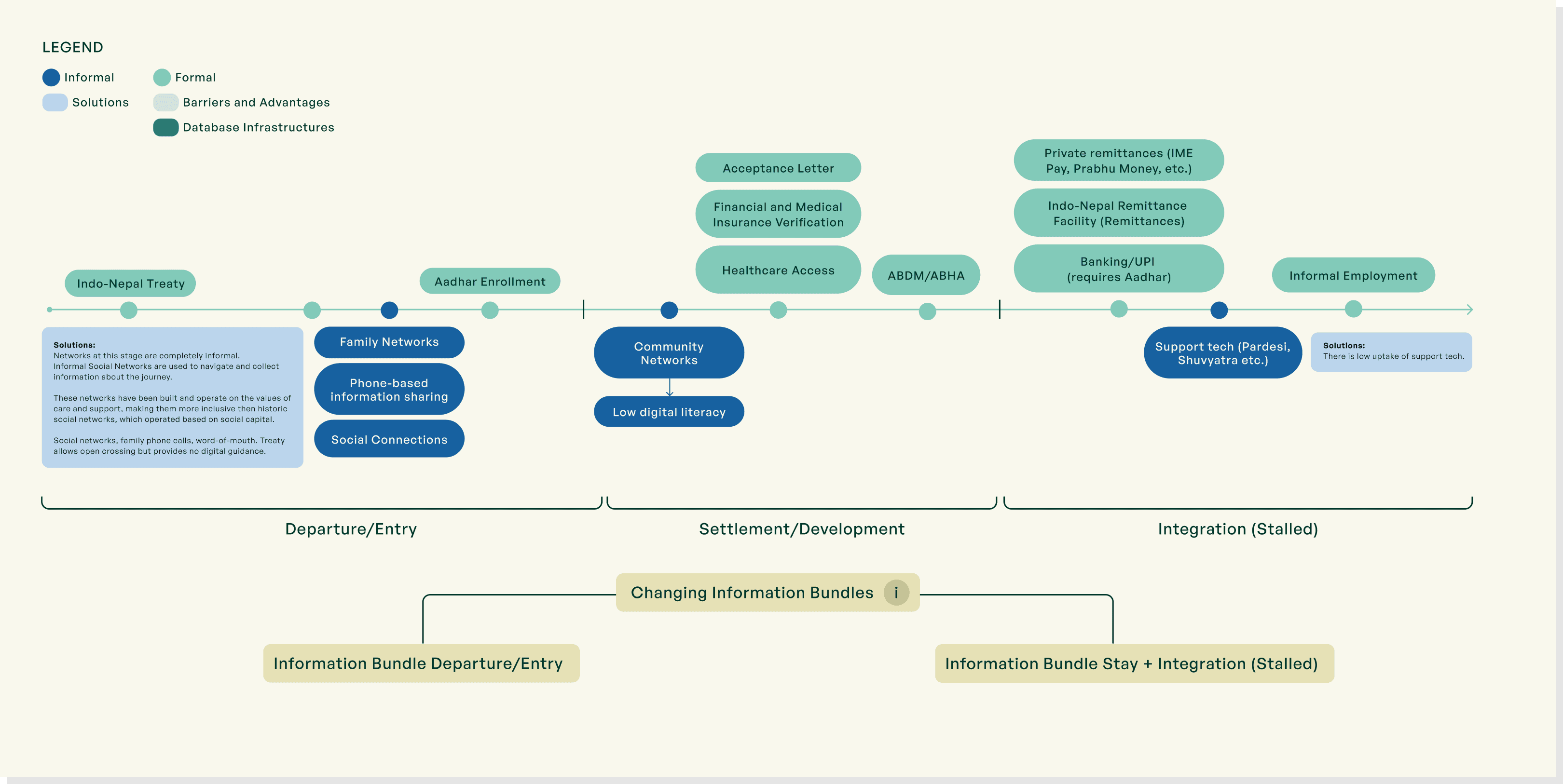
The Journey Map Explained
The journey map illustrates Nepalese migration to India as a series of phases marked by systemic barriers and fragmented digital infrastructure. Unlike student migration pathways with clear formal channels, the Nepal-India corridor reveals a fundamental disconnect between treaty promises and digital reality. The map is divided into three main stages: Departure/Entry, Settlement/Development, and Integration (Stalled).
Departure/Entry Phase
This initial phase is dominated by “Information Bundles.” Students gather and prepare the necessary documents and data for their applications.
This initial phase appears straightforward. The Indo-Nepal Treaty (1950) establishes an open border withno visa requirements, allowing unrestricted movement between the two countries. However, this openness comes at a cost: the absence of formal documentation at entry creates what the case study terms a "liminal" status; migrants are treated neither as foreigners nor as citizens.
Informal Networks Dominate: With no formal infrastructure to guide movement, migrants rely entirely on family networks, social connections, and phone-based information sharing. Unlike students who access DAAD or uni-assist, Nepalese migrants depend on word-of-mouth guidance from relatives already in India. The information bundle at this stage is entirely community-driven, with no official touchpoints to create digital records or provide systematic guidance.
Settlement/Development Phase
This stage reveals the consequences of the documentation gap created at entry. Migrants encounter India's Digital Public Infrastructure (DPI), designed primarily for Indian citizens, creating multiple friction points.
Aadhaar as Gateway and Barrier: The Aadhaar system becomes the central touchpoint required for banking, SIM cards, healthcare, and formal employment. Migrants are eligible after 182 days of residence, but enrollment is fraught with obstacles. The most critical barrier is calendar incompatibility: the Bikram Sambat (Nepalese calendar) versus the Gregorian calendar creates documentation discrepancies, with no offline conversion mechanism available at enrollment centers.
Inconsistent Access: Enrollment centers operate with inconsistent practices. Some issue Aadhaar cards to migrants based on government documentation; others turn them away due to uncertainty about eligibility requirements. Migrants are often incorrectly equated with illegal immigrants, creating distrust and discouragement.
Healthcare and Welfare Exclusion: Even when migrants attempt to access healthcare, they face discrimination. The case study documents instances where migrants are required to present Aadhaar cards at hospitals, while citizens are not subjected to the same requirement. More critically, a Himachal Pradesh High Court ruling denies ration cards to Nepali migrants (a case still pending at the Supreme Court) blocking access to subsidized healthcare through the PMJAY scheme.
Digital Health as Exception: The Ayushman Bharat Digital Mission (ABDM) stands as a notable exception, offering inclusive access for Nepali migrants through ABHA numbers for digitizing health records. However, this single inclusive system cannot compensate for broader exclusions.
Continued Informal Reliance: Community networks remain critical for survival, but face limitations due to low digital literacy. Technologies like Shuvayatra and Pardesi, designed to support migrants, have minimal awareness and uptake among those in informal sectors.
Integration Phase (Stalled)
This final phase reveals systemic failure; development never reaches true integration.
Financial Systems: Banking and UPI access require Aadhaar, creating a dependency chain. The Indo-Nepal Remittance Facility (INRF) through SBI provides an alternative that doesn't require bank accounts, but remittances are declining due to limited awareness. Private services like IME Pay exist but remain underutilized.
Double Invisibility: The defining characteristic of this phase is "double invisibility." Nepalese migrants cannot access welfare schemes in India (they are not citizens) and are not recognized as foreign workers by Nepal (which excludes India-based migrants from overseas worker protections). They exist in a policy vacuum with no advocacy stakeholder representing their interests.
Informal Economy: The majority of migrants work in unorganized sectors, unable to access formal employment despite treaty rights that theoretically grant them equal participation in trade and commerce. The case study notes that 80% of Nepal's absentee population resides in India, yet they remain largely invisible in both countries' databases.
State of other Migration Support Technologies
Our field research identified limited awareness and apprehension among many Nepalese migrants regarding technologies designed to aid them.
Shuvayatra is a comprehensive safe migration tool that provides vital information on labour rights, work permits, application processes, local dos and don’ts, and working conditions abroad. It also offers country-specific guidance for popular destination countries such as Malaysia, Saudi Arabia, and Qatar. Shuvayatra has been designed with prospective and returnee male and female labour migrants in Nepal to ensure its relevance and usability.
Pardesi, on the other hand, is a portal that serves as a one-stop information hub for Nepalis seeking foreign employment. It covers a broad spectrum of topics, including financial literacy, remittance utilisation, welfare arrangements, health facilities, etc in various destination countries. It also provides information on the culture, climate, and traffic rules of these countries, helping migrants prepare for their relocation.
Despite the potential benefits of these technologies, their use among migrants, particularly those in the unorganised or informal sectors, appears to be low. This can be primarily attributed to a lack of awareness about these initiatives. Many migrants are either unaware of the existence of such tools or are hesitant to use them due to limited digital literacy and apprehensions about technology.
Along the Periphery
IOM's Determinants of Migrant Vulnerability frames vulnerability as the product of individual, household, community and structural factors rather than as a fixed trait of particular migrants.
This corridor produces a distinct pattern: under an open border and a treaty promising integration, vulnerability takes a unique form through a liminal presence.
Dual invisibility
Nepali migrants are neither foreigners nor citizens and remain itinerant, liminal, and largely missing from the developments that shape policy and resourcing in both countries.
Even while accounted for in identification efforts, for example through Aadhar, these unlock ancillary functions like a SIM card, a bank KYC and identity verification while the substantial entitlements it ostensibly carries including welfare schemes and healthcare subsidies stay out of reach. This invisibility extends both ways: Nepal, by withholding the labour permits that guard its Migrant Workers' Welfare Fund, excludes India-bound workers from the protections it extends to other migrants abroad.
Specific markers of vulnerability
Economic vulnerability also compounds low digital literacy, limited awareness and language barriers that in turn shape integration experiences. Young men for whom migration is a 'rite of passage' are funnelled disproportionately into informal, undocumented work.
Legal status
Article VII of the 1950 Indo-Nepal Treaty promises the nationals of each country reciprocal privileges in the other including the same rights of residence, property ownership, participation in trade and commerce, and movement. In practice, India's Ministry of External Affairs reads the provision narrowly, and its meaning is contested across both policy landscapes. Migrants are therefore neither foreigners, subject to a clear immigration regime, nor citizens entitled to welfare and occupy an itinerant, liminal position that produces accountability gaps rather than protections.
Economic status
Despite treaty rights to equal participation in trade and commerce, migrants are confined to the informal economy. Remittances are the lifeline of economic life. However, the regulated channel, the Indo-Nepal Remittance Facility, routes only through two public-sector banks and suffers from the lack of awareness. Additionally, UPI, the interface that locally transformed domestic transfers, stays closed to a largely unbanked population.
Unequal access to community resources
With no formal touchpoint at entry, migrants rely predominantly on family networks and word-of-mouth. Concerningly, purpose-built tools such as Shuvayatra and Pardesi see minimal uptake shaped by low digital literacy and a wariness of technology.
Discrimination experiences
At enrolment centres they are frequently mistaken for illegal immigrants and turned away. A High Court ruling denying them ration cards that is still pending before the Supreme Court bars them from subsidised healthcare under PMJAY. Fieldwork records migrants being asked to produce an Aadhaar card at hospitals where citizens face no such demand, and being denied care when they cannot. Legal entry, in this scenario, seems to secure neither recognition nor equal treatment.
For these migrants, the periphery is defined by the experience of suspension. They are datafied as residents but denied as rights-bearers. Even while enrolled, identified and remitting through regulated rails, they remain unable to convert this into welfare, healthcare or formal work.
Across Data and the Digital
This section explores the integration of Nepalese migrants in India, focusing on the role of digital public infrastructure and examines the challenges migrants face in accessing services and the impact of digital systems on their socio-economic inclusion.

Regulators
Government departments and agencies with the legal power to regulate migration, issue documentation and enforce immigration laws.
Eg: Unique Identification Authority of India (UIDAI), Reserve Bank of India (RBI), Ministry of Health for ABDM, Ministry of External Affairs, Ministry of Labour, Employment and Social Security, Nepal, Nepal Rastra Bank, National Payments Corporation of India (NPCI), National Health Authority (NHA) - Ayushman Bharat Digital Mission, SBI/NSBI - Indo-Nepal Remittance Facility.

Facilitators
Well funded, large scale organisations providing protective services, legal aid and humanitarian assistance through formal programs or channels
Eg: Multilaterals and regional bodies

Service Providers
Formal businesses or institutions providing commercial services catering to Nepalese migrants, although it need not be exclusive to them, which requires data collection or identity verification.
Eg: Remittance service providers like IME Pay, Prabhu Money Transfer, Fia Global. Fintech applications like PhonePe, Google Pay, DPI providers (India Stack).

Advocacy
Organisations primarily focus on providing legal aid, representation, rights and policy advocacy for Nepalese migrants.
Eg: Student advocacy groups
Community Actors
Community or bottom-up organisations which are created by and for Nepalese migrant communities as systems of care.
Eg: Nepalese migrants forming part of a largely informal economy, community networks and support systems

Research Organisations
Organisations or institutes which conduct research about or with Nepalese migrants coming into India, enabling further movement towards improved living conditions.
Eg: Academics and researchers
Dissonance between the promise of openness of the border and the reality of migration
India's digital public infrastructure (DPI) enables Nepali residents to access Aadhaar and UPI, yet research shows they still suffer precarity, lack integration, and remain in the informal economy, with technological design failing to address the Peace and Friendship treaty's promises of ease of movement.
The dissonance between the border's promised openness and the reality of migration between India and Nepal, where DPI prevalence doesn't translate to migrant integration, forms the core justification for this case study.
Role of DPI in bridging the integration gap
Digital platforms provide migrants with:
essential information about their rights, available services, and integration processes in their native languages, facilitating easier adaptation to new environments
legal identity and financial stability through user friendly and accessible DPI
streamlined access to essential services including identification, banking, healthcare, and employment information through digital platforms, effectively bridging the integration gap
Valid ID (Aadhaar in India) is a critical gateway for accessing bank accounts, employment, SIM cards, and healthcare services. Without Aadhaar, migrants struggle to receive wages through formal banking, limiting financial inclusion and increasing reliance on informal/exploitative systems.
Seamless digital payment systems enable efficient, affordable remittances to support families and communities back home. Easy money transfers significantly impact migrants' financial management capabilities
legal identity and financial stability through user friendly and accessible DPI
Digital integration further
creates a sense of belonging and stability, reducing migration-related uncertainty and isolation.
integrates migrants into host country's socio-economic fabric rather than leaving them on the periphery
offers potential for meaningful, responsible, migrant-centric integration through digital mediation
Such integration tools are vital for helping migrants navigate their new environment and achieve successful settlement.
India's DPI primarily caters to citizens
Digital platforms provide migrants with:
India’s DPI is a multifaceted digital stack with foundational systems for ID, payments, and data exchange, supporting sectoral applications in health, education, and e-commerce. Nepalese citizens migrating to India for generations face a complex technological landscape requiring precise navigation due to a lack of effective offline infrastructure. This is due to how India's DPI has been built primarily for citizens rather than resident foreigners, significantly influencing migrants' capacity to integrate and flourish in their new environment. These systems often lack a migrant-centric approach despite the promises made in the Friendship Treaty.
The outcome is a multiplicity of data flows working towards differing ends depending on the stakeholders' intent and accessibility to the data.
The three essential systems/ Triple axes of migrant interaction with India’s DPI
The following illustration depicts the India Stack of DPI.
These are examples of end-user solutions developed by the public and private sector. By using and building over open protocols, the government, private sector and civil society are enabled to participate in the digital ecosystem.
Finance
The Unified Payments Interface (UPI) has led to the creation of a digital payments ecosystem that includes more than 450 banks and 50 million merchants as part of its network.
Healthcare
The Unified Health Interface includes 240 million user accounts, 145,000 healthcare facilities and over 70,000 health professionals, integrating hospitals, labs, insurance firms, and other service providers under a single network.
Education & Skilling


Diksha reaches more than 4.7 million teachers and 180 million students. It currently has more than 57 billion minutes from around 290,000 pieces of content in 33 languages.
E-Commerce
ONDC is a population-scale network where more than US$100 billion of commerce is expected with over 500 million customers and 15 million sellers. It is up and running in over 80 cities with more than 30 network participants.
These form the building blocks of India stack’s core DPI.

Account Aggregator
By examining these three essential systems—digital ID, payment systems, and healthcare infrastructure—we can better understand the barriers and opportunities for Nepalese migrants in India. These systems are the fundamental to effective integration and assimilation, impacting every aspect of a migrant’s life from financial stability to health and well-being.
Digital identification, primarily through the Aadhaar system, is vital for migrants as it serves as a gateway to numerous services. Without a digital ID, migrants face challenges in accessing banking services, mobile connections, and government welfare schemes.
Access to robust and inclusive payment systems is essential for financial integration. Migrants often rely on remittances as a significant source of income for their families back home. Efficient and accessible digital payment platforms can drastically reduce the cost and complexity of sending money across borders.
Access to healthcare is a fundamental human right and a critical aspect of integration for migrants. The ability to use health services can significantly impact the well-being of Nepalese migrants. Understanding how migrants interact with healthcare infrastructure helps identify gaps in service delivery and ensures that health services are inclusive and accessible.
Of particular relevance to this case is also a growing interest between both States to innovate together towards creating India-Nepal digital bridges anchored in exploring the potential of the DPI approach. Therefore, this exploration focuses on how identity enables access to welfare services and facilitates integration for Nepalese migrants.
The identity question/Interaction with Aadhaar and Integration with DPI: Welfare and offline inclusivity
The Government of India enacted the Aadhaar (Targeted Delivery of Financial and other Subsidies, Benefits, and Services) Act,[34] 2016 to provide identification to every resident of the country against submission of demographic and biometric information. Over time, the usage of Aadhaar has primarily become two-pronged - a proof of identity and proof of address, becoming a preferable document for banking services[35] among others.
Aadhar is the linchpin for accessing numerous services, both direct and ancillary benefits that include the procurement of a SIM card, and fulfilling Know Your Customer (KYC) requirements, which are mandatory for opening bank accounts. This, in turn, enables financial inclusion and economic participation.
Hurdles in accessing Aadhar
Nepalese citizens meeting 182-day residence requirements are eligible for Aadhaar enrolment under UIDAI with specific documentation requirements and foreign resident enrolment form
They face significant challenges obtaining Aadhaar cards despite legal eligibility, with empirical fieldwork evidence revealing substantial impediments
Primary challenge involves discrepancies in recording age and date of birth due to incongruity between Nepalese Bikram Sambat calendar system and Indian Gregorian calendar
Lack of offline mechanisms for converting dates between calendars exacerbates difficulty, making Aadhaar application process complicated despite government assurances of accessibility
Inconsistent practices at enrolment centres stem from lack of clarity about Aadhaar eligibility for migrants—some centres issue Aadhaar based on government documentation while others turn migrants away due to uncertainty about requirements
Lack of uniformity creates distrust, with applicants often incorrectly equated with illegal immigrants, discouraging enrolment pursuit
Therefore, Aadhaar envisioned as a socio-economic inclusion tool is undermined by the absence of calendar conversion mechanisms and inconsistent enrolment centre practices. Disparity exists between bilateral treaty promises, Aadhaar system's theoretical inclusivity, and on-ground realities of infrastructural inadequacies and procedural hurdles. This deficiency highlights critical gaps between inclusive policy promises and implementation, with procedural rigidity compounding exclusion. Such exclusion leads to incomplete assimilation as true integration necessitates equitable access to services like healthcare.
Ostensibly integrated into Aadhar but unable to access its full benefits
Nepalese migrants are currently integrated into the Aadhaar network with a unique identification number, ostensibly facilitating access to various services and benefits within India. However, the benefits of the Aadhaar system are predominantly available only to Indian citizens, excluding resident foreigners, from accessing the full range of advantages associated with the Aadhaar card.
When evaluating the utility of Aadhaar for these migrants, it is crucial to adopt a twofold perspective: examining both the primary/substantial benefits and the secondary/ancillary benefits.
The first-order or substantial benefits of Aadhaar are those directly related to government schemes and entitlements. These include access to social welfare programs, healthcare subsidies, and other governmental provisions that are designed to improve the socio-economic status of residents. In theory, Aadhaar should enable Nepalese migrants to seamlessly access these benefits, thereby ensuring their inclusion in the broader socio-economic framework of the country. However, institutional barriers prevent migrants from fully leveraging Aadhaar’s potential. As a result, the substantial benefits that Aadhaar is designed to provide are not reaching the migrant population. These benefits are essential for ensuring long-term stability and integration for migrants. This discrepancy arises due to systemic barriers and the partial implementation of Aadhaar’s potential benefits.
On the other hand, the ancillary benefits of Aadhaar are more readily accessible to Nepalese migrants. These include the ability to open bank accounts, purchase SIM cards, and facilitate identity verification processes.[63] These benefits, while significant, represent only a fraction of the intended utility of Aadhaar. For many migrants, the ability to access basic financial and communication services marks an improvement in their quality of life, yet it falls short of the comprehensive support that Aadhaar is meant to provide.
Migrants may manage to utilise ancillary benefits, the more transformative substantial benefits remain largely inaccessible. The gap between the design and the actual delivery of these benefits showcases a pressing need for policy reform and enhanced implementation strategies.
The failure of offline infrastructure
The most significant constraint in achieving this integration is the inadequacy of the current offline infrastructure. Many government schemes and services require in-person verification and documentation processes, which can be cumbersome and inaccessible for migrants who often face language barriers, lack of awareness, and bureaucratic red tape. The offline infrastructure fails to fully support the seamless integration of Nepali migrants.
The failure of offline infrastructure
Nepalese migrants face challenges navigating India's healthcare system. Our fieldwork revealed migrants reported significant difficulties accessing healthcare at both private and public hospitals:
Financial constraints compel preference for government hospitals over private providers
Government hospitals offer more affordable services but are frequently overwhelmed
Language barriers and lack of awareness about available health services exacerbate difficulties
Migrants required to present Aadhaar card for identification while citizens were not subjected to same requirement
Aadhaar card as healthcare access prerequisite represents systemic barrier exacerbating vulnerabilities and demonstrating basic-level exclusion. Without Aadhaar identification, migrants have been denied essential medical services
Treatment disparity between migrants and Indian citizens highlights broader challenges in securing well-being and societal integration
Challenges in PMJAY:
Prime Minister Narendra Modi initiated Pradhan Mantri Jan Arogya Yojana (PMJAY) scheme in 2018 to provide certain populations with subsidised health insurance rates
PMJAY eligibility is restricted to ration card holders—a significant barrier for migrants arises from lack of ration card access
Unlike Indian citizens, Nepali migrants lack official ration card access due to Himachal Pradesh High Court ruling in Mool Pravah Akhil Bharat Nepal Ekta Samaj and Anr v. State of Himachal Pradesh, a matter currently awaiting final Supreme Court ruling. This protracted legal battle perpetuates uncertainty and impedes migrants' ability to benefit from ration card entitlements
Exclusion from ration cards effectively bars Nepali migrants from accessing crucial PMJAY healthcare subsidy and has far-reaching implications for access to essential services and welfare schemes
These systemic challenges highlight the need for policy reforms addressing unique circumstances of resident foreigners.
Challenges in PMJAY:
In contrast to the ration card and PMJAY scheme, the Ayushman Bharat Digital Mission (ABDM) offers inclusivity for Nepali migrants.
ABDM facilitates the issuance of an Ayushman Bharat Health Account (ABHA) number, which enables individuals to digitise their health data and records.[45]
This digital integration enhances healthcare accessibility and continuity for migrants, providing them with a portable health information system.
The ABHA number allows healthcare providers to access a migrant’s medical history, thereby improving the quality and efficiency of healthcare services rendered.[46] These systemic challenges highlight the need for policy reforms addressing unique circumstances of resident foreigners.
Despite the advantages presented by the ABDM, the overarching exclusion from the ration card system and PMJAY scheme highlights a dichotomy in the accessibility of India’s welfare mechanisms. While digital health records offer some degree of inclusion, an inability to access subsidised healthcare and other benefits linked to the ration card remains an obstacle.
What role does the Indo-Nepal remittance facility play in supporting migrants?
The Indo-Nepalese remittance system serves as a critical financial conduit for many Nepalese families, with migrant workers in India sending substantial portions of their earnings back home. This section elaborates on the mechanisms of the Indo-Nepal remittance system and digital payment solutions to enhance the efficiency of cross-border financial transfers.

Indo-Nepal Remittance Facility (INRF) is key part of digital infrastructure that Nepalese migrants interact with; INRF is a collaborative effort between Reserve Bank of India (RBI) and Nepal Rastra Bank (NRB) with significant enhancements for cross-border remittances between India and Nepal; Only authorized banks for routing remittances are State Bank of India (SBI) and Nepal SBI (NSBI), both public sector entities
Advantages:
The system provides secure channel for Nepalese migrants to send money home and leverages digital platforms to address challenges posed by low banking penetration in Nepal
Streamlined, regulated channel for financial transfers leverages existing DPI
Represents transformative tool extending utility to non-bank holders—individuals don't need bank accounts in either India or Nepal to use remittance services
Ensures remittances are sent quickly and securely, supporting financial stability of migrant families
INRF exemplifies India's "Neighbourhood First" policy and aims to bolster regional connectivity
Recent transaction ceiling increased from ₹50,000 to ₹2 lakh; Cap on number of remittances per year removed, expanding scope and ease of transactions
The bilateral arrangements between banks and non-bank entities to handle cross-border transactions between India and Nepal remain outside the purview of the INRF which exclusively relies on the National Electronic Funds Transfer ecosystem to manage remittances to Nepal. Consequently, all NEFT-enabled bank branches are already integrated into the scheme, ensuring a structured and regulated remittance pathway.
Different banks have tied up with each other to facilitate remittances and accelerate cross-border relationship
Beyond official bank remittance facility, private players operate in the sector
IME Pay allows customers to receive international remittances directly into their mobile wallets
Fia Global and Prabhu Money Transfer have partnered with various banks to enable people to use remittance services
Gaps in the remittance system
Despite transformative nature, remittance facility shows declining trend in number of remittances in recent years, raising concerns about underlying contributing factors
Primary concern is migrants' lack of knowledge about available databases and facilities; many migrants may lack necessary awareness or understanding to fully utilize remittance services
Information gap possibly stems from inadequate dissemination or limited digital literacy
Reliance on only two banks (SBI and NSBI) for remittance services presents accessibility and convenience challenges
Migrants in areas without easy access to SBI or NSBI branches find it difficult to use services, hindering ability to remit money to Nepal
Procedural complexities may deter migrants from fully engaging with system
Complete reliance on NEFT for remittance under INRF Scheme, while secure and regulated, may not be most accessible method for all users
The elephant in the room, lack of access to UPI
Beyond NEFT and walk-ins, UPI is one of most important interfaces for domestic money transfers in India
Among Nepalese migrants with Indian bank accounts, digital payment platform adoption is prevalent, with PhonePe and Google Pay being most commonly used applications
Even non-users are aware of family members (spouses, children) using these apps, indicating widespread familiarity and reliance on digital payment solutions within migrant community
UPI's real-time payment capabilities could revolutionize remittance landscape through instant transfers, enhancing efficiency and user experience
UPI's immediacy and simplicity could significantly streamline remittance process, providing seamless and cost-effective fund transfer means
Despite its potential, UPI remains underutilized among migrants, particularly Nepalese, due to exclusive bank-to-bank transfer mechanism
Limitation is significant given substantial portion of Indo-Nepal migrant population remains unbanked; without bank account access, individuals are excluded from UPI benefits
Current INRF system provides regulated, secure remittance pathway and UPI integration has the potential to streamline and expedite remittance process, offering more user-friendly and accessible options
Expanding INRF Scheme guidelines to include UPI could democratize remittance service access, providing faster and potentially cheaper alternative to NEFT
Current updates to UPI:
UPI use case extended to Nepal in furtherance of "Neighbourhood First" policy; RBI and NRB actively exploring UPI utilization to facilitate cross-border remittances between India and Nepal
This move represents a step toward leveraging digital payment platforms to enhance cross-border financial transactions and holds potential to simplify remittance process for Nepalese migrants and foster greater financial integration between countries
However, marginalization of unbanked communities would persist even with UPI inclusion which raises fundamental questions about access to and impetus of digital infrastructure
The real challenge is envisioning technological streamlining in tandem with offline challenges to prevent exacerbation of existing inequities.
Within our Framework
The Migration Infrastructure Assessment (MIA) is a diagnostic tool that allows us to evaluate migratory corridors across the world by understanding how data and digital spaces account for the needs of people on the move. This tool situates five pillars across three stages, as laid down below. More information on the parameters and diagnosis structure of the MIA can be found here.
" height="16.504237999999997px" id="bAcwUBxmE" stroke-dasharray="" stroke-linecap="butt" stroke-linejoin="miter" stroke-miterlimit="10" stroke-width="0.7" stroke="rgb(23, 97, 160)" transform="translate(47.494 0.352)" width="19.656099999999995px"/><path d="M 48.858 73.653 C 75.841 73.653 97.716 57.165 97.716 36.826 C 97.716 16.488 75.841 0 48.858 0 C 21.874 0 0 16.488 0 36.826 C 0 57.165 21.874 73.653 48.858 73.653 Z" fill="rgb(254, 253, 244)" height="73.6525px" id="jDLC3p_u9" stroke-dasharray="" stroke-linecap="butt" stroke-linejoin="miter" stroke-miterlimit="10" stroke-width="0.7" stroke="rgb(23, 97, 160)" transform="translate(16.203 17.75)" width="97.7159px"/><path d="M 7.761 15.523 C 12.048 15.523 15.523 12.048 15.523 7.762 C 15.523 3.475 12.048 0 7.761 0 C 3.475 0 0 3.475 0 7.762 C 0 12.048 3.475 15.523 7.761 15.523 Z" fill="rgb(254, 253, 244)" height="15.523100000000003px" id="S8lqqhMFF" stroke-dasharray="" stroke-linecap="butt" stroke-linejoin="miter" stroke-miterlimit="10" stroke-width="0.7" stroke="rgb(23, 97, 160)" transform="translate(101.723 30.867)" width="15.522999999999996px"/><path d="M 0 14.553 C 0 6.514 8.959 0 20.012 0 C 31.065 0 40.024 6.514 40.024 14.553 Z" fill="rgb(254, 253, 244)" height="14.552900000000001px" id="dWst33jwF" stroke-dasharray="" stroke-linecap="butt" stroke-linejoin="miter" stroke-miterlimit="10" stroke-width="0.7" stroke="rgb(23, 97, 160)" transform="translate(89.473 48.605)" width="40.02430000000001px"/><path d="M 0 0 C 0 0 0.39 5.035 7.65 6.931" fill="transparent" height="6.931099999999997px" id="QIeOaVUgT" stroke-dasharray="" stroke-linecap="butt" stroke-linejoin="miter" stroke-miterlimit="10" stroke-width="0.7" stroke="rgb(23, 97, 160)" transform="translate(109.486 30.867)" width="7.6499999999999915px"/><path d="M 7.649 0 C 7.649 0 7.26 5.035 0 6.931" fill="transparent" height="6.931099999999997px" id="x2hwmD9iw" stroke-dasharray="" stroke-linecap="butt" stroke-linejoin="miter" stroke-miterlimit="10" stroke-width="0.7" stroke="rgb(23, 97, 160)" transform="translate(101.723 30.867)" width="7.649000000000001px"/><path d="M 12.275 0 C -2.297 0.074 0.156 27.27 0.156 27.27 L 24.353 27.27 C 24.353 27.27 25.49 -0.066 12.275 0 Z" fill="rgb(254, 253, 244)" height="27.26971824227173px" id="jJVbPKdjQ" stroke-dasharray="" stroke-linecap="butt" stroke-linejoin="miter" stroke-miterlimit="10" stroke-width="0.7" stroke="rgb(23, 97, 160)" transform="translate(8.086 42.391)" width="24.37739025406398px"/><path d="M 0 14.553 C 0 6.515 8.959 0 20.012 0 C 31.065 0 40.025 6.515 40.025 14.553 Z" fill="rgb(254, 253, 244)" height="14.552900000000001px" id="mVXsgi0Ka" stroke-dasharray="" stroke-linecap="butt" stroke-linejoin="miter" stroke-miterlimit="10" stroke-width="0.7" stroke="rgb(23, 97, 160)" transform="translate(0.35 62.02)" width="40.024591px"/><path d="M 14.695 0 C 15.559 1.272 15.896 2.582 15.896 4.232 C 15.896 8.619 12.338 12.18 7.948 12.18 C 3.557 12.18 0 8.622 0 4.232 C 0 2.782 0.389 1.422 1.066 0.252 L 14.794 0.055" fill="rgb(254, 253, 244)" height="12.179500000000004px" id="U1dSCGCiy" transform="translate(12.131 47.871)" width="15.895800000000001px"/><path d="M 14.695 0 C 15.559 1.272 15.896 2.582 15.896 4.232 C 15.896 8.619 12.338 12.18 7.948 12.18 C 3.557 12.18 0 8.622 0 4.232 C 0 2.782 0.389 1.422 1.066 0.252 L 14.794 0.055" fill="transparent" height="12.179500000000004px" id="qXsBuoc5q" stroke-dasharray="" stroke-linecap="butt" stroke-linejoin="miter" stroke-miterlimit="10" stroke-width="0.7" stroke="rgb(23, 97, 160)" transform="translate(12.131 47.871)" width="15.895800000000001px"/><path d="M 7.762 15.523 C 12.048 15.523 15.523 12.048 15.523 7.762 C 15.523 3.475 12.048 0 7.762 0 C 3.475 0 0 3.475 0 7.762 C 0 12.048 3.475 15.523 7.762 15.523 Z" fill="rgb(254, 253, 244)" height="15.52308px" id="S6e0VeYtz" stroke-dasharray="" stroke-linecap="butt" stroke-linejoin="miter" stroke-miterlimit="10" stroke-width="0.7" stroke="rgb(23, 97, 160)" transform="translate(49.531 4.137)" width="15.523200000000003px"/><path d="M 0 14.553 C 0 6.515 8.959 0 20.012 0 C 31.065 0 40.025 6.515 40.025 14.553 Z" fill="rgb(254, 253, 244)" height="14.552900000000001px" id="YCPyLrdGJ" stroke-dasharray="" stroke-linecap="butt" stroke-linejoin="miter" stroke-miterlimit="10" stroke-width="0.7" stroke="rgb(23, 97, 160)" transform="translate(37.279 21.875)" width="40.0246px"/><path d="M 7.731 15.463 C 12.001 15.463 15.463 12.001 15.463 7.731 C 15.463 3.462 12.001 0 7.731 0 C 3.462 0 0 3.462 0 7.731 C 0 12.001 3.462 15.463 7.731 15.463 Z" fill="rgb(254, 253, 244)" height="15.462800000000001px" id="oWDyZiqO1" stroke-dasharray="" stroke-linecap="butt" stroke-linejoin="miter" stroke-miterlimit="10" stroke-width="0.7" stroke="rgb(23, 97, 160)" transform="translate(67.51 63.18)" width="15.462800000000001px"/><path d="M 0.003 14.495 C 0.003 6.49 8.926 0 19.933 0 C 30.939 0 39.863 6.49 39.863 14.495 L 0 14.495 Z" fill="rgb(254, 253, 244)" height="14.4953px" id="Fv_WWWMWO" stroke-dasharray="" stroke-linecap="butt" stroke-linejoin="miter" stroke-miterlimit="10" stroke-width="0.7" stroke="rgb(23, 97, 160)" transform="translate(55.307 80.848)" width="39.862899999999996px"/><path d="M 0 0 L 0 14.602" fill="transparent" height="14.602199999999996px" id="JByZBiyhc" stroke-dasharray="" stroke-linecap="butt" stroke-linejoin="miter" stroke-miterlimit="10" stroke-width="0.7" stroke="rgb(23, 97, 160)" transform="translate(75.24 80.848)" width="1px"/><path d="M 1.113 2.226 C 1.727 2.226 2.226 1.727 2.226 1.113 C 2.226 0.498 1.727 0 1.113 0 C 0.498 0 0 0.498 0 1.113 C 0 1.727 0.498 2.226 1.113 2.226 Z" fill="rgb(254, 253, 244)" height="2.2256px" id="JIyVYe18K" stroke-dasharray="" stroke-linecap="butt" stroke-linejoin="miter" stroke-miterlimit="10" stroke-width="0.7" stroke="rgb(23, 97, 160)" transform="translate(71.115 84.313)" width="2.2256px"/><path d="M 1.113 2.226 C 1.727 2.226 2.226 1.727 2.226 1.113 C 2.226 0.498 1.727 0 1.113 0 C 0.498 0 0 0.498 0 1.113 C 0 1.727 0.498 2.226 1.113 2.226 Z" fill="rgb(254, 253, 244)" height="2.2256px" id="KPS4GxuJv" stroke-dasharray="" stroke-linecap="butt" stroke-linejoin="miter" stroke-miterlimit="10" stroke-width="0.7" stroke="rgb(23, 97, 160)" transform="translate(71.115 90.617)" width="2.2256px"/></svg>)
" transform="translate(32.342 2.461)" width="8.845399999999998px"/><path d="M 4.219 2.11 C 4.219 0.945 3.275 0 2.11 0 C 0.945 0 0 0.945 0 2.11 C 0 3.275 0.945 4.219 2.11 4.219 C 3.275 4.219 4.219 3.275 4.219 2.11 Z" fill="rgb(254, 253, 244)" height="4.219420000000001px" id="rvDT7p0As" stroke-dasharray="" stroke-linecap="butt" stroke-linejoin="miter" stroke-miterlimit="10" stroke-width="0.7" stroke="rgb(23, 97, 160)" transform="translate(39.079 0.352)" width="4.2194199999999995px"/><path d="M 0 54.882 L 0 17.902 L 30.809 0.052 C 31.001 -0.057 31.339 0.017 31.339 0.17 L 31.339 54.882 L 0.003 54.882 Z" fill="rgb(254, 253, 244)" height="54.8818667780653px" id="fKRNq6Xnn" stroke-dasharray="" stroke-linecap="butt" stroke-linejoin="miter" stroke-miterlimit="10" stroke-width="0.7" stroke="rgb(23, 97, 160)" transform="translate(9.457 20.375)" width="31.33937px"/><path d="M 0 0 L 0 13.076" fill="transparent" height="13.075700000000001px" id="lP2FoEBTr" stroke-dasharray="" stroke-linecap="butt" stroke-linejoin="miter" stroke-miterlimit="10" stroke-width="0.7" stroke="rgb(23, 97, 160)" transform="translate(36.602 28.887)" width="1px"/><path d="M 0 0 L 0 13.073" fill="transparent" height="13.072899999999997px" id="MSANqNS54" stroke-dasharray="" stroke-linecap="butt" stroke-linejoin="miter" stroke-miterlimit="10" stroke-width="0.7" stroke="rgb(23, 97, 160)" transform="translate(32.656 36.238)" width="1px"/><path d="M 0 0 L 0.014 11.678" fill="transparent" height="11.678000000000004px" id="qY7hom1Ra" stroke-dasharray="" stroke-linecap="butt" stroke-linejoin="miter" stroke-miterlimit="10" stroke-width="0.7" stroke="rgb(23, 97, 160)" transform="translate(28.799 30.281)" width="1px"/><path d="M 0 0 L 0 13.076" fill="transparent" height="13.075700000000005px" id="rR6GqB6Aw" stroke-dasharray="" stroke-linecap="butt" stroke-linejoin="miter" stroke-miterlimit="10" stroke-width="0.7" stroke="rgb(23, 97, 160)" transform="translate(26.428 46.18)" width="1px"/><path d="M 0 0 L 0 13.073" fill="transparent" height="13.072999999999993px" id="XbzW5enCa" stroke-dasharray="" stroke-linecap="butt" stroke-linejoin="miter" stroke-miterlimit="10" stroke-width="0.7" stroke="rgb(23, 97, 160)" transform="translate(30.998 51.254)" width="1px"/><path d="M 0 0 L 0 13.073" fill="transparent" height="13.073px" id="GRwQgO1sk" stroke-dasharray="" stroke-linecap="butt" stroke-linejoin="miter" stroke-miterlimit="10" stroke-width="0.7" stroke="rgb(23, 97, 160)" transform="translate(36.602 47.008)" width="1px"/><path d="M 0 0 C 0 2.195 0 4.391 0 6.586" fill="transparent" height="6.585800000000006px" id="P_n4gKeUP" stroke-dasharray="" stroke-linecap="butt" stroke-linejoin="miter" stroke-miterlimit="10" stroke-width="0.7" stroke="rgb(23, 97, 160)" transform="translate(32.346 68.672)" width="1px"/><path d="M 0 0 C 0.033 3.659 0.033 7.578 0 11.042" fill="transparent" height="11.042200000000008px" id="ttlh1vlVa" stroke-dasharray="" stroke-linecap="butt" stroke-linejoin="miter" stroke-miterlimit="10" stroke-width="0.7" stroke="rgb(23, 97, 160)" transform="translate(27.465 64.211)" width="1px"/><path d="M 0.031 0 C -0.01 3.705 -0.01 7.622 0.031 11.376" fill="transparent" height="11.376499999999993px" id="oiFSw5Q65" stroke-dasharray="" stroke-linecap="butt" stroke-linejoin="miter" stroke-miterlimit="10" stroke-width="0.7" stroke="rgb(23, 97, 160)" transform="translate(35.582 63.879)" width="1px"/><path d="M 0 0 L 0 13.076" fill="transparent" height="13.075699999999998px" id="bOkkKPZ_s" stroke-dasharray="" stroke-linecap="butt" stroke-linejoin="miter" stroke-miterlimit="10" stroke-width="0.7" stroke="rgb(23, 97, 160)" transform="translate(23.301 56.309)" width="1px"/><path d="M 0 0 L 0 13.073" fill="transparent" height="13.072899999999997px" id="Oj4dM7uRt" stroke-dasharray="" stroke-linecap="butt" stroke-linejoin="miter" stroke-miterlimit="10" stroke-width="0.7" stroke="rgb(23, 97, 160)" transform="translate(22.754 33.926)" width="1px"/><path d="M 0 0 L 0 13.073" fill="transparent" height="13.072899999999997px" id="AbMPltlR4" stroke-dasharray="" stroke-linecap="butt" stroke-linejoin="miter" stroke-miterlimit="10" stroke-width="0.7" stroke="rgb(23, 97, 160)" transform="translate(18.555 59.039)" width="1px"/><path d="M 0 0 L 0 13.073" fill="transparent" height="13.072900000000004px" id="e4prr_ViN" stroke-dasharray="" stroke-linecap="butt" stroke-linejoin="miter" stroke-miterlimit="10" stroke-width="0.7" stroke="rgb(23, 97, 160)" transform="translate(13.813 50.121)" width="1px"/><path d="M 0 0 L 0 13.073" fill="transparent" height="13.073px" id="iimHlDA5M" stroke-dasharray="" stroke-linecap="butt" stroke-linejoin="miter" stroke-miterlimit="10" stroke-width="0.7" stroke="rgb(23, 97, 160)" transform="translate(16.732 41.75)" width="1px"/><path d="M 0 0 L 0 6.213" fill="transparent" height="6.213100000000004px" id="YalmanN_n" stroke-dasharray="" stroke-linecap="butt" stroke-linejoin="miter" stroke-miterlimit="10" stroke-width="0.7" stroke="rgb(23, 97, 160)" transform="translate(13.447 35.871)" width="1px"/><path d="M 0 0 L 0 5.331" fill="transparent" height="5.330599999999997px" id="wufUgQVeD" stroke-dasharray="" stroke-linecap="butt" stroke-linejoin="miter" stroke-miterlimit="10" stroke-width="0.7" stroke="rgb(23, 97, 160)" transform="translate(19.182 32.758)" width="1px"/><path d="M 0 0 L 0 13.073" fill="transparent" height="13.072900000000004px" id="QigAnnsY_" stroke-dasharray="" stroke-linecap="butt" stroke-linejoin="miter" stroke-miterlimit="10" stroke-width="0.7" stroke="rgb(23, 97, 160)" transform="translate(20.742 46.664)" width="1px"/><path d="M 0 0 C 0 2.686 0 5.369 0 8.055" fill="transparent" height="8.0548px" id="adLB3L4I6" stroke-dasharray="" stroke-linecap="butt" stroke-linejoin="miter" stroke-miterlimit="10" stroke-width="0.7" stroke="rgb(23, 97, 160)" transform="translate(14.361 67.203)" width="1px"/><path d="M 5.336 0 L 40.194 0 C 43.141 0 45.531 2.393 45.531 5.336 L 45.531 64.482 L 0 64.482 L 0 5.336 C 0 2.39 2.393 0 5.336 0 Z" fill="rgb(254, 253, 244)" height="64.4823px" id="XeCO2Tmxv" stroke-dasharray="" stroke-linecap="butt" stroke-linejoin="miter" stroke-miterlimit="10" stroke-width="0.7" stroke="rgb(23, 97, 160)" transform="translate(39.988 10.754)" width="45.5306px"/><path d="M 14.854 0 L 0 0 L 0 9.62 L 14.854 9.62 Z" fill="transparent" height="9.619699999999998px" id="zRPhUfn_6" stroke-dasharray="" stroke-linecap="butt" stroke-linejoin="miter" stroke-miterlimit="10" stroke-width="0.7" stroke="rgb(23, 97, 160)" transform="translate(46.51 17.816)" width="14.854300000000002px"/><path d="M 14.854 0 L 0 0 L 0 9.62 L 14.854 9.62 Z" fill="transparent" height="9.619699999999998px" id="HSuymkCjT" stroke-dasharray="" stroke-linecap="butt" stroke-linejoin="miter" stroke-miterlimit="10" stroke-width="0.7" stroke="rgb(23, 97, 160)" transform="translate(65.5 17.816)" width="14.854399999999998px"/><path d="M 14.854 0 L 0 0 L 0 9.62 L 14.854 9.62 Z" fill="transparent" height="9.619699999999998px" id="SJ4PZN6_C" stroke-dasharray="" stroke-linecap="butt" stroke-linejoin="miter" stroke-miterlimit="10" stroke-width="0.7" stroke="rgb(23, 97, 160)" transform="translate(46.51 31.477)" width="14.854300000000002px"/><path d="M 14.854 0 L 0 0 L 0 9.62 L 14.854 9.62 Z" fill="transparent" height="9.619699999999998px" id="pvrc0YF2v" stroke-dasharray="" stroke-linecap="butt" stroke-linejoin="miter" stroke-miterlimit="10" stroke-width="0.7" stroke="rgb(23, 97, 160)" transform="translate(65.5 31.477)" width="14.854399999999998px"/><path d="M 14.854 0 L 0 0 L 0 9.62 L 14.854 9.62 Z" fill="transparent" height="9.619700000000002px" id="EVDDda8fT" stroke-dasharray="" stroke-linecap="butt" stroke-linejoin="miter" stroke-miterlimit="10" stroke-width="0.7" stroke="rgb(23, 97, 160)" transform="translate(46.51 45.129)" width="14.854300000000002px"/><path d="M 14.854 0 L 0 0 L 0 9.62 L 14.854 9.62 Z" fill="transparent" height="9.619700000000002px" id="uC5NAKhzi" stroke-dasharray="" stroke-linecap="butt" stroke-linejoin="miter" stroke-miterlimit="10" stroke-width="0.7" stroke="rgb(23, 97, 160)" transform="translate(65.5 45.129)" width="14.854399999999998px"/><path d="M 14.854 0 L 0 0 L 0 9.62 L 14.854 9.62 Z" fill="transparent" height="9.619700000000002px" id="mHz9m_7Vl" stroke-dasharray="" stroke-linecap="butt" stroke-linejoin="miter" stroke-miterlimit="10" stroke-width="0.7" stroke="rgb(23, 97, 160)" transform="translate(46.51 58.789)" width="14.854300000000002px"/><path d="M 14.854 0 L 0 0 L 0 9.62 L 14.854 9.62 Z" fill="transparent" height="9.619700000000002px" id="tHHd7fGYU" stroke-dasharray="" stroke-linecap="butt" stroke-linejoin="miter" stroke-miterlimit="10" stroke-width="0.7" stroke="rgb(23, 97, 160)" transform="translate(65.5 58.789)" width="14.854399999999998px"/><path d="M 3.472 0 L 25.882 0 C 27.801 0 29.358 1.557 29.358 3.475 L 29.358 42.376 L 0 42.376 L 0 3.475 C 0 1.557 1.557 0 3.475 0 Z" fill="rgb(254, 253, 244)" height="42.3761px" id="cETPfhocH" stroke-dasharray="" stroke-linecap="butt" stroke-linejoin="miter" stroke-miterlimit="10" stroke-width="0.7" stroke="rgb(23, 97, 160)" transform="translate(75.727 32.859)" width="29.35839999999999px"/><path d="M 2.072 0 L 15.427 0 C 16.57 0 17.499 0.929 17.499 2.072 L 17.499 25.305 L 0 25.305 L 0 2.072 C 0 0.929 0.929 0 2.072 0 Z" fill="rgb(254, 253, 244)" height="25.304500000000004px" id="v1SH0hKi4" stroke-dasharray="" stroke-linecap="butt" stroke-linejoin="miter" stroke-miterlimit="10" stroke-width="0.7" stroke="rgb(23, 97, 160)" transform="translate(81.658 49.93)" width="17.499100000000013px"/><path d="M 11.45 0 L 26.36 0 C 28.876 0 30.916 2.04 30.916 4.556 L 30.916 34.439 C 30.916 36.955 28.876 38.995 26.36 38.995 L 4.556 38.995 C 2.04 38.995 0 36.955 0 34.439 L 0 32.005" fill="transparent" height="38.99459999999999px" id="ze4Z_BVHA" stroke-dasharray="" stroke-linecap="butt" stroke-linejoin="miter" stroke-miterlimit="10" stroke-width="0.7" stroke="rgb(23, 97, 160)" transform="translate(86.303 43.219)" width="30.916299999999993px"/><path d="M 4.219 2.11 C 4.219 0.945 3.275 0 2.11 0 C 0.945 0 0 0.945 0 2.11 C 0 3.275 0.945 4.219 2.11 4.219 C 3.275 4.219 4.219 3.275 4.219 2.11 Z" fill="rgb(254, 253, 244)" height="4.2194199999999995px" id="s82v1FfZy" stroke-dasharray="" stroke-linecap="butt" stroke-linejoin="miter" stroke-miterlimit="10" stroke-width="0.7" stroke="rgb(23, 97, 160)" transform="translate(95.933 41.109)" width="4.219420000000014px"/><path d="M 28.447 0 L 28.447 17.147 C 28.447 19.663 26.407 21.703 23.891 21.703 L 4.556 21.703 C 2.04 21.703 0 19.663 0 17.147 L 0 8.515" fill="transparent" height="21.702600000000004px" id="yUhY1_Q7o" stroke-dasharray="" stroke-linecap="butt" stroke-linejoin="miter" stroke-miterlimit="10" stroke-width="0.7" stroke="rgb(23, 97, 160)" transform="translate(22.004 66.879)" width="28.446599999999997px"/><path d="M 4.219 2.11 C 4.219 0.945 3.275 0 2.11 0 C 0.945 0 0 0.945 0 2.11 C 0 3.275 0.945 4.219 2.11 4.219 C 3.275 4.219 4.219 3.275 4.219 2.11 Z" fill="rgb(254, 253, 244)" height="4.219420000000007px" id="BC71OMMw4" stroke-dasharray="" stroke-linecap="butt" stroke-linejoin="miter" stroke-miterlimit="10" stroke-width="0.7" stroke="rgb(23, 97, 160)" transform="translate(48.47 62.715)" width="4.2194199999999995px"/><path d="M 4.219 2.11 C 4.219 0.945 3.275 0 2.11 0 C 0.945 0 0 0.945 0 2.11 C 0 3.275 0.945 4.219 2.11 4.219 C 3.275 4.219 4.219 3.275 4.219 2.11 Z" fill="rgb(254, 253, 244)" height="4.2194199999999995px" id="Ap7ImuA9K" stroke-dasharray="" stroke-linecap="butt" stroke-linejoin="miter" stroke-miterlimit="10" stroke-width="0.7" stroke="rgb(23, 97, 160)" transform="translate(0.351 52.715)" width="4.21942px"/><path d="M 7.058 0 L 2.733 0 C 1.224 0 0 1.224 0 2.734 L 0 10.822" fill="transparent" height="10.822000000000003px" id="P9_GEW05A" stroke-dasharray="" stroke-linecap="butt" stroke-linejoin="miter" stroke-miterlimit="10" stroke-width="0.7" stroke="rgb(23, 97, 160)" transform="translate(2.461 41.777)" width="7.057670000000001px"/></svg>)
" height="97.91304371842251px" id="vtIhVTBXB" stroke-dasharray="" stroke-linecap="butt" stroke-linejoin="round" stroke-width="0.7" stroke="rgb(23, 97, 160)" transform="translate(3.859 0.348)" width="68.80432px"/><path d="M 53.161 7.589 C 53.161 4.448 54.726 1.677 57.113 0 L 0 16.863 L 62.435 16.863 C 57.313 16.863 53.161 12.711 53.161 7.589 Z" fill="rgb(254, 253, 244)" height="16.863256px" id="ZDkP8a551" stroke-dasharray="" stroke-linecap="round" stroke-linejoin="round" stroke-width="0.7" stroke="rgb(23, 97, 160)" transform="translate(3.996 0.902)" width="62.43501px"/><path d="M 0 0 L 52.999 0" fill="transparent" height="1px" id="TohVJKeuX" stroke-dasharray="" stroke-linecap="butt" stroke-linejoin="miter" stroke-miterlimit="10" stroke-width="0.7" stroke="rgb(23, 97, 160)" transform="translate(11.31 25.266)" width="52.9989px"/><path d="M 0 0 L 52.999 0" fill="transparent" height="1px" id="Q6yoZe927" stroke-dasharray="" stroke-linecap="butt" stroke-linejoin="miter" stroke-miterlimit="10" stroke-width="0.7" stroke="rgb(23, 97, 160)" transform="translate(11.31 33.293)" width="52.9989px"/><path d="M 0 0 L 52.999 0" fill="transparent" height="1px" id="sVPmLN3xC" stroke-dasharray="" stroke-linecap="butt" stroke-linejoin="miter" stroke-miterlimit="10" stroke-width="0.7" stroke="rgb(23, 97, 160)" transform="translate(11.31 41.32)" width="52.9989px"/><path d="M 0 0 L 52.999 0" fill="transparent" height="1px" id="N0K7empv4" stroke-dasharray="" stroke-linecap="butt" stroke-linejoin="miter" stroke-miterlimit="10" stroke-width="0.7" stroke="rgb(23, 97, 160)" transform="translate(11.31 49.348)" width="52.9989px"/><path d="M 0 0 L 52.999 0" fill="transparent" height="1px" id="MnWqCbZll" stroke-dasharray="" stroke-linecap="butt" stroke-linejoin="miter" stroke-miterlimit="10" stroke-width="0.7" stroke="rgb(23, 97, 160)" transform="translate(11.31 57.375)" width="52.9989px"/><path d="M 0 0 L 52.999 0" fill="transparent" height="1px" id="EOWlbptFN" stroke-dasharray="" stroke-linecap="butt" stroke-linejoin="miter" stroke-miterlimit="10" stroke-width="0.7" stroke="rgb(23, 97, 160)" transform="translate(11.31 65.402)" width="52.9989px"/><path d="M 0 0 L 52.999 0" fill="transparent" height="1px" id="Z8RY5ejkc" stroke-dasharray="" stroke-linecap="butt" stroke-linejoin="miter" stroke-miterlimit="10" stroke-width="0.7" stroke="rgb(23, 97, 160)" transform="translate(11.31 73.43)" width="52.9989px"/><path d="M 0 0 L 52.999 0" fill="transparent" height="1px" id="zxYXb8ual" stroke-dasharray="" stroke-linecap="butt" stroke-linejoin="miter" stroke-miterlimit="10" stroke-width="0.7" stroke="rgb(23, 97, 160)" transform="translate(11.31 81.453)" width="52.9989px"/><path d="M 0 0 L 52.999 0" fill="transparent" height="1px" id="rGXv5AkxR" stroke-dasharray="" stroke-linecap="butt" stroke-linejoin="miter" stroke-miterlimit="10" stroke-width="0.7" stroke="rgb(23, 97, 160)" transform="translate(11.31 89.481)" width="52.9989px"/><path d="M 17.568 49.976 L 20.906 52.07 L 24.244 49.979 C 29.525 46.668 41.811 37.399 41.811 22.887 L 41.811 9.483 L 36.722 8.49 C 33.696 7.901 29.169 6.476 24.784 3.039 L 20.906 0 L 17.028 3.039 C 12.643 6.476 8.115 7.901 5.089 8.49 L 0 9.483 L 0 22.887 C 0 37.399 12.286 46.668 17.568 49.979 Z" fill="rgb(254, 253, 244)" height="52.069700000000005px" id="Xg3237kiZ" stroke-dasharray="" stroke-linecap="butt" stroke-linejoin="miter" stroke-miterlimit="10" stroke-width="0.7" stroke="rgb(23, 97, 160)" transform="translate(45.063 51.863)" width="41.811499999999995px"/><path d="M 13.876 27.752 C 21.54 27.752 27.752 21.539 27.752 13.876 C 27.752 6.212 21.54 0 13.876 0 C 6.213 0 0 6.212 0 13.876 C 0 21.539 6.213 27.752 13.876 27.752 Z" fill="transparent" height="27.7519px" id="LIuT2kgGK" stroke-dasharray="" stroke-linecap="butt" stroke-linejoin="miter" stroke-miterlimit="10" stroke-width="0.7" stroke="rgb(23, 97, 160)" transform="translate(52.09 62.738)" width="27.75200000000001px"/><path d="M 8.208 27.752 C 12.742 27.752 16.417 21.539 16.417 13.876 C 16.417 6.212 12.742 0 8.208 0 C 3.675 0 0 6.212 0 13.876 C 0 21.539 3.675 27.752 8.208 27.752 Z" fill="transparent" height="27.7519px" id="Gusfd69Jx" stroke-dasharray="" stroke-linecap="butt" stroke-linejoin="miter" stroke-miterlimit="10" stroke-width="0.7" stroke="rgb(23, 97, 160)" transform="translate(57.758 62.738)" width="16.416600000000003px"/><path d="M 0 4.338 C 2.557 1.666 6.177 0 10.19 0 C 14.202 0 17.532 1.535 20.067 4.023" fill="transparent" height="4.338499999999996px" id="w9NRb0y8w" stroke-dasharray="" stroke-linecap="butt" stroke-linejoin="miter" stroke-miterlimit="10" stroke-width="0.7" stroke="rgb(23, 97, 160)" transform="translate(55.912 82.09)" width="20.067100000000003px"/><path d="M 20.675 0.151 C 18.113 2.869 14.462 4.571 10.406 4.571 C 6.35 4.571 2.565 2.809 0 0" fill="transparent" height="4.571400000000011px" id="aaL9VqIdH" stroke-dasharray="" stroke-linecap="butt" stroke-linejoin="miter" stroke-miterlimit="10" stroke-width="0.7" stroke="rgb(23, 97, 160)" transform="translate(55.701 67.234)" width="20.6755px"/><path d="M 0 0 L 27.755 0" fill="transparent" height="1px" id="T4prR_5NK" stroke-dasharray="" stroke-linecap="butt" stroke-linejoin="miter" stroke-miterlimit="10" stroke-width="0.7" stroke="rgb(23, 97, 160)" transform="translate(52.09 76.613)" width="27.7547px"/><path d="M 0 27.755 L 0 0" fill="transparent" height="27.754699999999993px" id="REIu1FUtW" stroke-dasharray="" stroke-linecap="butt" stroke-linejoin="miter" stroke-miterlimit="10" stroke-width="0.7" stroke="rgb(23, 97, 160)" transform="translate(65.967 62.734)" width="1px"/><path d="M 14.41 8.332 C 13.87 7.339 13.117 6.506 12.24 5.89 L 12.24 5.196 L 11.116 5.196 L 11.116 5.021 C 11.116 2.253 8.863 0 6.095 0 C 3.327 0 1.074 2.253 1.074 5.021 L 1.074 5.196 L 0 5.196 L 0 46.649 C 0 46.665 0 46.684 0 46.701 L 0 47.704 C 0 47.726 0 47.745 0 47.767 L 0 48.351 L 0.03 48.351 C 0.247 50.801 1.658 53.731 3.927 54.849 L 3.927 55.589 L 8.477 55.589 L 8.477 54.756 C 10.62 53.517 11.982 50.68 12.201 48.351 L 12.242 48.351 L 12.242 29.786 L 13.243 26.16 C 12.818 26.042 12.432 25.705 12.242 25.302 L 12.242 21.879 C 12.242 21.879 12.248 21.851 12.254 21.838 C 12.459 21.089 12.9 20.314 13.369 19.492 C 13.736 18.845 14.114 18.176 14.441 17.431 C 14.983 16.186 15.312 14.868 15.414 13.511 C 15.562 11.59 15.216 9.798 14.416 8.329 Z" fill="rgb(254, 253, 244)" height="55.5888px" id="gRJQSqJz7" transform="translate(0 38.73)" width="15.446932681546345px"/><path d="M 4.391 21.336 C 3.209 21.01 2.209 20.081 1.801 18.927 C 1.551 18.223 1.51 17.461 1.518 16.713 C 1.527 15.871 1.59 15.024 1.814 14.213 C 2.28 12.528 3.407 11.108 4.106 9.505 C 4.544 8.499 4.813 7.416 4.898 6.32 C 5.002 4.974 4.815 3.582 4.169 2.398 C 3.525 1.214 2.382 0.266 1.052 0.039 C 0.474 -0.06 0.584 0.069 0 0.014" fill="transparent" height="21.336209296278362px" id="VY5hPe_dO" stroke-dasharray="" stroke-linecap="round" stroke-linejoin="round" stroke-width="0.7" stroke="rgb(23, 97, 160)" transform="translate(8.246 45.75)" width="4.924680345271px"/><path d="M 2.749 0 L 2.746 0 C 1.229 0 0 1.229 0 2.746 L 0 5.942 C 0 7.458 1.229 8.688 2.746 8.688 L 2.749 8.688 C 4.266 8.688 5.495 7.458 5.495 5.942 L 5.495 2.746 C 5.495 1.229 4.266 0 2.749 0 Z" fill="rgb(254, 253, 244)" height="8.687899999999999px" id="lrzojursG" stroke-dasharray="" stroke-linecap="butt" stroke-linejoin="miter" stroke-miterlimit="10" stroke-width="0.7" stroke="rgb(23, 97, 160)" transform="translate(3.354 41.008)" width="5.49502px"/><path d="M 0 0 L 0 3.621" fill="transparent" height="3.6206999999999994px" id="R0SouL75O" stroke-dasharray="" stroke-linecap="round" stroke-linejoin="round" stroke-width="0.7" stroke="rgb(23, 97, 160)" transform="translate(6.203 90.703)" width="1px"/><path d="M 3.914 10.256 L 3.629 10.184 C 1.507 10.184 0 6.967 0 4.846 L 0 3.842 C 0 1.721 1.721 0 3.842 0 C 5.964 0 7.685 1.721 7.685 3.842 L 7.685 4.846 C 7.685 6.967 6.035 10.256 3.914 10.256 Z" fill="rgb(254, 253, 244)" height="10.255600000000001px" id="hkieU5n4d" stroke-dasharray="" stroke-linecap="butt" stroke-linejoin="miter" stroke-miterlimit="10" stroke-width="0.7" stroke="rgb(23, 97, 160)" transform="translate(2.275 81.59)" width="7.684810000000001px"/><path d="M 7.693 0 L 0 0 L 0 38.605 L 7.693 38.605 Z" fill="rgb(254, 253, 244)" height="38.605px" id="fIqBqhbod" stroke-dasharray="" stroke-linecap="butt" stroke-linejoin="miter" stroke-miterlimit="10" stroke-width="0.7" stroke="rgb(23, 97, 160)" transform="translate(2.275 46.203)" width="7.69304px"/></svg>)
" transform="translate(56.365 3.395)" width="1px"/><path d="M 9.47 4.928 L 11.789 9.424 C 11.855 9.552 11.763 9.707 11.618 9.707 L 0 9.707 L 0 0.474 C 0 0.211 0.214 0 0.474 0 L 11.733 0 C 11.878 0 11.973 0.155 11.904 0.283 Z" fill="transparent" height="9.707138px" id="k0jVHA_tI" stroke-dasharray="" stroke-linecap="butt" stroke-linejoin="miter" stroke-miterlimit="10" stroke-width="0.7" stroke="rgb(23, 97, 160)" transform="translate(56.35 0.352)" width="11.927214126223639px"/><path d="M 8.571 0 L 2.217 0 C 0.992 0 0 0.992 0 2.217 L 0 41.78 C 0 43.004 0.992 43.997 2.217 43.997 L 8.571 43.997 C 9.795 43.997 10.788 43.004 10.788 41.78 L 10.788 2.217 C 10.788 0.992 9.795 0 8.571 0 Z" fill="rgb(254, 253, 244)" height="43.996900000000004px" id="gWvIDUWa9" stroke-dasharray="" stroke-linecap="butt" stroke-linejoin="miter" stroke-miterlimit="10" stroke-width="0.7" stroke="rgb(23, 97, 160)" transform="translate(23.803 54.039)" width="10.787599999999998px"/><path d="M 8.571 0 L 2.217 0 C 0.992 0 0 0.992 0 2.217 L 0 41.78 C 0 43.004 0.992 43.997 2.217 43.997 L 8.571 43.997 C 9.795 43.997 10.787 43.004 10.787 41.78 L 10.787 2.217 C 10.787 0.992 9.795 0 8.571 0 Z" fill="rgb(254, 253, 244)" height="43.996900000000004px" id="Z8YnG2UU5" stroke-dasharray="" stroke-linecap="butt" stroke-linejoin="miter" stroke-miterlimit="10" stroke-width="0.7" stroke="rgb(23, 97, 160)" transform="translate(78.344 54.039)" width="10.787499999999994px"/><path d="M 40.331 3.623 L 1.812 3.623 C 0.833 3.623 0 2.833 0 1.812 C 0 0.79 0.791 0 1.812 0 L 40.331 0 C 41.309 0 42.142 0.79 42.142 1.812 C 42.142 2.833 41.352 3.623 40.331 3.623 Z" fill="rgb(0, 0, 0)" height="3.6233000000000004px" id="j43jqfHog" stroke-dasharray="" stroke-linecap="butt" stroke-linejoin="miter" stroke-miterlimit="10" stroke-width="0.7" stroke="rgb(23, 97, 160)" transform="translate(35.617 41.988)" width="42.14240000000001px"/><path d="M 99.72 61.208 L 1.532 61.208 C 0.705 61.208 0 60.418 0 59.396 L 0 1.812 C 0 0.833 0.669 0 1.532 0 L 99.72 0 C 100.547 0 101.252 0.791 101.252 1.812 L 101.252 59.396 C 101.252 60.375 100.547 61.208 99.72 61.208 Z" fill="transparent" height="61.20759999999999px" id="qhVt0H29A" stroke-dasharray="" stroke-linecap="butt" stroke-linejoin="miter" stroke-miterlimit="10" stroke-width="0.7" stroke="rgb(23, 97, 160)" transform="translate(5.873 42.023)" width="101.25195px"/><path d="M 45.11 15.676 L 2.026 15.676 C 0.932 15.676 0 15.136 0 14.441 L 0 14.335 C 0 6.433 10.557 0 23.525 0 C 36.493 0 46.922 6.354 47.05 14.184 C 47.09 14.263 47.09 14.338 47.09 14.441 C 47.09 15.139 46.207 15.676 45.104 15.676 L 45.114 15.676 Z" fill="rgb(254, 253, 244)" height="15.6758px" id="giueft0pW" stroke-dasharray="" stroke-linecap="butt" stroke-linejoin="miter" stroke-miterlimit="10" stroke-width="0.7" stroke="rgb(23, 97, 160)" transform="translate(33.275 13.566)" width="47.08990000000001px"/><path d="M 1.812 8.472 C 0.791 8.472 0 8.093 0 7.599 L 0 0.873 C 0 0.402 0.791 0 1.812 0 L 40.331 0 C 41.309 0 42.142 0.379 42.142 0.873 L 42.142 7.599 C 42.142 8.07 41.352 8.455 40.367 8.455" fill="transparent" height="8.471999999999998px" id="TXjUeLcpA" stroke-dasharray="" stroke-linecap="butt" stroke-linejoin="miter" stroke-miterlimit="10" stroke-width="0.7" stroke="rgb(23, 97, 160)" transform="translate(35.736 30.758)" width="42.1425px"/><path d="M 15.86 0 L 1.215 0 C 0.544 0 0 0.544 0 1.215 L 0 7.135 C 0 7.806 0.544 8.35 1.215 8.35 L 15.86 8.35 C 16.531 8.35 17.076 7.806 17.076 7.135 L 17.076 1.215 C 17.076 0.544 16.531 0 15.86 0 Z" fill="rgb(254, 253, 244)" height="8.350099999999998px" id="b9GmnnwFl" stroke-dasharray="" stroke-linecap="butt" stroke-linejoin="miter" stroke-miterlimit="10" stroke-width="0.7" stroke="rgb(23, 97, 160)" transform="translate(20.838 49.836)" width="17.0757px"/><path d="M 15.86 0 L 1.216 0 C 0.544 0 0 0.544 0 1.215 L 0 7.135 C 0 7.806 0.544 8.35 1.216 8.35 L 15.86 8.35 C 16.532 8.35 17.076 7.806 17.076 7.135 L 17.076 1.215 C 17.076 0.544 16.532 0 15.86 0 Z" fill="rgb(254, 253, 244)" height="8.350099999999998px" id="HsAQYtwtB" stroke-dasharray="" stroke-linecap="butt" stroke-linejoin="miter" stroke-miterlimit="10" stroke-width="0.7" stroke="rgb(23, 97, 160)" transform="translate(75.059 49.836)" width="17.075699999999998px"/><path d="M 50.595 7.072 L 1.878 7.072 C 0.863 7.072 0 6.565 0 5.909 L 0 1.163 C 0 0.534 0.817 0 1.878 0 L 50.631 0 C 51.645 0 52.508 0.507 52.508 1.163 L 52.508 5.909 C 52.472 6.565 51.645 7.072 50.595 7.072 Z" fill="rgb(254, 253, 244)" height="7.071999999999999px" id="Q_vUbSqgS" stroke-dasharray="" stroke-linecap="butt" stroke-linejoin="miter" stroke-miterlimit="10" stroke-width="0.7" stroke="rgb(23, 97, 160)" transform="translate(30.607 24.297)" width="52.508399999999995px"/><path d="M 80.125 0 L 1.407 0 C 0.63 0 0 0.63 0 1.406 L 0 6.944 C 0 7.72 0.63 8.35 1.407 8.35 L 80.125 8.35 C 80.901 8.35 81.531 7.72 81.531 6.944 L 81.531 1.406 C 81.531 0.63 80.901 0 80.125 0 Z" fill="rgb(254, 253, 244)" height="8.350099999999998px" id="AcSII5OGx" stroke-dasharray="" stroke-linecap="butt" stroke-linejoin="miter" stroke-miterlimit="10" stroke-width="0.7" stroke="rgb(23, 97, 160)" transform="translate(16.111 42.738)" width="81.5312px"/><path d="M 111.476 10.083 L 1.532 10.083 C 0.705 10.083 0 9.292 0 8.271 L 0 1.812 C 0 0.833 0.669 0 1.532 0 L 111.476 0 C 112.303 0 113.008 0.791 113.008 1.812 L 113.008 8.271 C 113.008 9.292 112.303 10.083 111.476 10.083 Z" fill="rgb(254, 253, 244)" height="10.082700000000003px" id="Vcj9fFwvU" stroke-dasharray="" stroke-linecap="butt" stroke-linejoin="miter" stroke-miterlimit="10" stroke-width="0.7" stroke="rgb(23, 97, 160)" transform="translate(0.373 35.527)" width="113.007953px"/><path d="M 111.476 10.119 L 1.532 10.119 C 0.705 10.119 0 9.329 0 8.308 L 0 1.812 C 0 0.834 0.669 0 1.532 0 L 111.476 0 C 112.303 0 113.007 0.791 113.007 1.812 L 113.007 8.308 C 113.007 9.329 112.303 10.119 111.476 10.119 Z" fill="rgb(254, 253, 244)" height="10.1186px" id="xf5E1c1sQ" stroke-dasharray="" stroke-linecap="butt" stroke-linejoin="miter" stroke-miterlimit="10" stroke-width="0.7" stroke="rgb(23, 97, 160)" transform="translate(0.35 99.609)" width="113.007391px"/><path d="M 0 0 L 112.856 0" fill="transparent" height="1px" id="iFwbiCxHd" stroke-dasharray="" stroke-linecap="butt" stroke-linejoin="miter" stroke-miterlimit="10" stroke-width="0.7" stroke="rgb(23, 97, 160)" transform="translate(0.512 40.707)" width="112.856281px"/><path d="M 8.62 17.24 C 13.381 17.24 17.24 13.381 17.24 8.62 C 17.24 3.859 13.381 0 8.62 0 C 3.859 0 0 3.859 0 8.62 C 0 13.381 3.859 17.24 8.62 17.24 Z" fill="rgb(254, 253, 244)" height="17.240400000000008px" id="rqEsxySL0" stroke-dasharray="" stroke-linecap="butt" stroke-linejoin="miter" stroke-miterlimit="10" stroke-width="0.7" stroke="rgb(23, 97, 160)" transform="translate(75.365 73.859)" width="17.240399999999994px"/><path d="M 0 16.166 C 0 7.237 9.954 0 22.231 0 C 34.507 0 44.461 7.237 44.461 16.166 L 0.003 16.166 Z" fill="rgb(254, 253, 244)" height="16.1665px" id="XlNuUvCFb" stroke-dasharray="" stroke-linecap="butt" stroke-linejoin="miter" stroke-miterlimit="10" stroke-width="0.7" stroke="rgb(23, 97, 160)" transform="translate(61.754 93.563)" width="44.4611px"/><path d="M 0 0 C 0 0 0.431 5.593 8.498 7.698" fill="transparent" height="7.69789999999999px" id="KWnhRoa26" stroke-dasharray="" stroke-linecap="butt" stroke-linejoin="miter" stroke-miterlimit="10" stroke-width="0.7" stroke="rgb(23, 97, 160)" transform="translate(83.986 73.856)" width="8.4983px"/><path d="M 8.498 0 C 8.498 0 8.067 5.593 0 7.698" fill="transparent" height="7.69789999999999px" id="JLf03XnjG" stroke-dasharray="" stroke-linecap="butt" stroke-linejoin="miter" stroke-miterlimit="10" stroke-width="0.7" stroke="rgb(23, 97, 160)" transform="translate(75.365 73.856)" width="8.4983px"/><path d="M 0 5.346 L 17.692 5.221 L 12.474 0 L 5.346 0 Z" fill="rgb(254, 253, 244)" height="5.346099999999993px" id="Lyjzyge4f" transform="translate(20.852 73.078)" width="17.691599999999998px"/><path d="M 13.635 0 C -2.551 0.082 0.173 30.291 0.173 30.291 L 27.051 30.291 C 27.051 30.291 28.316 -0.076 13.635 0 Z" fill="rgb(254, 253, 244)" height="30.291141670185525px" id="rHVVuUo43" stroke-dasharray="" stroke-linecap="butt" stroke-linejoin="miter" stroke-miterlimit="10" stroke-width="0.7" stroke="rgb(23, 97, 160)" transform="translate(16.105 71.758)" width="27.078484474651454px"/><path d="M 0 16.166 C 0 7.236 9.954 0 22.231 0 C 34.507 0 44.461 7.236 44.461 16.166 L 0.003 16.166 Z" fill="rgb(254, 253, 244)" height="16.166399999999996px" id="PpYIc4YYv" stroke-dasharray="" stroke-linecap="butt" stroke-linejoin="miter" stroke-miterlimit="10" stroke-width="0.7" stroke="rgb(23, 97, 160)" transform="translate(7.514 93.559)" width="44.461330000000004px"/><path d="M 16.522 0 C 17.491 1.43 17.873 2.902 17.873 4.76 C 17.873 9.697 13.871 13.696 8.936 13.696 C 4.002 13.696 0 9.694 0 4.76 C 0 3.129 0.438 1.601 1.199 0.283 L 16.638 0.063" fill="rgb(254, 253, 244)" height="13.696099999999987px" id="YQVEpHBgu" transform="translate(20.479 77.953)" width="17.8728px"/><path d="M 16.522 0 C 17.491 1.43 17.873 2.902 17.873 4.76 C 17.873 9.697 13.871 13.696 8.936 13.696 C 4.002 13.696 0 9.694 0 4.76 C 0 3.129 0.438 1.601 1.199 0.283 L 16.638 0.063" fill="transparent" height="13.696099999999987px" id="WS26as6Qk" stroke-dasharray="" stroke-linecap="butt" stroke-linejoin="miter" stroke-miterlimit="10" stroke-width="0.7" stroke="rgb(23, 97, 160)" transform="translate(20.479 77.953)" width="17.8728px"/><path d="M 9.496 18.993 C 14.741 18.993 18.993 14.741 18.993 9.496 C 18.993 4.252 14.741 0 9.496 0 C 4.252 0 0 4.252 0 9.496 C 0 14.741 4.252 18.993 9.496 18.993 Z" fill="rgb(254, 253, 244)" height="18.9927px" id="CUy_3DmeV" stroke-dasharray="" stroke-linecap="butt" stroke-linejoin="miter" stroke-miterlimit="10" stroke-width="0.7" stroke="rgb(23, 97, 160)" transform="translate(47.367 70.223)" width="18.9927px"/><path d="M 0.003 17.803 C 0.003 7.971 10.965 0 24.484 0 C 38.002 0 48.964 7.971 48.964 17.803 L 0 17.803 Z" fill="rgb(254, 253, 244)" height="17.803200000000004px" id="p6dYrLrOZ" stroke-dasharray="" stroke-linecap="butt" stroke-linejoin="miter" stroke-miterlimit="10" stroke-width="0.7" stroke="rgb(23, 97, 160)" transform="translate(32.381 91.926)" width="48.9641px"/></svg>)
" transform="translate(0.35 32.684)" width="54.372991px"/><path d="M 0 0 L 0 8.847 C 0 9.801 0.379 10.716 1.054 11.391 L 11.629 21.966" fill="transparent" height="21.966000000000008px" id="fc_PN3wXZ" stroke-dasharray="" stroke-linecap="butt" stroke-linejoin="miter" stroke-miterlimit="10" stroke-width="0.7" stroke="rgb(23, 97, 160)" transform="translate(42.685 94.582)" width="11.629100000000001px"/><path d="M 5.553 2.777 C 5.553 1.243 4.31 0 2.777 0 C 1.243 0 0 1.243 0 2.777 C 0 4.31 1.243 5.553 2.777 5.553 C 4.31 5.553 5.553 4.31 5.553 2.777 Z" fill="rgb(254, 253, 244)" height="5.5534800000000075px" id="Epu0BPgk0" stroke-dasharray="" stroke-linecap="butt" stroke-linejoin="miter" stroke-miterlimit="10" stroke-width="0.7" stroke="rgb(23, 97, 160)" transform="translate(51.538 114.609)" width="5.5534800000000075px"/><path d="M 0 0 L 28.254 0 C 30.241 0 31.852 1.611 31.852 3.598 L 31.852 18.322" fill="transparent" height="18.3221px" id="FRX8uJbtO" stroke-dasharray="" stroke-linecap="butt" stroke-linejoin="miter" stroke-miterlimit="10" stroke-width="0.7" stroke="rgb(23, 97, 160)" transform="translate(78.371 25.922)" width="31.8519px"/><path d="M 30.21 0 L 30.21 20.996 C 30.21 22.983 28.599 24.594 26.612 24.594 L 0 24.594" fill="transparent" height="24.594099999999997px" id="izz1y0aBW" stroke-dasharray="" stroke-linecap="butt" stroke-linejoin="miter" stroke-miterlimit="10" stroke-width="0.7" stroke="rgb(23, 97, 160)" transform="translate(37.402 43.063)" width="30.210000000000008px"/><path d="M 62.678 0 L 62.678 13.6 C 62.678 15.587 61.067 17.198 59.08 17.198 L 0 17.198" fill="transparent" height="17.197599999999994px" id="wyUPCXnDx" stroke-dasharray="" stroke-linecap="butt" stroke-linejoin="miter" stroke-miterlimit="10" stroke-width="0.7" stroke="rgb(23, 97, 160)" transform="translate(47.545 70.816)" width="62.6781px"/><path d="M 9.441 18.881 C 14.655 18.881 18.881 14.655 18.881 9.441 C 18.881 4.227 14.655 0 9.441 0 C 4.227 0 0 4.227 0 9.441 C 0 14.655 4.227 18.881 9.441 18.881 Z" fill="rgb(254, 253, 244)" height="18.8814px" id="rFjKJWcsZ" stroke-dasharray="" stroke-linecap="butt" stroke-linejoin="miter" stroke-miterlimit="10" stroke-width="0.7" stroke="rgb(23, 97, 160)" transform="translate(23.305 55.063)" width="18.881400000000003px"/><path d="M 0 17.705 C 0 7.926 10.902 0 24.347 0 C 37.792 0 48.693 7.926 48.693 17.705 L 0.004 17.705 Z" fill="rgb(254, 253, 244)" height="17.705399999999997px" id="eq_fWVjdo" stroke-dasharray="" stroke-linecap="butt" stroke-linejoin="miter" stroke-miterlimit="10" stroke-width="0.7" stroke="rgb(23, 97, 160)" transform="translate(8.396 76.641)" width="48.69332px"/><path d="M 0 0 C 0 0 0.473 6.125 9.307 8.431" fill="transparent" height="8.430599999999998px" id="FaY6OmzFA" stroke-dasharray="" stroke-linecap="butt" stroke-linejoin="miter" stroke-miterlimit="10" stroke-width="0.7" stroke="rgb(23, 97, 160)" transform="translate(32.744 55.059)" width="9.307199999999995px"/><path d="M 9.307 0 C 9.307 0 8.835 6.125 0 8.431" fill="transparent" height="8.430599999999998px" id="hpRvLAfMX" stroke-dasharray="" stroke-linecap="butt" stroke-linejoin="miter" stroke-miterlimit="10" stroke-width="0.7" stroke="rgb(23, 97, 160)" transform="translate(23.305 55.059)" width="9.307199999999998px"/><path d="M 0 19.579 L 14.393 19.579 C 16.38 19.579 17.991 17.968 17.991 15.981 L 17.991 0" fill="transparent" height="19.579000000000008px" id="ZNlcv69zF" stroke-dasharray="" stroke-linecap="butt" stroke-linejoin="miter" stroke-miterlimit="10" stroke-width="0.7" stroke="rgb(23, 97, 160)" transform="translate(125.811 52.371)" width="17.990999999999985px"/><path d="M 5.553 2.777 C 5.553 1.243 4.31 0 2.777 0 C 1.243 0 0 1.243 0 2.777 C 0 4.31 1.243 5.553 2.777 5.553 C 4.31 5.553 5.553 4.31 5.553 2.777 Z" fill="rgb(254, 253, 244)" height="5.5534800000000075px" id="LQAJDPYaY" stroke-dasharray="" stroke-linecap="butt" stroke-linejoin="miter" stroke-miterlimit="10" stroke-width="0.7" stroke="rgb(23, 97, 160)" transform="translate(141.025 49.086)" width="5.553479999999979px"/><path d="M 14.933 0 C -2.794 0.09 0.189 33.174 0.189 33.174 L 29.626 33.174 C 29.626 33.174 31.012 -0.083 14.933 0 Z" fill="rgb(254, 253, 244)" height="33.174255099720774px" id="CSkHn4GRg" stroke-dasharray="" stroke-linecap="butt" stroke-linejoin="miter" stroke-miterlimit="10" stroke-width="0.7" stroke="rgb(23, 97, 160)" transform="translate(96.023 37.32)" width="29.655560246261928px"/><path d="M 0 17.705 C 0 7.926 10.902 0 24.347 0 C 37.792 0 48.694 7.926 48.694 17.705 L 0.004 17.705 Z" fill="rgb(254, 253, 244)" height="17.705400000000004px" id="kLXWggw4F" stroke-dasharray="" stroke-linecap="butt" stroke-linejoin="miter" stroke-miterlimit="10" stroke-width="0.7" stroke="rgb(23, 97, 160)" transform="translate(86.613 61.199)" width="48.69369999999999px"/><path d="M 18.095 0 C 19.156 1.566 19.575 3.178 19.575 5.213 C 19.575 10.62 15.191 15 9.788 15 C 4.384 15 0 10.617 0 5.213 C 0 3.427 0.48 1.753 1.314 0.31 L 18.222 0.069" fill="rgb(254, 253, 244)" height="14.999700000000004px" id="RHb7jvTPW" transform="translate(100.812 44.105)" width="19.575000000000003px"/><path d="M 18.095 0 C 19.156 1.566 19.575 3.178 19.575 5.213 C 19.575 10.62 15.191 15 9.788 15 C 4.384 15 0 10.617 0 5.213 C 0 3.427 0.48 1.753 1.314 0.31 L 18.222 0.069" fill="transparent" height="14.999700000000004px" id="gXvilSqoO" stroke-dasharray="" stroke-linecap="butt" stroke-linejoin="miter" stroke-miterlimit="10" stroke-width="0.7" stroke="rgb(23, 97, 160)" transform="translate(100.812 44.105)" width="19.575000000000003px"/><path d="M 25.428 0 L 0 25.428 L 25.428 50.856 L 50.856 25.428 Z" fill="rgb(254, 253, 244)" height="50.855650000000004px" id="R3rSQ0Yci" stroke-dasharray="" stroke-linecap="butt" stroke-linejoin="miter" stroke-miterlimit="10" stroke-width="0.7" stroke="rgb(23, 97, 160)" transform="translate(42.185 7.256)" width="50.855700000000006px"/><path d="M 25.428 0 L 0 25.428 L 25.428 50.856 L 50.856 25.428 Z" fill="rgb(254, 253, 244)" height="50.855669999999996px" id="zrkI_bevu" stroke-dasharray="" stroke-linecap="butt" stroke-linejoin="miter" stroke-miterlimit="10" stroke-width="0.7" stroke="rgb(23, 97, 160)" transform="translate(42.185 0.494)" width="50.855700000000006px"/><g d="M 0 0 L 54.671 0 M 0 3.398 L 54.671 3.398 M 0 6.801 L 54.671 6.801 M 0 10.203 L 54.671 10.203 M 0 13.605 L 54.671 13.605 M 0 17.008 L 54.671 17.008 M 0 20.41 L 54.671 20.41 M 0 23.813 L 54.671 23.813 M 0 27.215 L 54.671 27.215 M 0 30.617 L 54.671 30.617 M 0 34.02 L 54.671 34.02 M 0 37.418 L 54.671 37.418 M 0 40.82 L 54.671 40.82" fill="transparent" height="40.82033157348633px" id="WDfY8Sf21" transform="translate(40.631 7.105)" width="54.6707px"><path d="M 0 0 L 54.671 0" fill="transparent" height="1px" id="ug4Wq_Hjm" stroke-dasharray="" stroke-linecap="butt" stroke-linejoin="miter" stroke-miterlimit="10" stroke-width="0.7" stroke="rgb(23, 97, 160)" width="54.6707px"/><path d="M 0 0 L 54.671 0" fill="transparent" height="1px" id="bmIsSv1zZ" stroke-dasharray="" stroke-linecap="butt" stroke-linejoin="miter" stroke-miterlimit="10" stroke-width="0.7" stroke="rgb(23, 97, 160)" transform="translate(0 3.398)" width="54.6707px"/><path d="M 0 0 L 54.671 0" fill="transparent" height="1px" id="X4wOJN07Z" stroke-dasharray="" stroke-linecap="butt" stroke-linejoin="miter" stroke-miterlimit="10" stroke-width="0.7" stroke="rgb(23, 97, 160)" transform="translate(0 6.801)" width="54.6707px"/><path d="M 0 0 L 54.671 0" fill="transparent" height="1px" id="QrtPU45uU" stroke-dasharray="" stroke-linecap="butt" stroke-linejoin="miter" stroke-miterlimit="10" stroke-width="0.7" stroke="rgb(23, 97, 160)" transform="translate(0 10.203)" width="54.6707px"/><path d="M 0 0 L 54.671 0" fill="transparent" height="1px" id="dlbRawObK" stroke-dasharray="" stroke-linecap="butt" stroke-linejoin="miter" stroke-miterlimit="10" stroke-width="0.7" stroke="rgb(23, 97, 160)" transform="translate(0 13.605)" width="54.6707px"/><path d="M 0 0 L 54.671 0" fill="transparent" height="1px" id="R4P5cNADH" stroke-dasharray="" stroke-linecap="butt" stroke-linejoin="miter" stroke-miterlimit="10" stroke-width="0.7" stroke="rgb(23, 97, 160)" transform="translate(0 17.008)" width="54.6707px"/><path d="M 0 0 L 54.671 0" fill="transparent" height="1px" id="JM8kGN8Mw" stroke-dasharray="" stroke-linecap="butt" stroke-linejoin="miter" stroke-miterlimit="10" stroke-width="0.7" stroke="rgb(23, 97, 160)" transform="translate(0 20.41)" width="54.6707px"/><path d="M 0 0 L 54.671 0" fill="transparent" height="1px" id="VHtxfHwiS" stroke-dasharray="" stroke-linecap="butt" stroke-linejoin="miter" stroke-miterlimit="10" stroke-width="0.7" stroke="rgb(23, 97, 160)" transform="translate(0 23.813)" width="54.6707px"/><path d="M 0 0 L 54.671 0" fill="transparent" height="1px" id="AnumJwwq0" stroke-dasharray="" stroke-linecap="butt" stroke-linejoin="miter" stroke-miterlimit="10" stroke-width="0.7" stroke="rgb(23, 97, 160)" transform="translate(0 27.215)" width="54.6707px"/><path d="M 0 0 L 54.671 0" fill="transparent" height="1px" id="HRGMIH1rd" stroke-dasharray="" stroke-linecap="butt" stroke-linejoin="miter" stroke-miterlimit="10" stroke-width="0.7" stroke="rgb(23, 97, 160)" transform="translate(0 30.617)" width="54.6707px"/><path d="M 0 0 L 54.671 0" fill="transparent" height="1px" id="broEJ8L9O" stroke-dasharray="" stroke-linecap="butt" stroke-linejoin="miter" stroke-miterlimit="10" stroke-width="0.7" stroke="rgb(23, 97, 160)" transform="translate(0 34.02)" width="54.6707px"/><path d="M 0 0 L 54.671 0" fill="transparent" height="1px" id="D5MNl99MA" stroke-dasharray="" stroke-linecap="butt" stroke-linejoin="miter" stroke-miterlimit="10" stroke-width="0.7" stroke="rgb(23, 97, 160)" transform="translate(0 37.418)" width="54.6707px"/><path d="M 0 0 L 54.671 0" fill="transparent" height="1px" id="KycMGE_Rm" stroke-dasharray="" stroke-linecap="butt" stroke-linejoin="miter" stroke-miterlimit="10" stroke-width="0.7" stroke="rgb(23, 97, 160)" transform="translate(0 40.82)" width="54.6707px"/></g><path d="M 0.002 27.772 L 0.002 21.997 L 4.865 21.997 L 4.865 11.799 L 0.002 11.799 L 0.002 6.024 L 5.867 6.024 C 5.706 5.911 5.553 5.784 5.41 5.64 C 4.789 5.024 4.446 4.194 4.446 3.307 C 4.446 2.346 4.828 1.473 5.523 0.85 C 6.131 0.303 6.922 0 7.751 0 C 8.653 0 9.49 0.338 10.104 0.952 C 10.719 1.568 11.056 2.403 11.056 3.305 C 11.056 4.133 10.753 4.928 10.202 5.538 C 10.037 5.721 9.856 5.882 9.66 6.021 L 10.638 6.021 L 10.638 21.993 L 15.501 21.993 L 15.501 27.768 L 0 27.768 Z" fill="rgb(254, 253, 244)" height="27.771600000000003px" id="vuMqmkfdP" transform="translate(60.447 10.098)" width="15.5013px"/><path d="M 0 22.252 L 0 21.995 L 4.863 21.995 L 4.863 6.279 L 0 6.279 L 0 6.022 L 5.12 6.022 L 5.12 21.995 L 9.984 21.995 L 9.984 22.252 Z M 4.991 1.094 C 4.841 1.094 4.712 1.041 4.605 0.933 C 4.497 0.826 4.444 0.697 4.444 0.547 C 4.444 0.375 4.497 0.242 4.605 0.144 C 4.712 0.048 4.841 0 4.991 0 C 5.163 0 5.298 0.048 5.394 0.144 C 5.49 0.24 5.538 0.375 5.538 0.547 C 5.538 0.697 5.49 0.826 5.394 0.933 C 5.298 1.041 5.163 1.094 4.991 1.094 Z" fill="rgb(254, 253, 244)" height="22.251999766540532px" id="ALywgKOS_" stroke-dasharray="" stroke-linecap="butt" stroke-linejoin="miter" stroke-miterlimit="10" stroke-width="0.7" stroke="rgb(23, 97, 160)" transform="translate(63.209 12.859)" width="9.983599999999996px"/></svg>)
This diagnosis offers us a peek into the data and digital ecosystem in the Nepal-India migration corridor. It signposts the current stage at which the corridor lies according to each pillar.
The report further expands on this diagnosis to suggest interventions through which the corridor can progress through the three stages in a manner that is rights-respecting for people on the move.
Entity
Nascent
Emerging
Mature
State of Digital Infrastructure
Migrants encounter vulnerabilities such as legal ambiguities, lack of social security, and difficulties navigating digital public infrastructure that is not primed to prioritise their needs.
The digital ID ideally enables Nepalese migrants to access social security just like an Indian citizen, but the design of the Aadhaar infrastructure lacks interoperability and portability across borders.
Governance of Digital Infrastructure
While Nepalese migrants are entitled to Aadhaar-linked benefits, they cannot apply for it and the subsequent social services linked to it due to inconsistent calendar conversions and enrolment procedures. This proves to be a barrier
Community Agency
Many of India’s welfare schemes are limited to citizens, and while Nepali migrants are allowed to hold national identification in India, this limitation disallows them from integrating into the country.
Policy Environment
Offline infrastructure to support the use of digital services is lacking, leaving many migrants with no access to routes of information on critical resources. Digital divides also prevail, hindering social cohesion. While community networks remain the primary source of information, there is minimal awareness and uptake among those in the informal sectors.
While the Indo-Nepal Treaty promises integration and privileges similar to those enjoyed by citizens of both countries through an open border, migrants encounter vulnerabilities such as legal ambiguities, lack of social security, and difficulties navigating digital public infrastructure that is not primed to prioritise their needs.
Information Landscape
Offline infrastructure to support the use of digital services is lacking, leaving many migrants with no access to routes of information on critical resources. Digital divides also prevail, hindering social cohesion. While community networks remain the primary source of information, there is minimal awareness and uptake among those in the informal sectors.
The Path Forward
Stakeholder Type
Problem Area
Action/Responsibility
General
Effective assimilation of migrants
• Launch awareness campaigns on digital tools and services.
• Design inclusive, user-friendly digital infrastructure catering to the specific needs of migrants.
• Reform policies to remove bureaucratic barriers.
• Continuously monitor and evaluate DPI outcomes, with a focus on real-world outcomes and user feedback
• Align digital systems with real-world needs of Nepalese migrants in India.
Integration into social welfare systems
• Combine digital and offline systems for migrant inclusion.
• Train local officials, health workers, and community staff on migrant needs and unique challenges.
• Prevent service denial due to lack of awareness or documentation issues.
Inclusive policy design
• Embed accessibility and diversity in policy design.
• Prevent unintentional exclusion from essential services.
• Fulfil integration and support promises in international treaties.
Safeguards in DPI
• Enforce robust data protection, sharing, and access controls.
• Manage interoperability risks between systems.
• Protect migrants’ personal data from misuse and exclusion.
Safeguards in DPI
• Engage migrants and community groups in DPI design.
• Create participatory spaces for feedback and dialogue.
• Conduct workshops on data risks and digital rights.
• Build trust through transparency and shared ownership.
Government Officials & Policymakers
Ineffective DPI integration
• Align Indo-Nepal Treaty goals with DPI systems.
• Address gaps in socio-cultural and digital assimilation.
• Reduce institutional barriers limiting Aadhaar’s effectiveness.
Limited access to welfare schemes
• Extend Indian and Nepali welfare schemes to migrants.
• Nepali policies exclude migrants in India from benefits given to other overseas workers, while Indian welfare schemes are limited to citizens. Remove exclusions that leave migrants unprotected in both countries.
Lack of outcome indicators
• Define measurable indicators for DPI impact.
• The number of Nepalese migrants successfully obtaining Aadhaar cards serves as a fundamental indicator of accessibility and outreach effectiveness.Track Aadhaar registrations, service access, and socio-economic gains.
• Use both quantitative and qualitative feedback to improve systems.
• Conduct surveys and case studies to capture migrant experiences.
Weak social security coverage
• Integrate digital and social welfare systems.
• Adapt models like the Philippines’ SSS and AlkanSSSya.
• Enable small, regular migrant contributions to social funds.
• Provide comprehensive coverage for retirement, disability, and healthcare.
• Combine digital inclusion with economic and social protection.
Barriers to Aadhaar access
• Expand Aadhaar enrolment centres in migrant hubs.
• Partner with NGOs for enrolment assistance.
• Simplify documentation and clarify eligibility.
•Raise awareness about Aadhaar-linked services.
Documentation inconsistencies (Bridge Calendars)
• Link Aadhaar to Nepalese identity documents.
• Auto-convert Nepalese (Bikram Sambat) dates to Gregorian format.
• Build a multilingual digital interface for applications.
• Integrate banking, healthcare, and verification on one platform.
High remittance costs
• Introduce a bilateral India–Nepal UPI system.
• Enable real-time, low-cost, bi-directional remittances.
• Strengthen financial inclusion and migrant resilience.
• Align with Indo-Nepal treaty and SDG commitments.
Civil Societies & NGOs
Lack of inclusion and awareness
• Advocate for migrant inclusion in DPI systems.
• Create alternate routes for access and information.
• Conduct workshops on Aadhaar, banking, and healthcare.
• Develop multilingual and mobile-based learning tools.
• Partner with NGOs, government, and private players to scale outreach.
Digital Service Providers & Technology Developers
Poor usability and limited reach
• Design migrant-friendly platforms with language support.
• Expand and improve tools like Shuvayatra and Pardesi.
• Develop community-driven innovations for inclusion.
• Adapt services like SympliFi and SentBe for the Indo-Nepal corridor.
• Create one-stop apps for Aadhaar, healthcare, and remittances.
• Build continuous feedback loops for user-driven improvements.
ID Systems & Government Agencies
Weak eligibility clarity and offline barriers
• Establish clear Aadhaar eligibility guidelines for Nepalese migrants.
• Train enrolment staff to apply them consistently.
• Track DPI uptake, service access, and offline infrastructure quality.
• Extend Aadhaar-linked benefits (banking, welfare, health, education).
• Set up migrant help centres and simplify paperwork.
• Increase awareness of rights and treaty-based entitlements.
Behind the Research
We extend our sincere gratitude to the independent anonymous researcher who contributed significantly to our fieldwork and authored several sections of this report, whose insights and dedication have been invaluable to this work.

Desk Research
SECONDARY

Expert Interviews
PRIMARY

Field Exploration
PRIMARY

Analysis
AUGMENTING
Desk Research on the history of the Nepalese migration to India, its drivers, the socio-political context, and most critically, the intersection with digital systems.
Expert interviews to untangle lived experiences of Nepalese migrants at an aggregated level. The ecosystem is largely made up of civil society organisations focused on the well-being of Nepalese migrants, especially from the lens of labour and the precarities around informality. Expert interviews also included community actors, who work on issues of social security to add perspective on ideas of inclusion and access.
Field Exploration through 16 semi-structured field interviews and 4 Focus Group Discussions (FGDs) across 2 sites in India [Bangalore and Delhi] in order to answer the following questions:
Which digital systems and data infrastructures do Nepalese migrants interact with?
Who are the stakeholders involved, what is the purpose of these infrastructures, and what are the intended benefits?
What are the experiences (and breakdowns) of Nepalese migrants who access and interact with such digital systems and data infrastructures?
What alternate systems of resilience can enable the realisation of intended benefits, the potential of community and civil society, and reimagining impact and value back to Nepalese migrants anchored in their digital and data interactions?
Analysis of the effectiveness of the digital ecosystem, particularly the ID system, healthcare along with financial systems, pertaining to the Nepalese migrants is vital in understanding their digital interactions
© 2026 Aapti Institute. All rights reserved.