Blog
Writings
Digital Divides and Bridges: Approaches to Climate-Induced Displacement in the Philippines
Our study on the Philippines examines the nexus between data, disasters, and the resulting displacement within the country. The journey of those displaced, towards safety as well as social protection, is examined by assessing the effectiveness of digital public infrastructure (DPI) in the country: through the PhilSys (digital ID), the digital payment providers in the country, and the disaster data sharing ecosystem and its governance in the disaster management cycle. The study analyses this ecosystem by highlighting alternative, bottom-up approaches to disaster risk reduction and management (DRRM) efforts that emerge from local capacities and aspirations. It offers stakeholder-specific recommendations for participation in DRRM and social protection.
Written by
Nandini Jiva
Share



This piece is a brief summary of our report (soon to be published) on the Philippines case study undertaken as part of the Data on the Move project. For more information on the analyses and findings, reach out to nandini@aapti.in.
At A Glance
Our study on the Philippines examines the nexus between data, disasters, and the resulting displacement within the country. The journey of those displaced, towards safety as well as social protection, is examined by assessing the effectiveness of digital public infrastructure (DPI) in the country: through the PhilSys (digital ID), the digital payment providers in the country, and the disaster data sharing ecosystem and its governance in the disaster management cycle. The study analyses this ecosystem by highlighting alternative, bottom-up approaches to disaster risk reduction and management (DRRM) efforts that emerge from local capacities and aspirations. It offers stakeholder-specific recommendations for participation in DRRM and social protection.
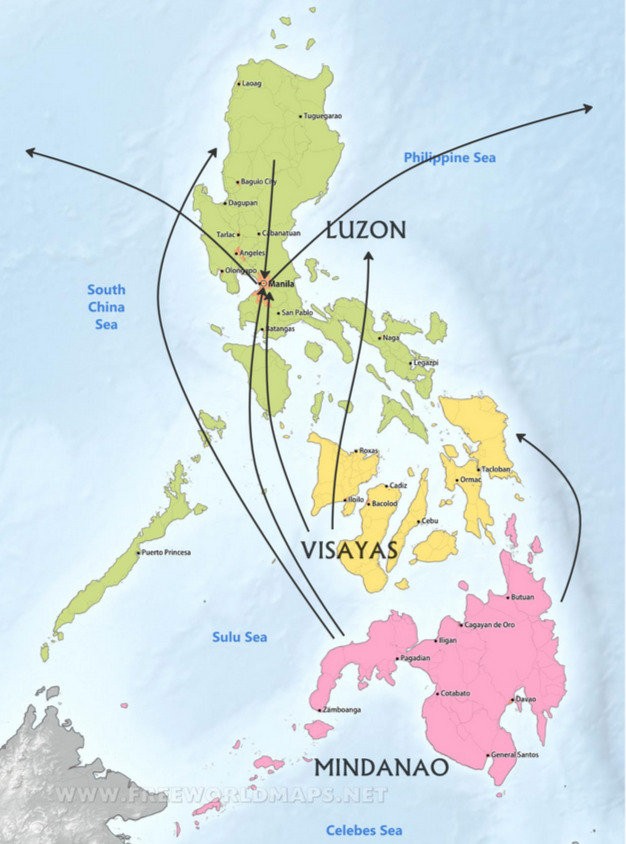
Scoping Internal Migration
Migration is multi-modal, mixed, and varied in what it offers to those undertaking it, as well as why they undertake it. In the scope of this study, disaster-induced internal displacement is the primary anchor for analysis because of the dearth of literature on how internal displacement, whether temporary or permanent, is represented through technological interfaces, infrastructure, and the institutions managing them. International law recognises the term internally displaced persons (IDPs) to describe people forced or obliged to leave their place of habitual residence due to armed conflict, violence, human rights violations, or disasters, but without crossing an international border. Philippine law, in contrast to this, defines IDPs mainly in the context of armed conflict; however, a big section of IDPs in the country are evacuees and relocated persons/families affected by natural disasters or rapid-onset events, and recognition for these demographics is limited in jurisprudence.
This study primarily focuses on persons affected by and displaced due to natural disasters. While it mainly examines rapid-onset events, the role of slow-onset effects of climate change, bringing with it a shift in what sustainable livelihoods look like, is also a big driver for long-term migration. However, the major focus is on disaster-induced displacement within the archipelago, and peoples’ interactions, tech-enabled or otherwise, with data infrastructure.
Policy developments at play
The country’s policy apparatus covers a range of protections and plans to prepare for and better respond to and mitigate disaster impacts. These extend throughout the disaster management cycle, covering preparedness, response, recovery, and mitigation, and involve multi-stakeholder participation in DRRM by bringing together governmental bodies, decentralised decision-making, and community organisations/volunteers.
Despite the involvement of policy apparatus and the government’s push towards digitising essential services, there is much to be said.
Technological advancements have expanded the scope of disaster management data, and its ability to effect real-time change in governments from the national to the local levels. Various departments, like the DOST, DSWD, OCD, DILG, PSA, among others, collect non-traditional data on a variety of metrics, creating a data ecosystem that is rich yet fragmented. Questioning this fragmentation through a policy lens involves critiquing this whole-of-government approach.
Most DRRM policies in the Philippines emphasise adopting this or a whole-of-society approach. While this is formally documented and mandated through policy, there are vested political interests that stand outside of this policy landscape that influences who gets access to data, and how much. The politics of data points influence which governments or departments, at the regional or local level, get access to a bigger share of budgetary allocations.
Mapping the journey
Migration in the Philippines proves to be more complicated than a linear trajectory. It is important to highlight these journeys as a way to show the ever-changing nature of movement and its drivers. While some of these movements are a result of climatic factors, many also tie into the larger driver of labour and better economic opportunities that tend to get distorted in the islands due to the changing nature of disaster events. A limited number of studies have compared the impact of rapid- and slow-onset events on the period of migration and eventual return.
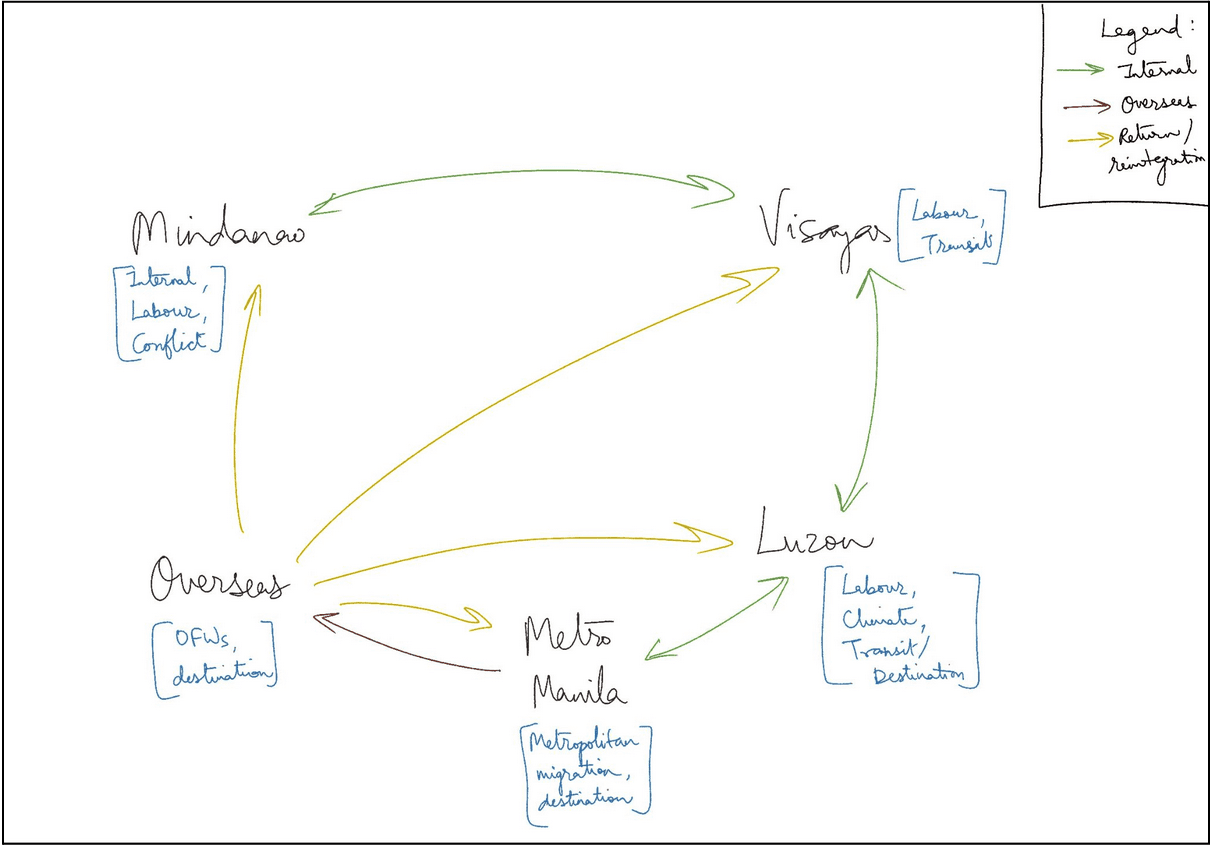
Barriers and Friction
With inconsistent urbanisation due to rapidly increasing migration toward Metro Manila, urban planning for disaster-resilient settlements becomes a challenge. Some of these barriers manifest in:
Digital spheres, through low internet penetration, high degrees of fraud, considerations for digital platforms design
Policy interventions, through the lack of legal recognition of IDPs, a fragmented disaster data ecosystem, and mismatches in meaningful aid delivery
Community agency, through a lack of community-in-the-loop principles in disaster management, the manifestation of digital divides, and low awareness on the utility of digital tools.
Embedding community-centric resilience
In our exploration of finding the crucial community link in the study of migration, the Philippines proved to be a frontrunner. This idea is institutionally reflected; the National DRRM Act of 2010 introduces ‘Community-Based Disaster Risk Reduction and Management’ or CBDRRM, to recognise the active engagement of at-risk community in the entirety of the disaster management cycle. The Act mandates the creation of a database of accredited community disaster volunteers (ACDVs) to respond alongside institutions when disaster strikes. In the Philippines, this philosophy of communities coming together to support each other without any expectation of return is called ‘bayanihan,’ the Tagalog word ‘bayan’ implying country or community. Bayanihan is an effort to bring community spirit to the forefront of disaster response.
Across Data and the Digital
Mapping data flows
The data landscape in the Philippines is rich in its variety of actors and bodies involved in the collection of data, especially on disaster-related preparedness and response efforts. Each central government department in the Philippines is obligated to contribute to disaster response efforts in various capacities, whether directly mandated or not, as prescribed through the whole-of-government approach. This creates a cluster of datasets on disasters and disaster-related movement that is extensive and uncommon in other geographies due to the Philippines’ unique position as a highly disaster-prone country.
While there is an abundance of effort and mandate on data collection before, during, and after disasters, these efforts and initiatives operate in silos, with contrasting, often clashing, motives. This creates duplication of data collection efforts across departments, which is tough to mitigate without addressing the financial gains of data as incentives within each department.
A combination of these challenges results in the creation of siloes of information and an overall fragmented ecosystem that can make the downstream effects of service delivery muddled. To highlight these flows of data, along with commentaries on governance and community participation, we have created a data flow mapping of actors and the types of data in circulation in this ecosystem.
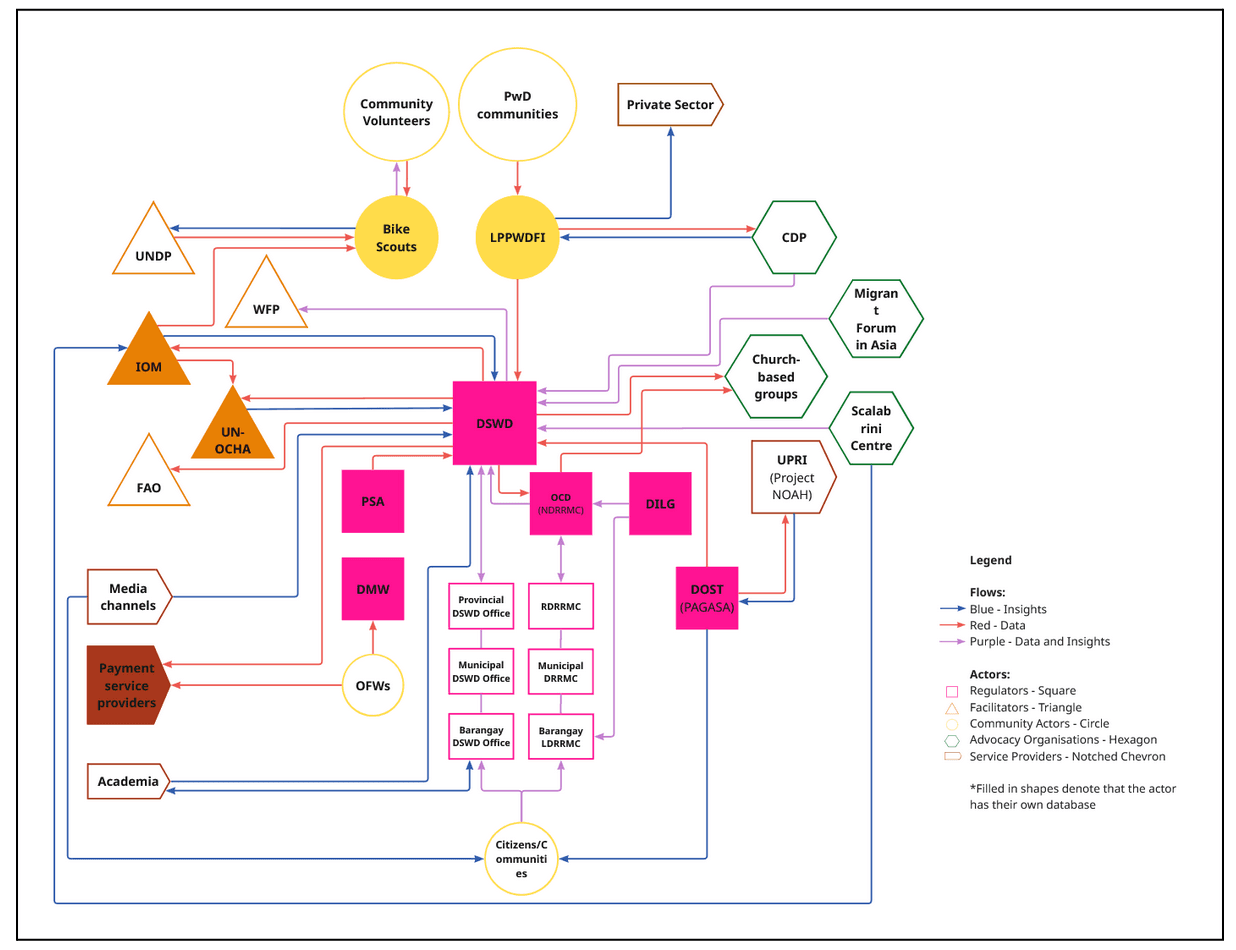
The map depicts relevant actors in this ecosystem, and the flows of information amongst them. While these interactions shed light on the larger disaster data ecosystem in the Philippines, it also indicates that power is often concentrated in institutional structures, and also that power changes shape when contextualised in a community-built data and digital ecosystem.
The PhilSys digital ID
In this section, we examine PhilSys, the digitally-backed ID system in the country. In order to set up a paperless, cashless digital economy, the Philippine Statistics Authority (PSA) administered PhilSys with the Department of Information and Communications Technology (DICT) in 2018. While the ID is promising in its technical architecture, safeguards, and rights-based implementation, there are gaps in the implementation plan, as well as awareness-building for communities on how the ID can affect their day-to-day challenges. The complexity of aid delivery through DPI can be addressed through integration with disaster preparedness and response efforts. Insights on what the ID could mean for persons displaced due to disasters have been situated in a thought-piece published as ‘PhilSys as a means of Digital Resilience’.
Digital payments infrastructure
Remittances form almost 10 percent of the Philippines’ GDP, making it a key income source that enables negotiating power and financial stability for Filipinos back home. Coupled with the government’s goals to move towards a cashless economy, the rise of digital banks has dramatically changed the way Filipinos transact. With the introduction of QR Ph, which acts as a unified payments interface (UPI) that connects multiple banks and e-wallet apps, the country has converted almost 60 percent of its payments into digital transactions. A study estimates that digitising welfare payments and converting cash cards into basic accounts to start off with, would already provide up to 11 million individuals with their first digital store of value.
For cross-border payments, remittances through e-wallet apps and digital banks can now be processed almost instantaneously, which also makes it possible for social benefit transfers (G2P) to be carried out. The DSWD, through a technical partnership with BSP, is setting up full-service transaction accounts for the distribution of cash grants under the 4Ps, the country’s largest social security scheme. The expansion of digital payments in disaster relief efforts can prove to be a gamechanger in aid delivery. Platforms like GCash have linked up with government departments to facilitate cash aid delivery for welfare scheme beneficiaries. Our assessment on the digital payments landscape in the Philippines has been discussed in our thought-piece published as ‘Migration and the Adoption of DPI in Asia: Designing Pathways for Gender-Intentional Remittances’.
Looking ahead
Through our analysis and findings, we have created a set of recommendations that cut across our Migration Infrastructure Assessment (MIA) framework, focusing on the role of different stakeholders in the ecosystem, and their accountability towards building better governance practices and inclusive platforms.
We use these recommendations to understand how:
Regulators can standardise relief and protection efforts through a whole-of-society approach
Facilitators like multilateral organisations can build better bridges between governments and civil society organisations, coordinating on delivering aid promptly and strategically
Service providers can build systems and platforms that enable agency and account for local realities and contexts
Advocacy organisations can find spaces to collaborate and speak to institutional structures
Community actors have reimagined notions of agency, solidarity, and their interactions with digital spheres
Research organisations can act as an intermediary between governments and the research community, solving for knowledge gaps in digital dexterity and data governance
Funders can support this ecosystem by financing efforts that are often overlooked, reassessing crisis response through a Global South lens
© 2026 Aapti Institute. All rights reserved.